


Here’s an experiment. Search “build vs buy marketplace” and read the top ten results. You’ll notice a pattern: every article that says buy is written by a company selling marketplace software. Every article that says buy the backend, build the frontend is written by a company selling backends. And every article that says hybrid, with expert help is written by an agency selling expert help.
The advice isn’t wrong, exactly. It’s just that the conclusion was written before the article was. Custom marketplace development deserves better than conclusion-first advice.
We’re a development agency, so you know our incentive too, which is why this guide to custom marketplace development is structured to be useful even if you never talk to us. It’s a decision framework that will, for a meaningful share of readers, conclude: don’t build custom, at least not yet. If that’s you, this article just saved you a very expensive year.
What is custom marketplace development?
Custom marketplace development means building a multi-vendor platform on your own codebase, typically on an open commerce framework rather than literally from scratch, so that vendor management, transaction flows, commission logic, and buyer experience are designed around your business model instead of a software vendor’s assumptions. It sits at the opposite end of the spectrum from marketplace SaaS, where you rent a proven model and accept its constraints. The decision between them is less about budget than about how non-standard your marketplace model is, and whose roadmap you can afford to depend on.
The build-vs-buy advice problem
Most build-vs-buy content presents the choice as a personality test: are you a scrappy validator (buy!) or a visionary enterprise (build!). That framing serves the people selling each option, but it fails founders on two counts.
First, it treats the marketplace as one thing to be bought or built. It isn’t. A marketplace is a compound of systems (payments, search, catalog, vendor operations, buyer experience, logistics, communications), and the build-vs-buy answer is different for each. Founders who decide at the “whole platform” level either overbuild (custom search infrastructure nobody asked for) or overbuy (a rented commission engine that can’t express their actual business model).
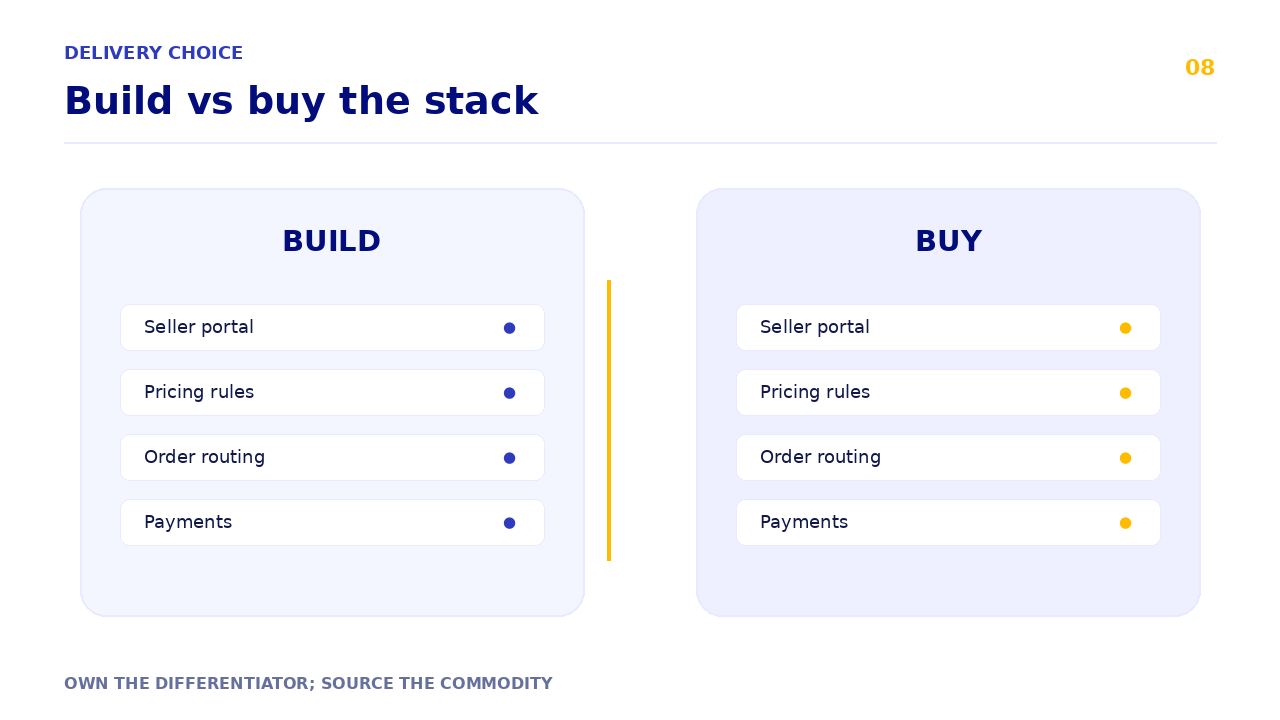
Second, it ignores time. The right answer at validation stage is usually the wrong answer at scale, and vice versa. The interesting question was never “build or buy.” It’s “what do I buy now, what do I build when it starts to matter, and how do I avoid trapping myself in between?”
That trap has a name, by the way. It’s the moment your rented platform’s constraints stop being quirks and start being ceilings: when workarounds pile up, the roadmap you need isn’t the roadmap you rent, and operations quietly move into spreadsheets. We’ve written a full diagnostic on marketplace platform limitations and how to tell a temporary annoyance from a structural ceiling. If you’re not sure whether you’ve hit that wall, read that first. This guide is for what comes after.
“Build vs buy” is the wrong question: decide per component

Here’s the framework we actually use when scoping marketplace projects. Go component by component, and for each one ask a single question: does this component differentiate my marketplace, or does it just need to work?
| Component | Default | Why |
|---|---|---|
| Payment processing & compliance | Buy (Stripe Connect or equivalent) | Regulated, solved, zero differentiation. Building this yourself adds risk, not advantage, and in some markets, regulatory exposure. |
| Search infrastructure | Buy (Algolia, Meilisearch, etc.) | Hard to build well; buyers only notice when it is bad. |
| Email, notifications, analytics | Buy | Commodity plumbing. |
| Hosting & infrastructure | Buy (cloud) | Undifferentiated heavy lifting. |
| Catalog & transaction core | Framework (open commerce core) | Don’t write a cart from scratch in 2026; don’t rent one you can’t shape either. An open framework is the middle path: solved fundamentals, owned code. |
| Vendor onboarding & operations | Build, if vendor experience is your edge | How sellers join, list, get paid, and get supported is where marketplaces actually compete. This is the system your SaaS platform is most likely to get wrong for you. |
| Commission & payout logic | Build, if your model is non-standard | Flat-rate commission? Buy it. Tiered, category-dependent, negotiated, or hybrid revenue models? This is your business model, so own it. |
| Matching, curation, discovery logic | Build, if it is your moat | The algorithm deciding who sees what is often the entire defensibility of a marketplace. |
| Buyer-facing storefront | Build on framework | Your brand, your funnel, your conversion, but on rented rails underneath. |
Two things follow from this table. First, custom marketplace development in practice doesn’t mean building everything. It means owning the three or four systems where your model lives, and ruthlessly buying everything else. Teams that build commodity components burn budget; teams that rent their differentiating components build someone else’s business. In practice, custom marketplace development is a subtraction exercise before it is an addition one.
Second, the table explains why platform limitations hurt where they do: SaaS marketplace platforms are, structurally, someone else’s answers to exactly the rows marked “build.” If your answers match theirs, SaaS is a gift. When they diverge, you feel it precisely in vendor operations, commission logic, and discovery, which is why those are the symptoms founders describe when a platform stops fitting.
Who should actually build custom (and who shouldn’t)
Build custom when:
- Your commission, payout, or transaction model can’t be expressed in a SaaS platform’s settings: you’re configuring around your business instead of running it.
- Vendor operations are your competitive edge, and the rented workflow actively flattens it.
- You’ve validated demand (real transactions, real repeat usage) and the constraint on growth is now the platform, not the market.
- You have (or will contract) genuine engineering ownership. A custom platform without an owner decays.
Don’t build custom when:
- You haven’t validated the marketplace’s core loop. A custom platform doesn’t create liquidity; it hosts it. Validate on SaaS, cheaply, first.
- Your model is standard. If a mainstream platform expresses your business today and for the next two years, the flexibility premium buys you nothing.
- The budget covers the build but not the operation. A marketplace platform is a product you now run: maintenance, infrastructure, iteration. If the plan is “build it and stop paying engineers,” don’t start.
- You’re building custom to feel like a tech company. Ownership is a means, not an identity. That distinction sits at the heart of every custom marketplace development decision.
For founders in Singapore and Southeast Asia, one addition: local requirements (payment rails, GST logic, data protection) are a real factor in the build-vs-buy math, and we’ve covered them in our guide to how to build a marketplace in Singapore. Those local factors shift the custom marketplace development calculus more than founders expect.
What a custom marketplace development build actually involves

At decision level, a marketplace has a recognizable anatomy: a commerce core (catalog, cart, orders), a vendor layer (onboarding, dashboards, payouts), a transaction engine (split payments, commissions, refunds that cross vendor boundaries), a buyer experience (storefront, search, discovery), and an operations layer (moderation, disputes, support tooling). We break down each component and how they connect in our dedicated marketplace architecture guide.
The strategic point for a founder: these layers are not equally hard, and not equally yours. The transaction engine and vendor layer carry most of the irreducible complexity. They’re also where tutorials and estimates most reliably go wrong. (One example we see constantly: teams budget for the platform admin but forget that the vendor-facing dashboard is a separate product with its own design, permissions, and support burden.) This is the part of custom marketplace development that estimates most often miss.
On foundations: the mature move in 2026 is rarely “from scratch.” Open commerce frameworks, Medusa.js being the one we work with most, give you solved fundamentals with owned code, and marketplace starters like Mercur shorten the path further when your model is close to standard B2C. We’ve written a full decision-level guide to that route in our Medusa marketplace architecture guide.
Custom marketplace development cost and timeline: the honest version
You’ve seen the numbers vendors publish: neat ranges that conveniently make their option look sensible. We won’t add ours, because any figure quoted before understanding your transaction flow is marketing, not estimation. That is the uncomfortable truth about custom marketplace development budgets.
Here’s what independent data suggests about the top of the market: a Forrester study (commissioned by a marketplace vendor, so read with that in mind, and skewed toward enterprise) found most surveyed firms spent upwards of $3M launching marketplaces, with self-built platforms costing meaningfully more, and two-thirds taking over six months to launch. Founder-stage builds in Southeast Asia operate at a fraction of those numbers, but the shape of the finding travels: the cost driver is not the platform, it’s the scope, and self-building everything is the most reliable way to multiply it.
What actually moves the number, in rough order: transaction-flow complexity (simple sales vs bookings, services, escrow-style flows), vendor-layer depth, payment architecture (single-market vs multi-currency SEA payouts with tiered commissions), operational features (search, reviews, messaging, disputes), and how far you deviate from a starter’s assumptions. Our full marketplace development cost breakdown makes those variables explicit; until you’ve answered them, treat any number that arrives before those questions as what it is: a pitch.
Timeline follows the same logic: a validation MVP and an operations-ready platform are different products. Scope the first honestly; architect it so the second is an evolution, not a rewrite.
Choosing a development partner

If you’re not building in-house, three questions filter partners faster than any portfolio review:
- “Walk me through my money flow.” Not their tech stack, your transaction: who pays whom, when commissions are computed, how refunds claw back, where funds sit overnight. Teams that have built marketplaces answer in specifics; teams that have built online stores answer in generalities. Payments are where marketplace builds fail.
- “What would you not build?” A partner who never says “buy this part” or “defer that” is scoping their invoice, not your platform. The per-component table above is a litmus test: ask them to fill it in for your model.
- “Who’s on it three months after launch?” Launch-ready and operation-ready are different states. Marketplaces reveal their real requirements only when vendors and buyers start colliding with them. A partner without a post-launch answer is selling you a handoff, not a platform.
Local vs offshore matters less than marketplace-specific scar tissue. A regional team that has shipped and operated split-payment platforms will outperform a nearby generalist agency learning on your budget. The best partners treat custom marketplace development as an operating commitment, not a one-off project.
The mistakes that kill marketplace builds
Five patterns account for most of the wreckage we’re called in to fix:
- Building before liquidity. A beautiful platform with no supply-demand fit is the most expensive way to learn your marketplace thesis was wrong.
- Buying the differentiator. Renting your commission model or vendor experience from a SaaS roadmap, then spending years working around it.
- Forgetting the vendor side. Budgeting the buyer experience meticulously while treating seller tooling as an afterthought. Sellers churn, liquidity dies.
- Payment architecture as integration. Treating split payments as “connect Stripe later.” Money flow is architecture; retrofitting it is the single most painful rework in marketplace development.
- No owner after launch. Shipping, disbanding the team, and letting the platform decay until the first serious change request becomes a re-platforming conversation.
Every one of these is cheaper to prevent than to fix, which is, honestly, the entire argument for doing the thinking in this article before writing a line of code. Avoiding them is most of what separates clean custom marketplace development from expensive rework.
Where to go from here
If this guide did its job, you now know which components are yours to build, whether you’re past validation, and what to demand from whoever builds it. What’s left is mapping that onto your specific model: transaction flow, vendor economics, market. That mapping is the real starting point of custom marketplace development.
That’s a roadmap conversation, and we do it as a structured exercise: your model, the per-component decisions, an honest sequence, and the risks flagged before they’re expensive. Get a marketplace roadmap, and if the honest answer is “stay on SaaS another year,” that’s the roadmap you’ll get.
Marketplace build guides
- Custom vs SaaS marketplace: how to decide
- Sharetribe alternatives compared
- How to migrate from Sharetribe
- Arcadier and CS-Cart alternatives
- WooCommerce or Wix for a marketplace?
FAQ
What is custom marketplace development?
Building a multi-vendor platform on your own codebase, usually on an open commerce framework, so vendor management, commission logic, and transaction flows are designed around your business model rather than rented from a SaaS platform’s assumptions.
Is it better to build or buy a marketplace platform?
Per component, not per platform: buy commodity systems (payments processing, search infrastructure, hosting), build the systems where your model differentiates (vendor operations, commission logic, discovery), and only after validating demand. Whole-platform answers usually reflect what the person answering sells.
How much does custom marketplace development cost?
It depends on transaction-flow complexity, vendor-layer depth, and payment architecture, which is why credible estimates follow discovery, not precede it. Independent research on mostly enterprise marketplace launches found budgets in the millions with six-month-plus timelines; founder-stage builds run far leaner, but the same driver holds: scope, not software, sets the price.
When should a startup avoid custom marketplace development?
Before demand is validated, when the model fits standard SaaS for the foreseeable future, or when the budget covers the build but not ongoing engineering ownership. In those cases marketplace SaaS is the rational choice, until its limitations become structural.