


Most advice on custom vs SaaS marketplace decisions is written as if you are standing in an empty field choosing what to build. You are not. If you are asking this question seriously, you almost certainly have a marketplace running, on Sharetribe, Arcadier, a Shopify setup, or another SaaS platform, with real vendors, real buyers, and real revenue flowing through someone else’s architecture.
That changes the question entirely. This is not a shopping decision, it is a switching decision, and switching decisions have variables that greenfield frameworks ignore: What you have already invested, what your community would experience, what a transition costs, and what staying quietly costs while you deliberate.
(If you are at the empty-field stage, deciding what to build before anything exists, we have written that framework separately, component by component, in our custom marketplace development guide. This article is for the founder who is already live.)
What this decision actually is (and isn’t)

Strip the vendor pitches away and the stay-or-switch call is one question: At your current trajectory, does the platform you are renting still cost less (in money, hours, and forgone strategy) than owning one would, once you include the price of getting there?
Note what that sentence includes that most comparisons skip: The price of getting there. Migration cost, community risk, and transition time belong in the math. Counting them is what separates an honest custom vs SaaS marketplace framework from a sales pitch. And note what the question does not ask: Which option is better. Neither is. SaaS optimizes for speed and low overhead, custom optimizes for control over exactly the things marketplaces compete on: Money flow, vendor experience, integrations. The decisive trade-off was never theme customization. It is who controls the checkout, the payouts, and the roadmap.
The four forces behind the custom vs SaaS marketplace decision
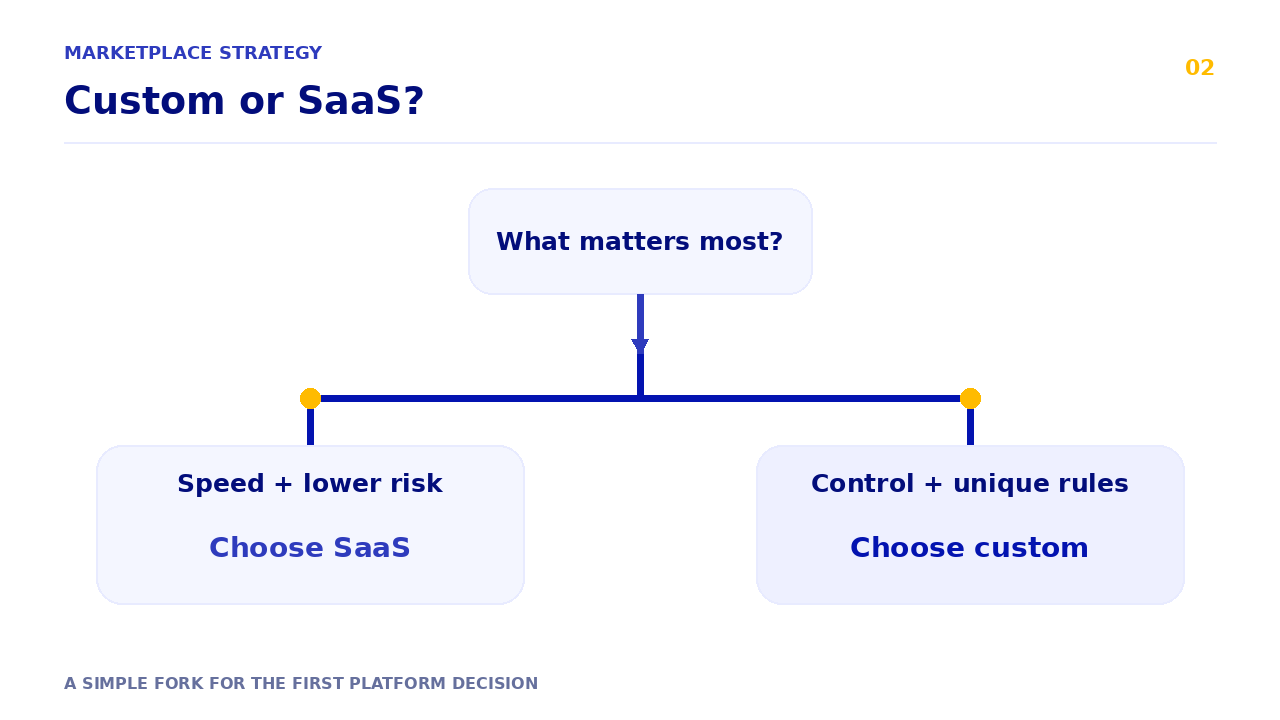
Every founder weighing a custom vs SaaS marketplace decision is being pulled by four forces. Naming them separately is the fastest way to stop them blurring into one anxious fog.
Force 1, push: The pain of staying. Workarounds that scale with growth, operations living in spreadsheets, roadmap items marked “can’t, platform,” fees that climb with volume. We have catalogued the decision-level signals in detail in our guide on outgrowing a no-code marketplace. If three or more are trending, your push is real and measured, not a mood.
Force 2, pull: What custom would enable. The commission model your category actually needs. Vendor workflows competitors can’t copy. Regional payment rails and multi-currency payouts. An owned roadmap. Be specific here: “flexibility” is not a pull, “negotiated per-vendor commissions with delayed split payouts” is. Vague pull is how founders build expensive platforms that do nothing their SaaS didn’t.
Force 3, anchors: What holds you, legitimately. Sunk learning, vendor habits, reviews and trust accumulated on the current platform, integrations that work, a team that knows the tool. Anchors get dismissed as “sunk cost fallacy,” but for marketplaces that’s glib: Your community’s comfort is an asset with real switching friction. The error isn’t having anchors, it’s letting them vote without being priced.
Force 4, anxieties: The fears about switching. Losing vendors mid-migration. The build going over budget. Owning infrastructure forever. Choosing the wrong foundation. All legitimate, and all priceable in a custom vs SaaS marketplace decision. An unpriced anxiety expands to fill your entire decision. A priced one becomes a line item you can plan around.
The decision rule: Switch when push and pull exceed anchors and anxieties sustainably, measured over quarters, not after one bad week. And notice the asymmetry in how the forces behave over time: Push compounds with growth, anchors deepen the longer you stay, and anxieties only shrink when you price them. Which means the custom vs SaaS marketplace fog doesn’t clear by waiting. It clears by measuring.
Pricing both sides honestly: the cost of staying vs the cost of switching

The cost of staying is mostly invisible, which is why it wins by default: subscription and transaction fees (visible), the workaround tax in salary-hours (invisible), strategic drag from platform-vetoed roadmap items (deeply invisible), and compounding migration debt. Every month adds vendors, data, and habits that make the eventual move bigger. We have broken down how these hide in plain sight in our guide on marketplace platform limitations.
The cost of switching is mostly visible, which is why it intimidates: the build itself (scope-driven, the honest variables are transaction-flow complexity, vendor-layer depth, and payment architecture, as we cover in our custom marketplace development guide), the migration project (data with relationships intact, vendor re-onboarding, parallel running), and the ownership payroll, engineering as a standing function, not a one-time invoice. Anyone who quotes you a number before understanding your model is marketing.
The comparison that matters for any custom vs SaaS marketplace decision: total cost of staying versus total cost of switching, at your projected volume, over two to three years, both sides fully loaded. Founders who compare visible against visible conclude “stay” forever; founders who panic on push alone switch too early into unscoped builds. The math only works when both columns are honest.
When custom vs SaaS marketplace tips toward custom (and when staying wins)
Custom earns its cost when your model can’t be expressed in the platform’s settings (commissions, payouts, vendor flows), the workaround tax is scaling with volume, a committed strategic move is platform-blocked, and you have (or will contract) durable engineering ownership. If that’s you, the foundation question comes next, and we’ve mapped it: framework-based builds and marketplace starters in our guide to building a marketplace with Medusa.js, with a fit-check to confirm you’re choosing from strength in our Medusa.js decision framework.
Staying wins when the pain is real but flat (not scaling), your model still fits the platform’s assumptions, the two-to-three-year math hasn’t crossed, or the honest gap is validation rather than architecture. Staying by decision is a respectable strategy for a custom vs SaaS marketplace call: it comes with a calendar reminder to re-run this framework quarterly, because the forces move, and the founders who get this right are the ones who re-measure instead of re-agonizing.
There’s also a middle answer worth naming: switching SaaS-to-SaaS. Sometimes the ceiling belongs to your specific platform, like Sharetribe or Arcadier, not the category. A heavier platform can buy years. It relocates the ceiling rather than removing it, but for some models that’s exactly enough.
The path: how to switch without betting the company

If the forces say switch on your custom vs SaaS marketplace call, how you switch determines whether the community, the asset all four forces were really about, arrives intact.
Decide from strength, not crisis. The worst migrations are rebounds from a platform emergency. If you’re pre-crisis, you have the luxury of sequence, use it. Audit before architecture. Map what actually constrains you, what must be preserved (data relationships, vendor accounts, trust signals), and what the platform contract lets you take. Validate the foundation before committing the community. Build the risky parts first (money flow, vendor dashboard) and prove them while the old platform still runs. Migrate in phases, never big-bang. Parallel-run, move vendor cohorts deliberately, keep revenue continuity, and cut over when the new platform has demonstrated, not promised, that it works. We’re publishing a full community-preserving migration playbook separately.
None of this is exotic, it’s project discipline. The founders who lose communities in migration almost always skipped a step above, usually the audit, occasionally the parallel run.
Decide with a map, not a mood
The stay-or-switch call goes wrong in two symmetrical ways: staying by default because the costs are invisible, or switching in panic because the pain got loud. Both are decisions made by mood. The alternative is a map: your four forces, priced; your two columns, fully loaded; your path, sequenced.
That’s what a marketplace roadmap session builds for a custom vs SaaS marketplace decision: your model against this framework, with numbers where the anxieties used to be. And if the map says “stay another year,” you’ll leave with that answer, the signals to watch, and a standing framework to re-run when they move.
FAQ
Custom vs SaaS marketplace: how do I decide whether to switch?
Switch when the pain of staying (workarounds, fees, blocked roadmap) plus what custom enables sustainably outweighs your legitimate anchors (community, sunk learning) and your anxieties, after pricing both sides over two to three years at your projected volume. Before demand is validated or while your model fits the platform, staying wins.
What does it cost to move from a SaaS marketplace to a custom platform?
Three buckets: the build (driven by transaction-flow complexity, vendor-layer depth, payment architecture), the migration (data with relationships intact, vendor re-onboarding, parallel running), and ongoing ownership (engineering as a standing cost). Credible numbers for a custom vs SaaS marketplace move follow an audit of your specific model, never precede it.
What’s the biggest risk when leaving a SaaS marketplace platform?
Vendor and community loss during transition, and it’s concentrated in how you migrate, not whether. Phased migrations with parallel running, preserved data relationships, and mapped vendor paths routinely succeed; big-bang cutovers under crisis are where communities get lost.
Can I switch to a different SaaS platform instead of going custom?
Yes, when the ceiling belongs to your specific platform rather than the SaaS category, a more capable platform can buy years. It relocates the ceiling rather than removing it, so run the same four-forces math against the new platform’s constraints before committing to a second migration.