


There’s a particular stage in a marketplace’s life that nobody warns founders about: the moment you outgrow no-code marketplace tools that once felt like plenty. The platform that got you live, quickly, cheaply, credibly, starts to pinch. Not catastrophically. Just constantly. And at the exact moment you begin wondering whether it’s time to move, a second thought arrives: migrating a marketplace sounds terrifying.
Both instincts are correct. The pinch is real, and so is the risk. A marketplace isn’t a website you can rebuild quietly over a weekend: it’s a living community of vendors and buyers whose trust took years to accumulate. That’s exactly why this decision deserves better than vibes: clear signs that migration is justified, an honest look at why founders delay it, and a sober picture of what moving actually involves. If you’re trying to work out whether you outgrow no-code marketplace tooling or you’re just having a rough month, this is the diagnostic.
What does it mean when you outgrow no-code marketplace tools?
You outgrow no-code marketplace software when your operations, business model, or growth plans now exceed what the platform was designed to support, so that workarounds, manual processes, and platform constraints cost you more (in money, hours, and missed opportunities) than the platform saves you. It’s a threshold, not an event: most marketplaces cross it gradually, which is precisely why it’s hard to see from inside.
First, confirm it’s structural, not a rough patch

Not every frustration justifies a migration. Plenty of platform pain is temporary: a missing feature that’s on the vendor’s roadmap, a process problem masquerading as a platform problem, friction a cleanup or an integration would resolve. Migrating over that is how founders end up rebuilding their way into the same problems on a new stack.
The threshold question is whether you’ve hit a structural ceiling, a mismatch between how your marketplace needs to operate and how the platform is designed, and we’ve written a full diagnostic for exactly that call: Marketplace platform limitations: when your platform stops fitting your operations. If you haven’t confidently made the temporary-vs-structural distinction yet, start there.
This article assumes you have. What follows are the signs that the ceiling isn’t just real, but that now, not someday, is the time to act on it.
The 5 signs it’s time to migrate

Each of these signs is a way founders discover they outgrow no-code marketplace platforms, usually one quarter after they first suspected it.
1. You’ve already optimized, extended, and worked around, and the ceiling held
The strongest sign isn’t frustration; it’s exhausted alternatives. You tightened processes. You added the integrations. You bought the add-ons, filed the feature requests, built the spreadsheet bridges. The friction dropped for a quarter and came back with growth. When the honest inventory shows you’ve done everything short of leaving, and the constraint is still the platform, you’re no longer diagnosing. You’re deciding.
2. The workaround cost scales with your growth
A fixed annoyance is livable. A scaling one is a tax on your trajectory. Watch the trend, not the level: if every new vendor adds manual onboarding steps, every order-volume milestone adds reconciliation hours, and every market you consider adds another impossible requirement, then the gap between what you pay the platform and what the platform costs you widens every month. Flat pain says stay and optimize. Compounding pain says the platform’s ceiling and your growth curve have officially diverged.
3. Your roadmap is being written by the platform’s limitations
Somewhere in your planning documents there’s a feature, market, or vendor segment marked “can’t, platform.” Maybe it’s multi-currency payouts for regional expansion. A commission structure your category needs. A vendor workflow your competitors can’t copy, and you can’t build. When strategic decisions are being made for you by a tool’s constraints, the platform has stopped being infrastructure and started being a co-founder with veto power. That veto compounds silently: the opportunities you stop pursuing never show up on any invoice.
4. The economics have crossed over
There’s a crossover point where subscription fees, transaction cuts, add-on costs, and the salary-hours spent on workarounds exceed what owning your platform would cost over two to three years. Before that point, migrating is premature; after it, every month is a small overpayment. Run the math honestly (total cost on both sides, at your projected volume, people included) using the same build-vs-buy discipline that applies whenever a business decides to outgrow no-code marketplace limits. If the numbers have crossed and you’re still on the fence, what’s holding you isn’t economics anymore. Which brings us to the last sign.
5. Staying has quietly become the riskier option
Founders frame migration as the risky path and staying as the safe one. At a certain scale, that inverts. Every month you stay, the eventual migration grows: more vendors to move, more data to map, more buyer habits to preserve, deeper dependence on a roadmap, pricing, and policies you don’t control. Meanwhile the platform can change its fees, its rules, or its priorities without asking you. When the cost and risk of leaving later is growing faster than the cost of leaving now, staying isn’t caution. It’s compounding exposure with a calmer name, and it’s one more reason founders outgrow no-code marketplace platforms later than they should.
Why founders wait too long (and why the fear is legitimate)

Let’s name the real reason marketplaces stay past the crossover, because it isn’t laziness or ignorance: the community is the asset, and migration feels like gambling it. Vendors learned your current platform. Reviews and ratings live there. Buyer habits formed around it. Liquidity, the thing that took years, feels platform-shaped. Industry research has tracked how routinely no-code builds get rewritten as custom platforms within a couple of years of scaling; what the research doesn’t capture is how many founders delayed that move a year past the point of sense, paying the tax the whole way, because the fear of breaking the community outweighed a spreadsheet.
Here’s the reframe that matters: the community is exactly what you’re protecting by migrating well, and exactly what you’re eroding by staying too long. Every workaround your vendors feel, every payout delay, every feature your buyers expect and don’t get, spends trust in small denominations. The risk isn’t migration versus no migration. It’s a planned migration from strength versus a forced one from crisis, and forced migrations are where communities actually get lost.
What migrating actually involves
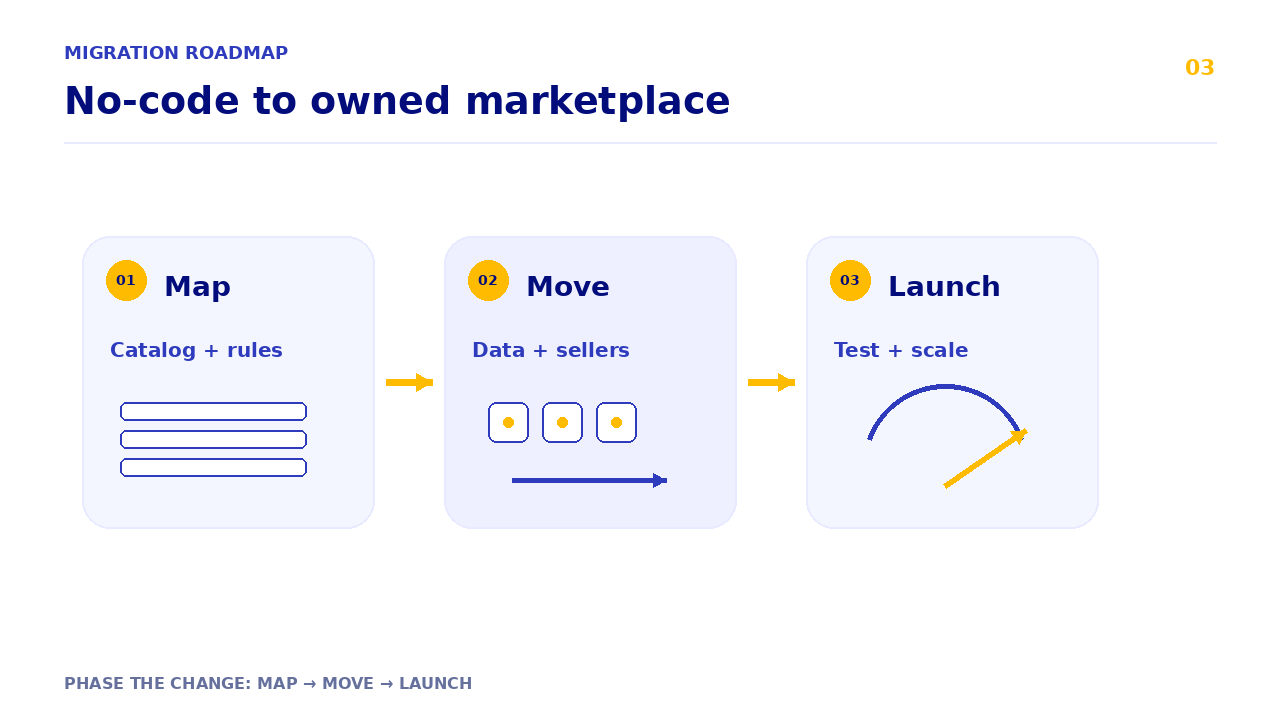
A responsible migration for a team that decides to outgrow no-code marketplace constraints is less dramatic than the horror stories, but it has non-negotiables, and they’re different from migrating a store, because you’re moving a community, not just a catalog:
- Data with its meaning intact: vendors, listings, orders, and the relational history between them (who sold what to whom), not just CSV exports.
- Vendor continuity: sellers need a mapped path (accounts, dashboards they can learn, payouts that don’t skip a cycle); vendor churn during migration is the failure mode that matters most.
- Revenue continuity: the old platform runs until the new one demonstrably works, with a cutover plan rather than a leap.
- Trust signals: reviews, ratings, and profiles preserved wherever technically and contractually possible, because that’s the community’s accumulated capital.
Each of these is a solvable engineering and planning problem (our playbook on migrating from Sharetribe without losing your community walks through them). The point here is simpler: migration done properly is a sequence of managed steps, not a cliff jump.
Your options from here
If the signs above read like your operating reality, three honest paths exist. Move to a more capable SaaS: sometimes the ceiling is your specific platform, not the category (if you started on a plugin stack, see when you outgrow WooCommerce or Wix as a marketplace); a heavier platform buys years for some models (though it relocates the ceiling rather than removing it). Move to an owned platform: a commerce framework foundation gives you the roadmap, the economics, and the ceiling-free architecture, at the price of engineering ownership; we’ve mapped what that path looks like in Custom Marketplace Development: A Founder’s Guide. Or stay, deliberately: if you’ve read the five signs and honestly count fewer than two, staying isn’t denial; it’s the right call, revisited quarterly.
Choosing between them is its own decision with its own trade-offs, and it deserves its own framework: we’ve laid it out in our Custom vs SaaS Marketplace decision guide. Whichever path you lean toward, the decision to outgrow no-code marketplace tooling should follow the evidence, not the fear.
Get the picture before you move
The worst migrations share one origin: they started from a feeling, either panic or frustration, instead of a map. The best ones start with an honest inventory: where the platform actually constrains you, what staying costs at your trajectory, what moving requires, and in what order.
That’s what a marketplace technical audit produces: your constraints, your crossover math, and a migration path designed around the thing that matters most, keeping your community whole. Whether you’re ready to outgrow no-code marketplace tools now or still weighing it, the audit gives you the map either way, and if the answer is “you’re not there yet,” you’ll get that too, with the signals to watch for when you are.
FAQ
How do I know if I’ve outgrown my no-code marketplace platform?
The decision-level signs: you’ve exhausted optimization and the ceiling held; workaround costs scale with growth; the platform’s limits are dictating roadmap decisions; the 2 to 3 year economics favor owning; and delaying migration is compounding the eventual cost. One sign, intermittently, says optimize. Three or more, trending, say migrate. That combination is usually how founders realize they outgrow no-code marketplace tools.
Is migrating a marketplace risky?
The risk is real but asymmetric: planned migrations that preserve vendor continuity, data relationships, and trust signals succeed routinely; forced migrations under crisis are where communities get lost. Past the economic crossover point, staying quietly accumulates more risk than a well-planned move.
What are the limitations of no-code marketplace platforms?
Structurally: commission and payout models bounded by settings, vendor workflows you can’t reshape, a roadmap you don’t control, per-transaction economics that scale against you, and constraints on expansion (multi-currency, regional payments, custom flows). Whether those are dealbreakers depends on how standard your model is.
Should I move from no-code to a custom marketplace platform?
Only after validating demand and confirming the ceiling is structural. Then it’s an economics-and-model question: if workaround costs plus fees exceed ownership costs at your volume, and your model needs flows SaaS can’t express, an owned platform is the rational next stage.