

Cerebro: AI-Driven Crypto Portfolio Platform
Multi-agent portfolio intelligence for crypto: manipulation-resistant signals, tail-risk-aware allocation, and conversational research across 10,000+ tokens.
10,000+
Tokens tracked
< 60s
Research report generated
< 1s
Optimization solve time
7
Live data sources
About the project
Cerebro helps investors construct, analyze, and monitor crypto portfolios using machine learning and an LLM-powered research assistant, Alice.
KVY TECH built the platform end to end: real-time ingestion and entity resolution across seven market and social data sources, a manipulation-resistant momentum engine, a convex optimizer built around tail risk, and a multi-agent assistant that answers portfolio questions in natural language.
The ML recommender clusters 1,900+ tokens into 8 behavioural categories and tailors allocations to risk profiles from Ultra Conservative to Ultra Aggressive.
Cerebro Pte Ltd
Dedicated Team: AI/ML, Backend, Frontend, Data, DevOps
AI platform, conversational assistant & ML recommendation engine
LangGraph, Python, Elixir, Node.js, Next.js, MongoDB, PostgreSQL, Qdrant, Redis, Modal, Vercel
The problem
Crypto investors, retail and semi-professional alike, face decisions across thousands of tokens with no reliable way to separate signal from noise. Existing tools lack personalisation, risk models suited to crypto, and real-time intelligence. The result is portfolios driven by emotion rather than data.
Information overload
Prices, social sentiment, breaking news, tokenomics and unlock schedules sit across dozens of fragmented sources. Synthesising them by hand is slow and error-prone.
Emotional decision-making
Without a data-driven framework, traders chase FOMO and panic-sell. A market that never closes amplifies the bias, producing poor entry and exit timing.
Risk models that do not fit crypto
Conventional tools assume normally distributed returns. Crypto returns are fat-tailed, so those models understate the downside precisely when it matters most.
Delayed signal detection
Breaking news moves crypto markets within minutes. Manual monitoring cannot match the speed required to act before prices adjust.
Market manipulation
Wash trading, pump-and-dump schemes and coordinated social campaigns distort standard momentum indicators, making manufactured activity look like genuine demand.
Engineering challenges
01
Signal quality
Many sources, low signal-to-noise. The platform needed robust features and a disciplined evaluation loop, not more data.
02
Manipulation resistance
Standard statistical measures are trivially gamed in crypto. The momentum engine had to stay reliable on adversarial data.
03
Explainability
Every recommendation needs a stated driver, constraint and trade-off, or users will not act on it.
04
Latency & scale
Sub-second optimization and sub-minute research over large historical datasets and continuous live feeds.
05
Security & privacy
Wallet addresses, balances and preferences protected end to end, including at the LLM boundary.
Our solution: a 5-layer architecture
KVY TECH built a modular, explainable portfolio engine and multi-agent LLM system, structured in five layers that carry data from raw ingestion through AI analysis to actionable delivery.
Layer 1: Data ingestion
Seven live sources are ingested and normalised into a single source of truth. Prices stream in real time over Binance’s WebSocket feed for listed tokens, while CoinGecko and CoinMarketCap are polled every five minutes to keep the long tail of 10,000+ tracked assets current. Entity resolution eliminates duplicate references to the same token, person or organisation across feeds, so every downstream signal is computed on clean data.
| Source | Data type | Refresh |
|---|---|---|
| Binance (WebSocket) | Live price stream for listed tokens | Real-time |
| CoinGecko & CoinMarketCap | Price quotes and metadata for remaining tokens | Every 5 min |
| X (Twitter) API v2 | Curated social posts | Every 1 min |
| News RSS / APIs | Long-form articles | Every 10 min |
| LunarCrush | Social sentiment, galaxy scores | Every 1 hour |
| Hyperliquid | Perpetual market data | Every 1 hour |
| Token Unlocks | Vesting schedules, tokenomics events | Every 24 hours |
Layer 2: Knowledge system
- Entity resolution: Token references, people, organisations and blockchain networks are normalised into a unified knowledge graph.
- Semantic search: News articles and social posts are embedded as vectors in Qdrant and retrieved by similarity with confidence scoring.
- Cross-referencing: Market events, entities and sentiment signals are linked automatically to build context around every asset.
Layer 3: Signal generation
Three specialised engines turn clean data into actionable signals.
A1 Momentum Score: manipulation-resistant
A proprietary momentum indicator, scored 1 to 100 and recalculated every 15 minutes, combining price momentum, volume activity and volatility burst. The design decision that matters: robust statistics (median and median absolute deviation) replace mean and standard deviation, so wash trading and artificially inflated volume cannot drag the signal. Manufactured activity stops looking like genuine demand.
CVX Portfolio Optimizer: built around tail risk
Allocation is solved by convex optimization (CVXPY) with the objective of minimising Expected Shortfall (CVaR) rather than variance. Constraints cover short-selling, concentration limits, sector diversification, turnover caps and configurable anchor assets. The optimizer runs every 4 hours and solves in under one second.
Breaking News Detector: three-model consensus
Three independent LLMs (Gemini, Grok and DeepSeek) score each piece of content, and at least two must agree before it is classified as breaking news. Social posts are held to a higher confidence bar than long-form articles. Alerts reach users on Telegram with a severity badge and source attribution.
Layer 4: Alice, the multi-agent research assistant
Alice is a conversational research system built on LangGraph with a ReAct loop. Routing between agents follows explicit graph paths rather than probabilistic selection, so every research flow is reproducible and auditable, a requirement in financial applications.
Six specialised agents:
- Portfolio Creation: Generates recommended token allocations from user inputs.
- Category Adjustment: Rebalances sector weights such as L1s, DeFi and memes.
- Token Discovery: Identifies outperforming or trending tokens.
- Performance Simulation: Runs backtests and what-if scenarios.
- Rebalancing: Suggests adjustments based on drift and risk.
- Risk Evaluation: Analyses drawdown scenarios and correlation risk.
On receiving a research question, Alice decomposes it into three parallel angles (Market, News and Tokenomics), runs them concurrently, and synthesises a structured report with citations in under 60 seconds.
Questions Alice handles:
- “What if I rebalance to 60% majors, 20% AI, 20% memes?”
- “What is my portfolio’s correlation with BTC?”
- “What is my drawdown in a 20% crash?”
- “Can you shift my allocation to be more defensive?”
- “Which tokens are outperforming right now?”
Layer 5: Interfaces
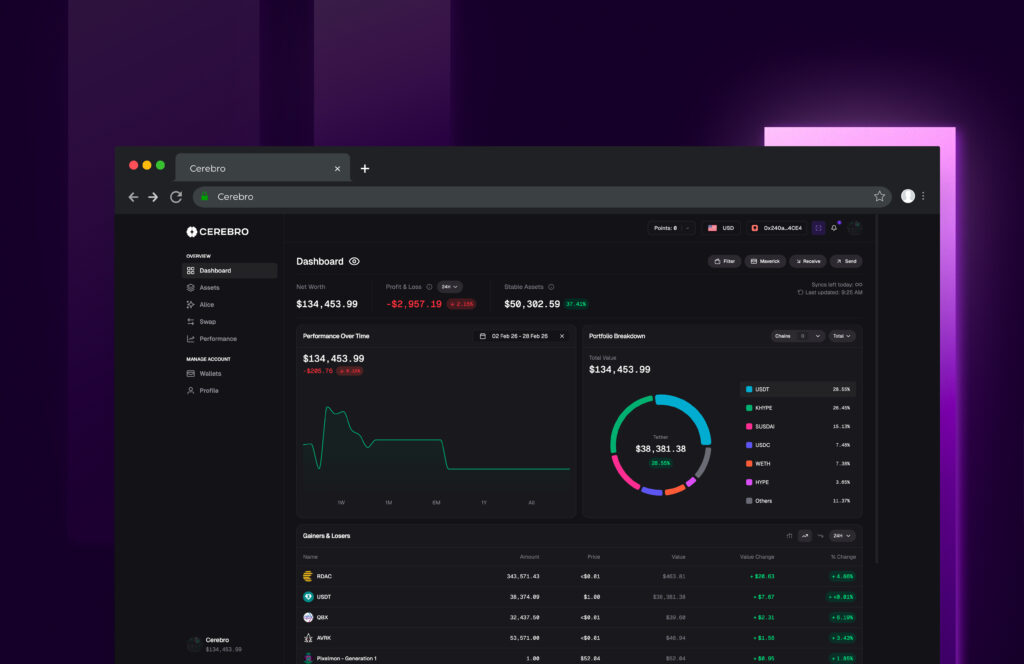
- Admin dashboard (Next.js): Token explorer across 10,000+ assets, entity graph visualisation, news browser with semantic search.
- Operational dashboards (Streamlit): Monitoring for data ingestion health, momentum scores and optimization results.
- Telegram alerts: Real-time breaking news notifications with market context and severity.
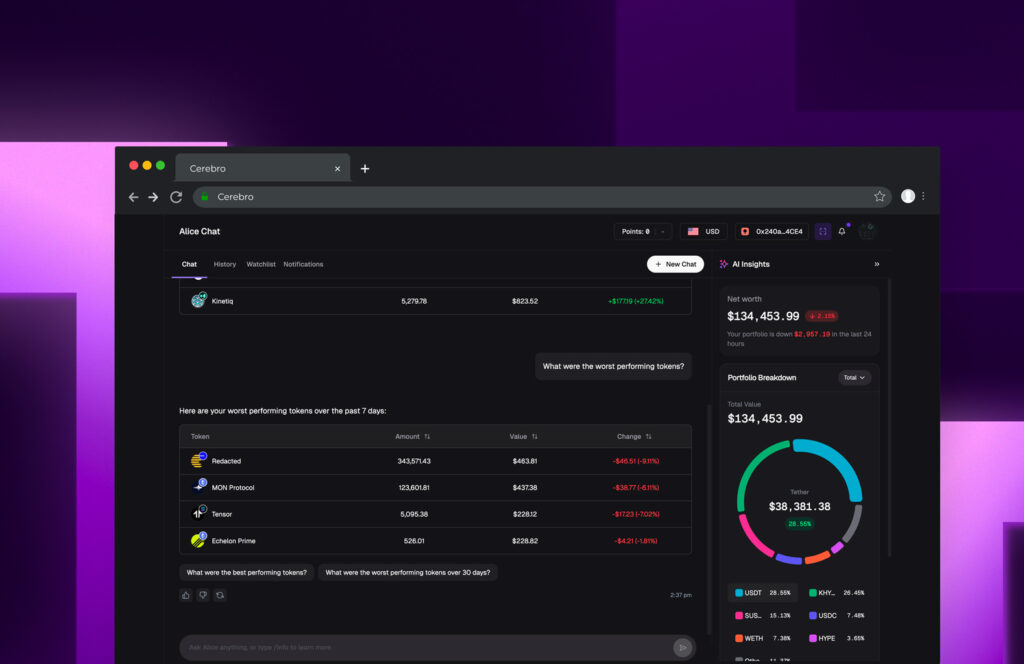
- Alice chat UI: Conversational interface for natural-language portfolio research.
Technologies used
Runtime


AI / ML





Databases



Frontend



Data processing



Deployment

Observability

High-level architecture

Ingestion
Binance WebSocket for real-time prices; scheduled collectors for market, social and tokenomics feeds.
Agent
LangGraph ReAct loop with tools for data retrieval, optimization and alert rules.
Data
MongoDB for prices and analytics; PostgreSQL for relational entities; Qdrant for vector search.
Compute
Python on Modal for scheduled jobs; Node.js / Next.js API for the application; Redis for queues and caching.
Backtesting
bt library with BTC benchmark comparison and reporting.
Observability
LangSmith traces for agent conversations; centralised logs, metrics and errors.
Deployment
LangGraph Cloud for agents; Vercel / Northflank for web; containerised workers for schedulers.
Key technical decisions
Key technical decisions
1/7
Streaming every one of 10,000+ tokens in real time would be prohibitively expensive. Binance’s WebSocket feed covers listed tokens live, while the long tail is polled every five minutes, giving real-time precision where it changes decisions and efficient coverage everywhere else
Tiered price ingestion
2/7
Mean-variance optimization understates crypto risk because it assumes normally distributed returns. CVaR targets the tail events that decide outcomes in volatile markets.
Expected Shortfall over variance
3/7
Median absolute deviation replaces standard deviation, nullifying the effect of wash-trading outliers on momentum signals without sacrificing responsiveness.
Robust statistics for momentum
4/7
No single LLM is reliable enough for breaking-news classification. Requiring consensus across three independent models cuts false positives sharply while holding recall.
Multi-model voting for news
5/7
Explicit graph paths instead of probabilistic routing keep research flows reproducible and auditable.
Deterministic agent routing
6/7
Modal.com scales with scheduled jobs and API load, so the client pays for compute used rather than idle infrastructure.
Serverless compute
7/7
With seven external feeds and three LLMs in the loop, failures are certain. Every component is designed to return partial results rather than fail outright.
Graceful degradation
Key capabilities
Risk-aware portfolios
VaR at 95% confidence, drawdown limits and cluster caps aligned to each user’s risk tier.
Editable suggestions
Users swap tokens or categories and the engine re-solves risk and return in under a second.
Scenario Q&A
Trim to five tokens, shift defensive, test BTC correlation, model a 20% crash.
Virtual portfolios
Create, save and compare what-if allocations with donut charts and KPIs.
Backtesting & metrics
Returns, volatility, Sharpe, Sortino and max drawdown against a BTC benchmark.
Real-time alerts
Consensus-verified breaking news, threshold breaches and allocation drift, delivered to Telegram.
Security & privacy
Application‑layer encryption (AES‑GCM/Fernet/Tink) for sensitive fields (wallets, balances).
Prompt sanitization & masking for LLM I/O (LLM Guard) and prompt‑injection defenses (Rebuff).
Privacy‑first logging with hashing & redaction; scoped JWTs and row‑level security where applicable.
Runtime moderation and evaluation tests (Giskard) to prevent data leakage and regressions.
Results and impact
Market coverage
10,000+ tokens tracked across 7 live data sources with unified entity resolution
Price freshness
Real-time streaming for listed tokens, five-minute refresh across the long tail
Research speed
Structured, cited research reports in under 60 seconds, three angles run in parallel
Optimization speed
Portfolio allocation solved in under 1 second, re-run every 4 hours
Personalisation
8 behavioural clusters across 1,900+ tokens, matched to risk profiles from Ultra Conservative to Ultra Aggressive
Signal integrity
Momentum signals that hold up against wash trading and artificial volume
Alert precision
Breaking news verified by three-model consensus before it reaches a user
Explainable suggestions
Alice cites the drivers, constraints and trade-offs behind every portfolio change, so users can audit a recommendation instead of taking it on trust.
Production reliability
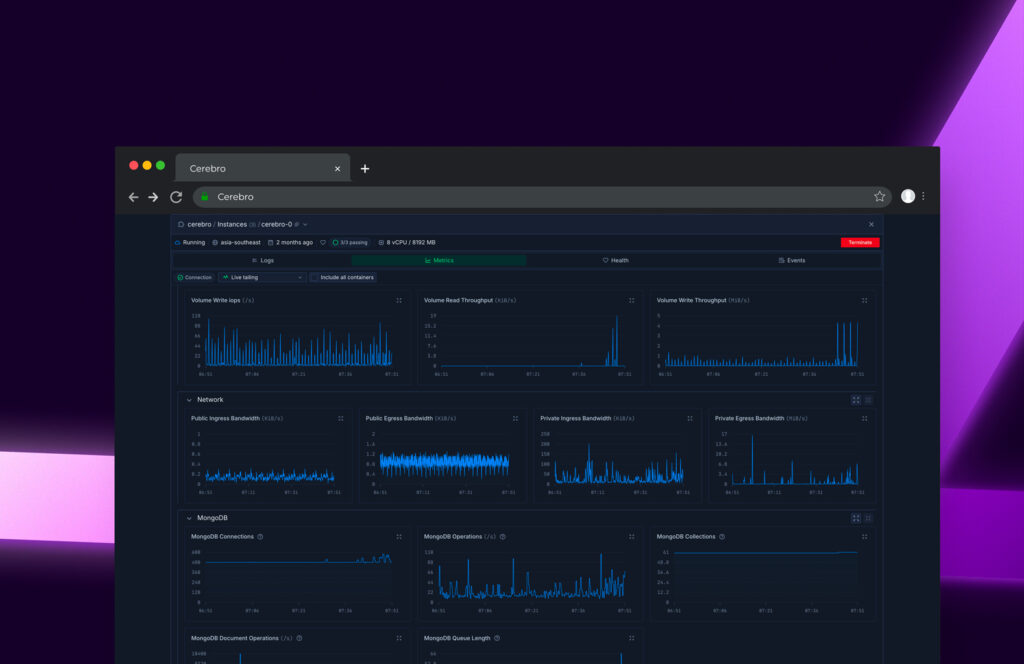
Cloud-hosted agents with LangSmith tracing give full visibility into agent behaviour in production.
Modular delivery
A layered architecture let the team ship and replace individual engines without destabilising the platform.
Need an explainable
AI portfolio engine?
We build reliable, auditable ML + LLM systems that users trust.