

Above Diamond
Composable Ecommerce Development
Mobile-first rebuild on Next.js, Medusa, and Payload CMS powering a real-time build-a-ring configurator, multi-currency checkout, and automated sync of 100,000+ lab-grown and 50,000+ natural diamonds from supplier feeds.
About the project
Above Diamond
Jewelry & Luxury Ecommerce (D2C)
Design, Development, Data Integration
Next.js, Medusa.js, Payload CMS, PostgreSQL, Redis
The Challenge
Above Diamond had outgrown its legacy WordPress setup. The team couldn’t offer a real-time “build-a-ring” experience, admin tooling was fragmented, third-party transaction fees were cutting into margins, and international shoppers faced slow performance with no multi-currency support. They needed a composable platform they could fully own and scale globally.
Our Solution
We delivered a modern, maintainable ecommerce foundation while solving data ingestion, customization complexity, and internationalization at once.
Composable architecture
Headless stack with Medusa for the commerce core, Payload CMS for content, and Next.js for the storefront clear domain boundaries and APIs built for durability.
Real-time diamond data pipeline
Automated syncing of 100,000+ lab-grown and 50,000+ natural diamonds from supplier FTP feeds and APIs. Schedulers validate, normalize, and upsert catalogs into canonical product variants, with price markup logic and fallback handling for provider downtime.
Ring customization engine
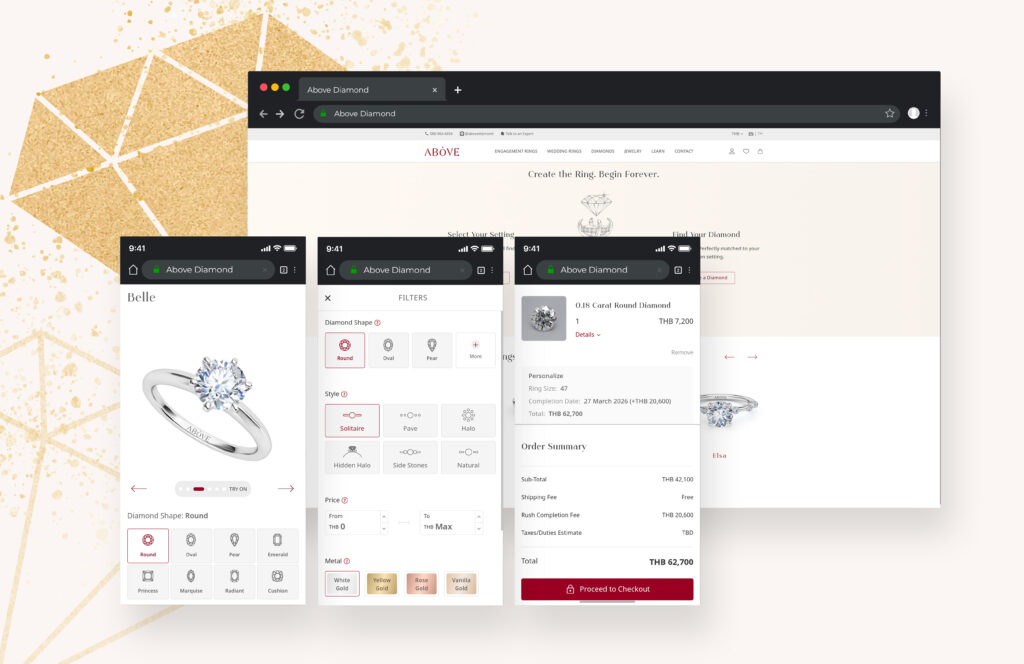
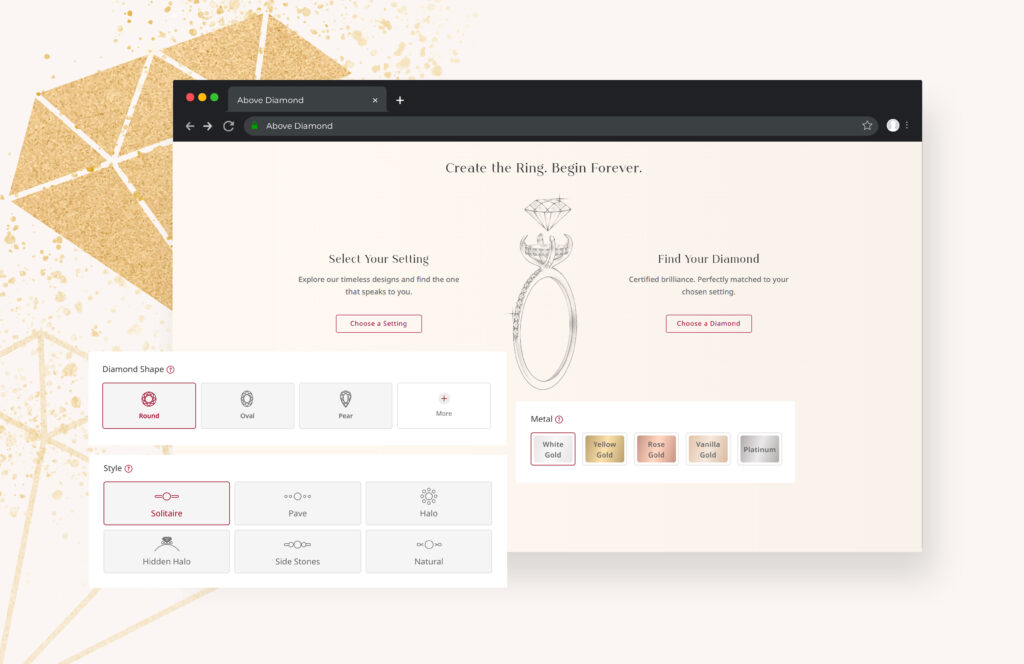
A fully interactive build-a-ring flow: 360° preview, diamond shape and metal-type selectors, ring size guide, engraving preview, and GIA/HRD certificate display with constraint rules, live pricing, and availability checks, all tuned for mobile-first performance.
Localization and currency
Route-aware locales with English and Thai content managed in Payload CMS. Multi-currency support for THB, USD, and EUR through Stripe adaptive pricing with market-specific markup logic, so international shoppers see accurate local pricing at checkout.
Payments and checkout
Stripe and BeamCheckout power a checkout flow with address validation, tax handling, guest checkout, and promo-code logic. Order webhooks drive downstream fulfillment and CRM sync.
Backend operational control
Custom admin dashboard with role-based access, exportable reports for orders, customers, and inventory, and CMS-driven control over landing pages, collection banners, and SEO content.
Engineering Challenges
Massive dataset integration
Importing 100K+ records from multiple suppliers caused database overload, solved with Redis caching, snapshot-comparison logic to avoid redundant writes, and sync processes migrated to Google Cloud Functions.
Asset crawling under provider restrictions
Diamond images, certificates, and videos were protected by anti-bot mechanisms, we engineered a robust crawling system to securely extract and store assets without triggering provider limits.
Medusa framework limitations
Extended a still-evolving Medusa through custom plugins and internal overrides to fit Above Diamond’s workflows.
Performance optimization
Lazy loading, CDN image tuning, and route-level prefetching, with heavy sync processes decoupled from user-facing services.
Security, Governance & Observability
Built for a platform handling high-value transactions and international customer data:
GDPR-friendly data flows across customer records and order history.
Role-based access control with audit trails on administrative actions.
Rate limiting at the API gateway to protect catalog and pricing endpoints.
Webhook-driven CRM synchronization for order and customer events.
Full observability: request logging, service metrics, and error tracing.
Tech Stack
Frontend


Backend

CMS

Database


Payments


Infrastructure




Results and impact
Mobile-first conversion flow
Configuration and checkout optimized for handheld devices, with a sticky cart and shareable design links.
Operational efficiency
Automated supplier sync replaces manual catalog uploads and reduces data-entry errors.

Scalable foundations
A composable stack ready for new markets, currencies, and product lines.
Editor autonomy
Payload CMS gives the marketing team direct control over content without developer cycles.

High-level architecture

Next.js storefront consumes Medusa commerce APIs and Payload CMS content APIs.
Scheduled workers pull supplier CSVs over FTP, validate, normalize, and upsert to product database
Checkout integrated with Stripe or BeamCheckout; webhooks drive order status and notifications.
Redis-backed caching for catalog and configuration rules to keep response times low
Observability with request logs, metrics, and error tracing across services.