


Here’s what you’ll find if you research this question for an hour: published estimates ranging from under $10,000 to $350,000 and beyond, sometimes from the same company, in two different articles. One vendor says a marketplace costs $2,000, another says a small project starts at $100,000. They can’t all be right, and in a sense none of them are wrong: they’re measuring different scopes, different regions, and, honestly, writing toward different sales pitches, which is exactly why marketplace development cost estimates disagree by as much as 50x.
A founder trying to budget off any single one of these numbers is stuck guessing which sales pitch happens to match their situation, if any of them do. That’s not a useful way to plan a real spend, and it’s not how anyone who actually builds marketplaces for a living arrives at a number internally.
So this article won’t hand you another arbitrary range. It will do something more useful: show you the math that produces any honest marketplace development cost estimate, with every variable visible, so you can compute a number for your own marketplace and interrogate anyone else’s.
The only honest formula
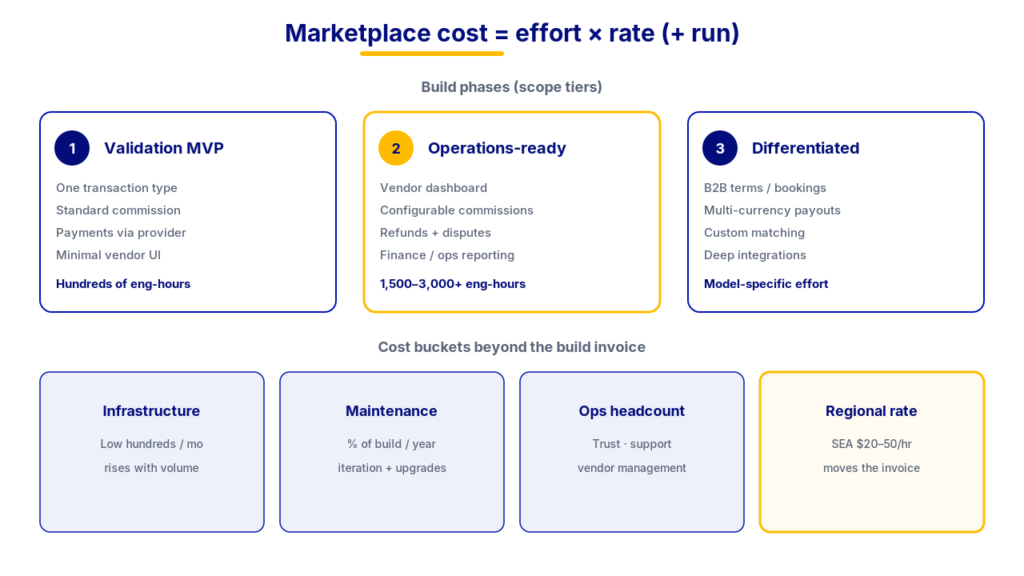
Every credible marketplace development cost estimate, whatever the letterhead, reduces to two lines: build cost equals effort (hours, driven by scope) times rate (driven by region and seniority), and total cost of ownership equals build plus run (infrastructure, maintenance, iteration) over 2 to 3 years.
Published estimates disagree wildly because they hide different assumptions inside those variables. Make the assumptions visible and the fog around marketplace development cost clears. Everything below is one of those two variables, made explicit enough that you can plug in your own numbers rather than take anyone’s word for the total.
Variable 1: Effort, what scope actually drives hours

From build and audit work across dozens of platforms, marketplace scope sorts into three recognizable tiers.
| Tier | What it includes | Typical effort |
|---|---|---|
| Tier 1: Validation MVP | One transaction type, standard commission, payments via a provider like Stripe Connect, minimal vendor interface, buyer storefront on a framework’s solved foundations | Hundreds of engineer-hours (roughly a small team for 2 to 3 months) |
| Tier 2: Operations-ready platform | Everything in Tier 1, plus a proper vendor dashboard, configurable commissions, refunds that reverse cleanly across split orders, dispute tooling, and reporting for finance and operations | 1,500 to 3,000+ engineer-hours (a small team for 4 to 8 months) |
| Tier 3: Differentiated platform | Non-standard flows (B2B terms, bookings, escrow-style logic), multi-currency regional payouts, custom matching or curation, deep integrations | A function of your specific model, not a fixed range |
The gap between Tier 1 and Tier 2 is usually where founders most underestimate effort, and the vendor dashboard is the specific reason why. A buyer-facing storefront looks, to most people scoping a project, like the whole product. It isn’t. The vendor side, onboarding, payout visibility, commission clarity, dispute status, is a second full product that has to exist before a marketplace can run at real volume without the founding team manually reconciling spreadsheets every week. Treating it as an afterthought is the single most common way a Tier 1 budget quietly turns into a Tier 2 build partway through.
Two structural notes move marketplace development cost more than any feature list. The first is how far your model deviates from a starter’s assumptions: building on a framework or marketplace starter, like Medusa, can remove a large share of Tier 1 and Tier 2 effort, and the honest comparison between a Shopify-plus-apps route and a Medusa-plus-custom route walks through exactly where that effort gets absorbed and where it doesn’t.
The second is how much you buy instead of build: payments processing, search infrastructure, and hosting are solved, rentable problems, and the per-component build-versus-buy call is its own discipline that deserves more attention than a single line item usually gets, since guessing wrong on even one of these three can add months to a Tier 2 timeline.
Variable 2: Rate, the regional reality

Public rate guides consistently place experienced development teams in Southeast Asia and Vietnam around $20 to 50 an hour, Eastern Europe roughly $40 to 80, and US or Western Europe $100 to 200-plus. The arithmetic consequence is blunt: the same 2,000-hour Tier 2 build is roughly $60,000 to $90,000 with a capable SEA team, and $250,000-plus at US agency rates, identical scope, radically different invoice.
| Region | Typical hourly rate | Same 2,000-hour Tier 2 build |
|---|---|---|
| Southeast Asia / Vietnam | $20 to 50/hour | Roughly $60,000 to $90,000 with a capable team |
| Eastern Europe | $40 to 80/hour | Roughly $80,000 to $160,000 |
| US / Western Europe | $100 to $200+/hour | $250,000+ at agency rates |
Two honest caveats belong here. Rate is a proxy for cost, not for value: a cheap team learning marketplaces on your budget is the most expensive option on this page, whatever the hourly rate says, because every mistake they make while learning gets billed to your timeline twice, once to build it wrong and once to rebuild it right.
And the filter that actually matters isn’t geography, it’s marketplace scar tissue. In practice that comes down to three questions worth asking any team before signing anything: can they describe, unprompted, what happens to a payout when a buyer disputes an order after the vendor has already been paid out? Can they explain how their commission logic behaves when an order is partially refunded across multiple vendors? And have they actually shipped a vendor dashboard before, not just a buyer storefront? A team that answers all three concretely, without needing the question explained further, has the scar tissue that makes the regional rate advantage real rather than a false economy.
Teams that can’t are learning marketplaces on your budget, whatever region they’re quoting from. That combination of real experience and regional rates is why founders in Singapore and the wider region increasingly build with SEA-based specialist teams rather than importing a Western agency by default.
The costs that aren’t the build

The invoice everyone budgets is only the build side of marketplace development cost. The costs that decide whether the platform survives are recurring: infrastructure (from low hundreds monthly at MVP scale, rising with volume as transaction and search load grow), maintenance and iteration (commonly modeled at a meaningful percentage of build cost annually, since a platform without a standing engineering function decays into the next rewrite within a couple of years), and the operational headcount behind trust, support, and vendor management, which is payroll, not software, and rarely shows up in a development quote at all.
This is also where the comparison founders actually need lives, not “custom versus free” but owning versus renting over time: stacked SaaS subscription plus transaction fees plus workaround hours at your projected volume, against build plus run over the same horizon. We’ve built that stay-or-switch math out in full; the one-line version is that the crossover is real, but where it sits depends entirely on your volume and how badly your model fits the rented platform. A marketplace processing a modest volume on a well-fitting SaaS platform may never cross over. One fighting its rented platform’s assumptions every month can cross over well before the founders expect it.
A worked example (adjust every number)
A founder-stage, operations-ready B2C marketplace (Tier 2), built on a commerce framework with a marketplace starter absorbing the solved parts, by an experienced SEA team, looks something like this: effort around 1,800 engineer-hours (framework foundation, custom vendor dashboard and commission logic), rate at $35 an hour (mid-range SEA, marketplace-experienced), for a marketplace development cost of roughly $63,000, plus run costs, infrastructure and retained engineering, budgeted annually at a defined percentage of build.
Change any assumption and the marketplace development cost number moves, that’s the point. Move it to US rates: roughly $180,000-plus for the identical scope. Strip it to a Tier 1 MVP instead: a fraction of that, often well under $30,000 with the same regional team, because there’s no vendor dashboard, no dispute tooling, and no configurable commissions to build yet. Add multi-currency payouts and B2B terms on top: now you’re in Tier 3, and the right move is to remap the flow first rather than guess, because Tier 3 effort tracks your specific model far more than it tracks any general benchmark. The formula is yours now; the assumptions are the conversation.
Who should own this number
In practice, the founder or CFO who owns the budget rarely owns the scoping decisions that actually determine marketplace development cost, tier, region, and build-versus-buy calls tend to live with whoever is running engineering or the vendor relationship. That split is exactly how a Tier 1 budget quietly becomes a Tier 2 invoice: the person tracking spend isn’t in the room when the vendor dashboard, the dispute tooling, or the multi-currency payout gets added to scope.
The fix isn’t a bigger budget, it’s making the formula visible to both sides of that split. Whoever owns the number should be able to point at effort and rate separately, ask which tier a new request actually belongs to before it’s approved, and know whether a given feature request is closing a real gap or adding Tier 3 complexity to what should still be a Tier 1 or Tier 2 build. That’s a five-minute conversation when the formula is explicit, and a budget overrun discovered three months in when it isn’t.
How to keep the budget honest
Four disciplines separate controlled marketplace development cost budgets from runaway ones.
- Scope the MVP as a real tier, not a wish list: validation first, operational elegance second.
- Decide build-versus-buy per component before quoting anything, rather than after the quote is already in hand.
- Fix the money flow early: payment architecture retrofits are the single most expensive category of rework teams get called in to fix.
- Budget the run from day one, because a platform with no maintenance line item has a hidden countdown timer.
And one meta-discipline: treat any marketplace development cost estimate that arrives before someone has mapped your transaction flow as exactly what it is, marketing with digits in it. A real number follows a scoping conversation. It doesn’t precede one.
Get a number with assumptions attached
If you want your own marketplace development cost formula applied to your actual model, your tier, your flows, your build-versus-buy split, with every assumption on the table, that’s a marketplace roadmap session. You’ll leave with a scoped estimate you can interrogate, compare, and hold anyone, including us, accountable to.
Frequently asked questions
How much does it cost to build a marketplace?
Honest answer: marketplace development cost equals effort times rate. A validation MVP runs hundreds of engineer-hours; an operations-ready platform typically runs 1,500 to 3,000-plus. At experienced Southeast Asian team rates, roughly $20 to 50 an hour per public rate guides, that puts many founder-stage builds in the tens of thousands of dollars, while the same scope at US rates costs several times more. Published one-number estimates disagree by 50x precisely because they hide these variables.
Why do marketplace cost estimates vary so much?
Because they measure different things: different scope tiers, different regional rates, build-only versus total ownership, and because most are published by vendors whose estimate flatters their own offering. Any estimate without visible assumptions isn’t really an estimate.
Is it cheaper to build a marketplace or use SaaS?
Early on, SaaS is almost always cheaper, that’s what it’s for. The crossover comes when stacked subscription fees, transaction fees, and workaround hours at your volume exceed build-plus-run over 2 to 3 years. Where that point sits depends on your volume and how well your model fits the rented platform.
How can I reduce marketplace development cost without cutting corners?
Build on a commerce framework or marketplace starter instead of from scratch, buy the solved components (payments processing, search infrastructure, hosting), scope a true validation tier first, and work with a team that has real marketplace experience at regional rates. The combination, not any single lever, is what moves the number.