


Most “Medusa vs Shopify” comparisons answer a question you are not asking. They compare the two as platforms for a store: one seller, one catalog, one checkout. Useful, if you are opening a store.
But if you are building a marketplace, with multiple vendors, split payments, commissions, and seller dashboards, the honest starting point is this: neither platform does that out of the box. Shopify was architected for a single merchant. Medusa is a commerce framework that ships no vendor logic at all. So the real question in a Medusa.js vs Shopify marketplace decision is not between two products. It is between two extension paths.
- Path A: Shopify plus a multi-vendor app, renting a marketplace simulation on top of a single-seller platform.
- Path B: Medusa plus custom development or a starter like Mercur, building marketplace mechanics as owned architecture.
One gets you a low ceiling fast. The other gets you a high ceiling slowly. This Medusa.js vs Shopify comparison is about figuring out which side of that trade you are on, and just as importantly, when the answer changes. If you want the broader build-versus-buy picture before narrowing to these two paths, our guide to custom marketplace development covers that ground first.
One disambiguation before we start: Shopify’s “Marketplace Connect” app is for selling your products on Amazon, eBay, and similar channels. It has nothing to do with building your own marketplace. The naming confuses everyone.
Path A: Shopify + a multi-vendor app

What it really is. This half of the Medusa.js vs Shopify comparison starts with apps like Webkul’s Multi Vendor, Shipturtle, or Onport, which graft vendor management onto Shopify: sellers get an app-provided dashboard, products sync into your single Shopify catalog, and the app’s logic tracks who sold what and who is owed what. It works, thousands of small marketplaces run this way.
Where it’s genuinely strong. Speed and certainty. Shopify offers hosting, security, checkout, support services, and marketing tools for online stores, plus the app ecosystem, and you can be onboarding vendors within weeks with no engineering team. For validating that buyers and sellers actually want to meet (the question that kills most marketplaces), Path A is the cheapest credible experiment you can run. We recommend it regularly, including to people who ask us for custom builds.
Where it’s structurally weak. The weakness isn’t the apps, it’s the foundation. Shopify’s checkout has one merchant of record: you. Multi-vendor apps do not change that; they layer accounting on top, computing vendor payouts after the fact through their own logic. That single fact cascades, and it’s the crux of the Medusa.js vs Shopify trade-off:
- Money flow is simulated, not architected. By default, leading multi-vendor apps have the admin collect the full payment and transfer each seller’s share afterward, minus commission, accounting on top of the transaction, not inside it. Real-time auto-split does exist as an add-on (via Stripe Connect), but look at how it’s implemented: as a custom payment method created in Shopify’s settings, routing around the native checkout, with constraints like one active split method at a time and both parties needing Stripe accounts. The workaround works; it’s also the clearest evidence of what’s being worked around.
- Your marketplace’s roadmap is the app’s roadmap. Need a vendor approval flow, payout schedule, or commission structure the app doesn’t support? You’re filing a feature request, not writing a ticket.
- Fees stack. Shopify subscription, plus the app’s monthly fee, plus payment-provider costs and transaction fees, each reasonable alone, compounding as volume grows.
- The data model is single-seller at heart. Vendor-specific shipping, tax, and catalog logic all work around Shopify’s assumptions, and deep checkout customization is gated behind Shopify Plus.
None of this matters at ten vendors and a standard commission. All of it matters later, which is the point of the threshold section below.
Path B: Medusa.js (open source) + custom development or Mercur
What it really is. The other half of the Medusa.js vs Shopify comparison is an open source alternative among e-commerce platforms and headless platforms: modular architecture, workflow engine with rollback, owned code. Marketplace mechanics (vendors, split orders, commissions, payouts) are either built on that foundation or inherited from Mercur, an open-source marketplace starter built on Medusa. We’ve written a full decision-level guide to those routes in our Medusa.js marketplace guide.
Where it’s genuinely strong. The marketplace is architecture, not simulation. In headless commerce, that headless architecture gives you the ability to shape commerce logic with full control around specific business needs: tiered commissions, negotiated rates, vendor-specific flows, regional payout rules for Southeast Asia. There is no app roadmap between you and your business model, no per-transaction platform tax scaling against you, and no ceiling waiting at the end of your growth curve.
Where it’s honestly weak. Everything about Path B assumes engineering ownership by developers. There’s no vendor dashboard until you build one (or adopt Mercur’s). There’s no support SLA unless you contract one. Setup, self hosting, infrastructure management, hosting, and maintenance are your responsibility, and the learning curve is real, which is the honest cost side of the Medusa.js vs Shopify equation. We wrote an entire article on Medusa’s disadvantages and how to mitigate them, and we build on it for a living. If your team can’t own a codebase and won’t hire someone who can, especially if you lack the technical resources for those requirements, Path B fails regardless of its architectural merits.
The trade-off table for e commerce platforms
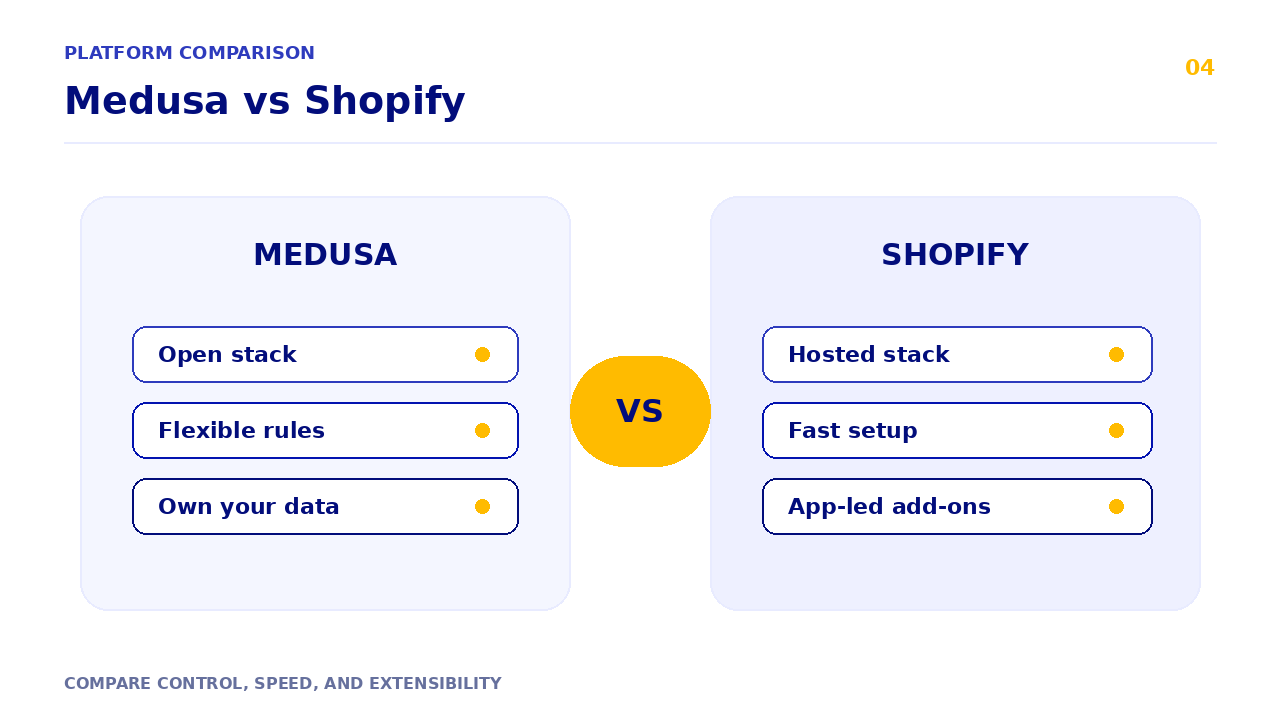
Here is the Medusa.js vs Shopify trade-off, side by side:
Path A: Shopify + app | Path B: Medusa + custom/Mercur | |
|---|---|---|
Time to first vendor | Weeks | Months |
Engineering required | None to minimal | Real, ongoing, including owning the backend |
Money flow | App-level accounting on single-merchant checkout | Owned split-payment architecture |
Commission models | What the app supports | Whatever your model needs |
Vendor experience | App’s dashboard, app’s roadmap | Yours to design (and build) |
Cost structure | Subscription + app fees + per-transaction; good for simpler e-commerce solutions early on | Build + infrastructure + maintenance; flatter after build for custom growth-stage e-commerce solutions |
Ceiling | Low, structural | High, budgetary |
Best at | Validating demand; standard models | Scaling operations; non-standard models |
Worst case | Outgrowing it mid-growth and migrating under pressure | Building it before demand exists |
Notice the symmetry of the worst cases. Path A’s failure mode is staying too long; Path B’s is arriving too early. Almost every marketplace horror story we’ve been called into is one of those two.
The switching threshold and vendor lock in: when Path A stops making sense
The interesting question in the Medusa.js vs Shopify decision isn’t which path is better, it’s where the crossover sits based on your specific requirements. From the projects we’ve audited, Path A stops making sense when any of these becomes true:
- Your commission model no longer fits the app’s settings. The moment finance maintains a spreadsheet to correct what the app calculates, the simulation has broken.
- Workaround cost scales with volume. Manual payout adjustments and support tickets that were minutes a week at ten vendors become someone’s job at a hundred.
- A roadmap decision is blocked by the platform. You’re delaying a market, category, or vendor feature because the app can’t support the next move for a specific business need: the platform is now pricing your strategy, not just your transactions.
- Fees cross the build line. Stacked subscription, app, and transaction costs at your projected volume exceed what owning the platform would cost over two to three years.
One or two signals, intermittently: optimize within Path A. Three or four, trending: you’ve crossed the threshold, and every month on the wrong side compounds. This is the same structural versus temporary diagnosis we’ve written about for marketplace platforms generally, applied to Shopify specifically.
A note for Southeast Asian founders weighing Medusa.js vs Shopify: regional expansion tends to hit the threshold early. Multi-currency vendor payouts, local payment methods, and country-specific tax logic are exactly the categories where the Shopify-plus-app approach strains first, especially around payment gateways and third-party integrations.
Hidden costs and transaction fees, on both sides

Path A’s hidden costs compound quietly for businesses running online stores: the workaround tax (staff hours reconciling what the app can’t express), migration debt (every month of growth on Path A raises the eventual switching cost: more vendors to re-onboard, more data to move, more habits to retrain), and strategic drag (features not built because the platform said no).
Path B’s hidden costs arrive up front and then recur: the vendor dashboard nobody budgeted, infrastructure and DevOps ownership for teams that want more control, plugin gaps that become custom modules, and the permanent line item of engineering maintenance. Anyone who tells you the Medusa.js vs Shopify choice is free because one side is open source is selling something: total cost of ownership is real, and we itemize it honestly in a dedicated cost guide (coming soon).
The mistake is comparing Path A’s visible costs against Path B’s, or Path A’s hidden costs against Path B’s visible ones. Compare totals, at your projected volume, over two to three years: that’s the only honest math for a Medusa.js vs Shopify decision.
So which one? An honest decision shortcut
- Unvalidated idea, standard commission model, no dev team: Path A, without hesitation; Shopify is the better fit for users without a dev team, so prove liquidity first.
- Validated demand, model still standard, volume modest: Path A, but audit yearly against the four threshold signals.
- Validated demand plus non-standard model, or two-plus threshold signals: Path B, deliberately, migrate from strength, not from crisis.
- Non-standard model from day one (B2B flows, services, regulated categories, complex commissions): Path B early, or at minimum architect your Path A stint so data and vendors can move.
If you’re somewhere in the middle (most founders who read this far are), the useful next step is specific, not general: which signals are firing, what’s the workaround tax actually costing, where’s your fee crossover. Different e-commerce platforms fit different brands and different growth stages, which is why the right answer can change as complexity and volume rise. That’s what a marketplace technical audit maps: your current setup against the threshold, with the numbers made explicit, and an honest read even when the read is “stay on Shopify.”
FAQ
Can Shopify be used to build a multi-vendor marketplace?
In the Medusa.js vs Shopify comparison, yes: Shopify is one of the e-commerce platforms that can support online stores and marketplaces through multi-vendor apps that layer seller management and payout accounting on top of its single-merchant checkout. It works well for standard models and modest vendor counts. Customers can complete purchases, but the checkout flow still follows Shopify’s single-merchant structure. The constraints are structural: the checkout, data model, and app roadmap set the ceiling.
Is Medusa.js better than Shopify for marketplaces?
For owned, non-standard marketplace mechanics at scale, Medusa is usually better because it gives you more control and enterprise-style flexibility. It also fits composable commerce, where you can pair a tailored commerce engine with separate services for more complex marketplace builds. But it requires real engineering ownership, and before demand is validated, Shopify plus an app is usually the smarter start. The honest Medusa.js vs Shopify marketplace comparison is between paths and stages, not products.
What are Shopify’s marketplace limitations?
In the Medusa.js vs Shopify comparison, Shopify’s standard plans differ from its headless options for larger or more customized builds, and its limitations are a single merchant-of-record checkout (split payments are app-level accounting, not architecture), commission models bounded by app settings, vendor experience owned by the app’s roadmap, stacking fees at volume, and deep checkout customization gated behind Shopify Plus, which high volume stores may outgrow sooner.
When should a marketplace move from Shopify to Medusa.js?
When workaround costs scale with volume, the commission model no longer fits app settings, roadmap decisions get blocked by platform constraints, or stacked fees exceed two to three years of ownership costs, it’s usually time to plan an e commerce migration to a new platform by moving product data before launch, then testing performance before going live, ideally migrating from strength rather than in a growth crisis.