


If you search for “Medusa.js marketplace,” you’ll find excellent developer tutorials: the official Marketplace Recipe, multi-part build guides, plugin walkthroughs. What you won’t find is the article for the person who has to decide: is Medusa the right foundation for our marketplace, which of the several routes should we take, and what will it actually demand from us?
This is that article. It is written for founders, product managers and technical leads choosing a marketplace foundation. No code, just the trade-offs, the limitations the tutorials mention quietly, and the honest cases where you shouldn’t choose Medusa at all. We build marketplaces on Medusa.js and MercurJS for a living, so this is written from production experience, including the parts that were painful.
Can you build a Medusa.js marketplace?
Yes. Medusa.js is one of the strongest open-source foundations for a custom multi-vendor marketplace, but it doesn’t do it out of the box. Medusa core is a modular commerce framework; marketplace capability (to support multiple vendors in one system, with split orders, commissions, and vendor dashboards) is something you add, either by building it on Medusa’s framework, starting from Mercur (an open-source marketplace starter built on Medusa), or adopting a community plugin, so vendors can sell to customers through the marketplace. Choosing between those routes is the real decision in any Medusa.js marketplace project, and it depends on how standard your marketplace model is. That fit question is the heart of every Medusa.js marketplace decision.
What open source Medusa 2.0 actually gives you (and what it doesn’t)

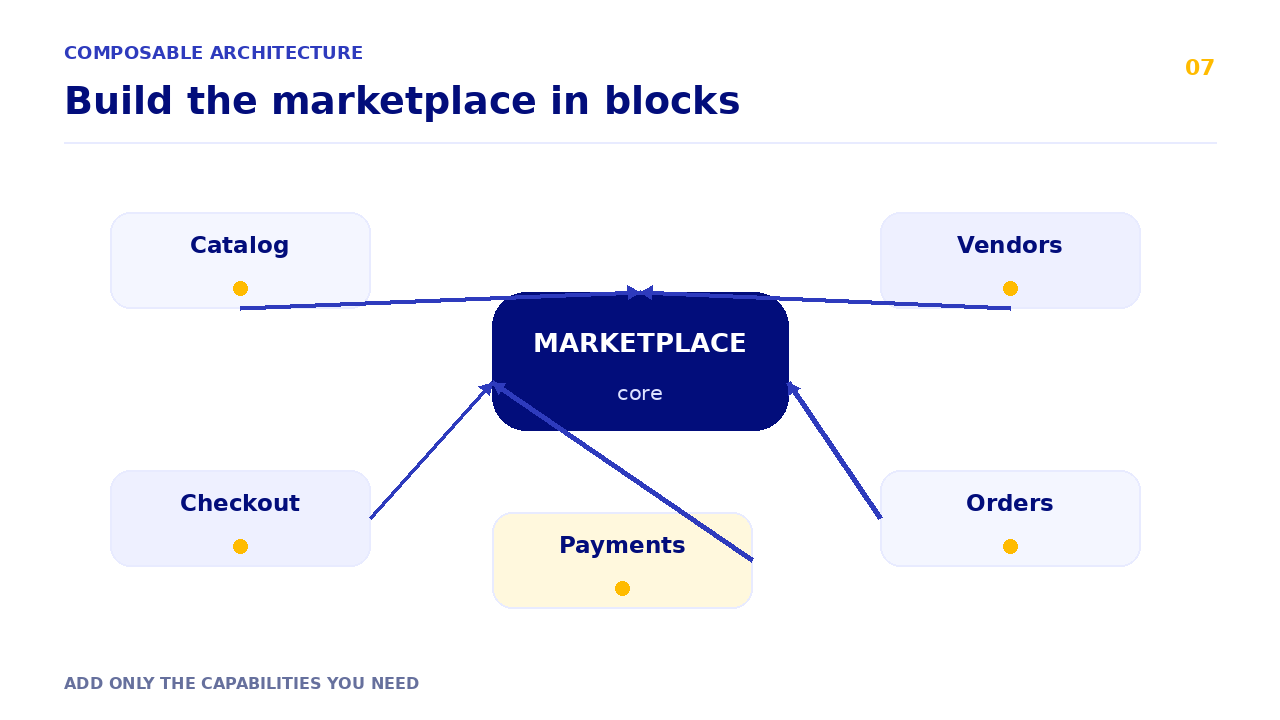
Medusa 2.0 is a ground-up modular architecture: commerce logic lives in decoupled modules (products, carts, orders, payments), and cross-module business logic runs through workflows, composable steps with automatic rollback when something fails. For a marketplace, that architecture is genuinely well-suited: splitting an order across vendors, calculating per-vendor commissions, and routing payouts are exactly the kind of multi-step, must-not-half-complete operations workflows were designed for.
What it gives you: full ownership of code and data, self-hosting (which matters for teams in Southeast Asia that want control over infrastructure and cost), a headless storefront with a separate front end you shape freely, and full control over customization through modules rather than by patching core, which gives teams the tools to extend commerce behavior without touching core and keeps your custom logic survivable across upgrades.
What it doesn’t give you out of the box: multi-vendor anything. No vendor entity, no built-in onboarding process for vendors, no order splitting, no commission engine, no vendor dashboard. The official documentation provides a Marketplace Recipe, but it’s explicitly an example of an approach, not a feature you switch on. That’s not a criticism; it’s the design philosophy. But it means “Medusa supports marketplaces” and “your marketplace is built” are separated by real engineering around the key features you still need for marketplace operations, and the integrations with third-party services those features usually depend on. A Medusa.js marketplace is assembled, not toggled on.
Your three routes to a multi-vendor Medusa.js marketplace with vendor dashboards
| Custom build (recipe pattern) | Mercur (open-source starter by Rigby) | Community plugins | |
|---|---|---|---|
| What it is | Build vendor logic as your own modules and workflows on Medusa core | A maintained marketplace foundation on Medusa: vendor dashboards, multi-vendor cart, commissions, Stripe Connect payouts | Third-party plugins adding multi-vendor features |
| Best when | Your marketplace model is non-standard (services, B2B flows, rentals, unusual commission logic) | Your model is close to a standard B2C product marketplace and you want a head start | Prototyping; validating an idea cheaply to test it before committing further |
| Trade-off | Longest timeline; you build (and own) everything, including the vendor dashboard | You inherit the starter’s opinions; deviating far from its model erodes the head start | Maintenance risk: some rely on patch scripts that can break on Medusa updates; support depends on one maintainer |
| Who owns the roadmap | You | You (open source), guided by the starter’s direction | The plugin author |
Whichever route you choose, split payouts to vendors usually run through a payment provider such as Stripe Connect, so plan that integration early.
Full disclosure: we build on both the custom route and Mercur, depending on the project, so we have no horse in this race except fit. The honest heuristic: the more standard your marketplace, the more Mercur saves you and helps you launch faster; the more unusual your model, the more the starter’s assumptions get in your way and custom wins. Matching route to model is what makes a Medusa.js marketplace succeed.
We compare Medusa against the mainstream alternative in more depth in a separate guide (publishing soon), and the FAQ below gives the short version. Either way, a Medusa.js marketplace is a strategic build, not just a plugin install or a decision to build from scratch rather than extend an existing solution.
The limitations nobody puts in the tutorial

We’ve written a full, updated breakdown of Medusa’s disadvantages, but three deserve special mention because they’re specific to a Medusa.js marketplace:
The vendor dashboard is on you (custom route). Medusa’s Admin is for platform operators, the super admins. Vendor-facing dashboards, where sellers manage their own products, orders, earnings, and inventory, are a separate build with its own design, auth, and maintenance. In marketplace budgets this is routinely the most underestimated line item. (Mercur ships one; that’s a large part of its value.)
Payments are architecture, not integration. A marketplace payment isn’t “connect Stripe”; it’s how vendors get paid through split payments, including support for multiple sellers in one checkout, commission calculation, payout scheduling, and refund flows that cross vendor boundaries. Medusa’s workflows handle the orchestration well, but the design decisions (who holds funds, when payouts fire, how refunds claw back commissions, and how shipping works across vendors) are yours, and if you operate somewhere like Singapore, how money flows has regulatory implications too.
Operational maturity is earned, not installed. Search, reviews, messaging, dispute flows, vendor verification and vendor profiles, the features that make a marketplace feel trustworthy, are ecosystem integrations or custom work, and enabling those workflows is part of the build challenge. Plan for them in phase two, but budget for them in phase one. These features separate a trustworthy Medusa.js marketplace from a demo.
When Medusa is the wrong choice
We’d rather tell you now than during a project retro:
- You haven’t validated demand yet. A no-code marketplace SaaS will teach you whether buyers, sellers, and shoppers actually show up, for a fraction of the cost, so a smaller test can help validate the niche before you build custom. Off-the-shelf multi-vendor plugins are another low-cost test, though with tighter limits; see whether WooCommerce or Wix works for a marketplace. Build custom when the model is proven and the platform starts limiting you: we’ve written about recognizing that moment.
- You have no JavaScript/TypeScript capability and no partner. Medusa is a framework, not a product. Without engineering ownership, in-house or contracted, it will fail slowly and expensively.
- Your model is 95% standard retail. If a Shopify-style setup covers your flows, a standard online store model will too, and the flexibility you’d pay for in complexity is flexibility you’d never use.
- You need vendor-backed SLAs and turnkey support. Open source means community support plus whatever accountability you contract. If that’s unacceptable, choose a commercial platform.
We’re publishing a fuller decision framework soon; the short version is above. Skipping Medusa is sometimes the smartest Medusa.js marketplace decision you can make.
What drives cost and timeline

We won’t quote a number without knowing your model, database, and infrastructure choices; anyone who does is guessing. What moves the budget, roughly in order:
- Transaction-flow complexity (simple product sales vs bookings, services, escrow-style flows)
- Vendor-side depth (product listing vs full self-serve onboarding, analytics, payout management)
- Payment architecture (single-currency, single-region vs multi-currency SEA payouts with tiered commissions)
- Route chosen (Mercur head start vs custom foundation)
- Operational features (search, reviews, messaging, disputes, and how you handle out-of-stock products to keep results accurate, now or later)
A validation MVP and an operations-ready platform are different products. Scope the first honestly and architect so the second doesn’t require a rewrite. Scoped this way, a Medusa.js marketplace grows with you instead of against you.
How to decide on a Medusa.js marketplace
Three questions settle most cases: Is your model proven enough to justify owning a platform? Is it standard enough for Mercur or unusual enough for custom? And do you have, or will you contract, the internal or partner team that will own the engineering responsibility Medusa assumes? Answer those three and the right Medusa.js marketplace route usually picks itself.
If you’re weighing Medusa for a marketplace build, discuss your marketplace project with us. We’ll map your model against the three routes and give you an honest read, including “don’t use Medusa” when that’s the truth.
FAQ
Does Medusa.js support multi-vendor marketplaces out of the box?
No. Medusa core is a modular commerce framework; multi-vendor capability, including a unified checkout across vendors and flows for registering and setting up new sellers, is added via the official Marketplace Recipe pattern (custom build), the Mercur open-source starter, or community plugins. The recipe is an example approach, not a switch-on feature.
What is Mercur and how does it relate to Medusa.js?
Mercur is an open-source multi-vendor marketplace starter built on top of Medusa by Rigby. It adds marketplace-specific features Medusa core lacks (vendor dashboards, multi-vendor cart, commission management, and Stripe Connect payouts), helping sellers sell through one marketplace foundation, and is used in production marketplaces.
How long does it take to build a marketplace with Medusa.js?
It depends on the route and model: starting from Mercur with a standard B2C model is meaningfully faster than a custom build, which typically runs several months. The biggest variables are payment architecture, vendor dashboard scope, and how far your model deviates from standard flows.
Is Medusa.js better than Shopify for a marketplace?
They solve different problems: Shopify-based marketplaces lean on apps within Shopify’s constraints, while Medusa gives you an owned, customizable foundation at the cost of engineering responsibility. If your model is standard and small-scale, Shopify-plus-apps may be enough; if marketplace mechanics are your core business, an owned platform usually wins long-term.