


To build a marketplace in Singapore is to launch into one of the best environments in Southeast Asia for a two-sided platform: dense demand, near-universal digital payments, efficient logistics, and a regulatory environment that is strict but predictable. That last part cuts both ways. The rules are clear, but they are yours to handle. A marketplace built for Singapore has to be built for Singapore (its payment rails, its GST rules, its data protection law), not copied from a US playbook.
This guide starts with the legal requirements for running a marketplace in Singapore, then walks through the decisions that actually determine whether your marketplace build succeeds: build vs SaaS, how money should flow, what compliance you own as an operator, what drives cost, and how to choose who builds it. The goal is simple: to help you build a marketplace in Singapore that is ready to operate, not just ready to launch.
One note before we start: this article covers regulatory topics at a founder’s working level. It isn’t legal or tax advice. Confirm specifics for your model with a qualified advisor.
Legal requirements for running a marketplace in Singapore
Running a marketplace in Singapore does not need a special marketplace licence, but the operator carries obligations in six areas: business registration, GST, personal data, consumer protection, payments and product-category rules. The table summarises them; the sections that follow explain how each one shapes the build.
| Area | What applies to a marketplace operator | Source |
|---|---|---|
| Business registration | Register the business with ACRA. A local company needs at least one director who is ordinarily resident in Singapore, and must appoint a company secretary within six months. | ACRA |
| GST | Register once taxable turnover over 12 months exceeds S$1 million, then charge GST on your own fees (commission, listing fees). For business-to-consumer sales of low-value goods (S$400 or less) imported by air or post, the operator can be treated as the supplier, for example if it authorises the charge to the customer or sets the terms of sale. | IRAS |
| Personal data | Under the PDPA: consent and a clear purpose for the data you collect, a data protection officer with published business contact details, and notification of significant data breaches to the PDPC within three calendar days of assessing them. | PDPC |
| Consumer protection | The Consumer Protection (Fair Trading) Act applies to sales to Singapore consumers. Show unavoidable charges in the headline price. Under the lemon law, defects found within six months of delivery are presumed to have existed at delivery. | CCS |
| Payments | Money transfer and merchant acquisition are licensable payment services under the Payment Services Act. Routing payments through a licensed provider is the usual way to stay outside licensing. | MAS |
| Product categories | Some categories have their own rules, such as health products (HSA) and certain food activities (SFA). | HSA, SFA |
| Platform safety | The E-Commerce Code under the Online Criminal Harms Act binds designated platforms only. MHA’s Transaction Safety Ratings and the TR 76 standard are voluntary benchmarks. | MHA |
What does it take to build a marketplace in Singapore?
To build a marketplace in Singapore means standing up a two-sided platform (buyers and sellers) with vendor onboarding, listings, payments that split money between the platform and its sellers, and local compliance: chiefly GST obligations that can fall on you as the marketplace operator, PDPA data protection, and payment structuring that keeps you on the right side of the Payment Services Act. The core decisions are your platform approach (SaaS vs custom), your payment architecture, and who builds it.
Why Singapore is a strong home base for a marketplace for local businesses
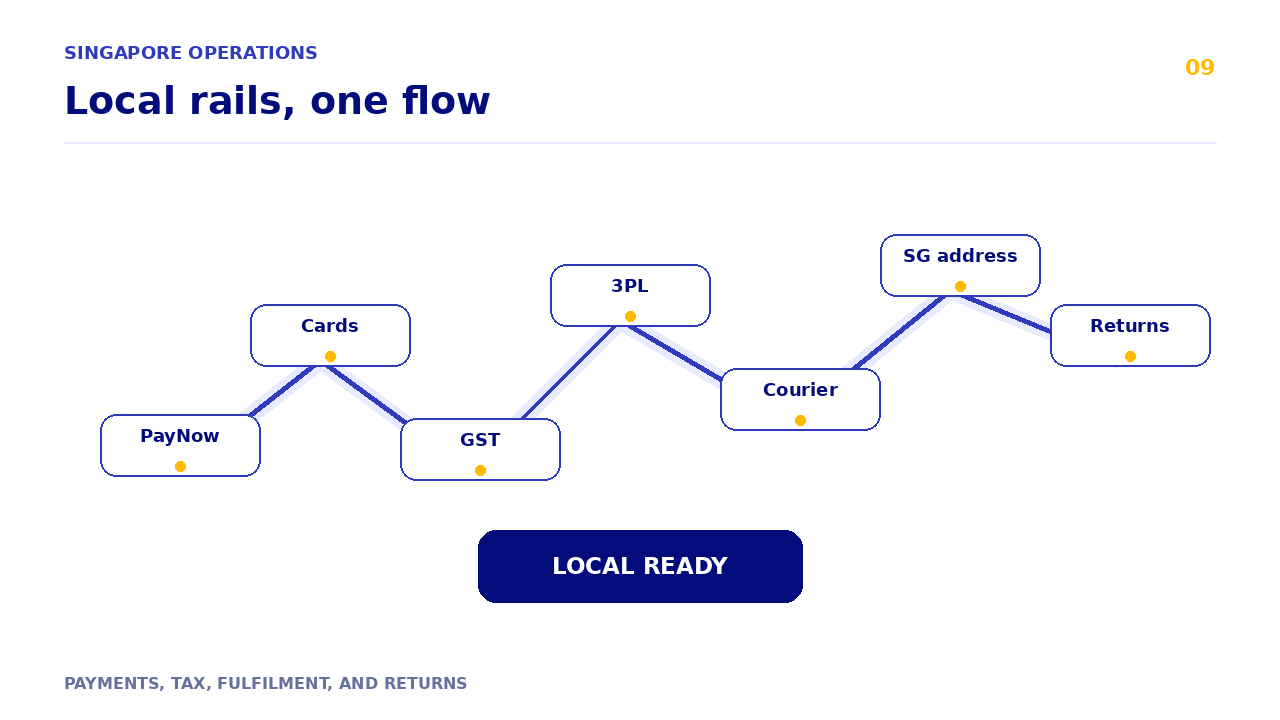
Three things make Singapore unusually marketplace-friendly. First, payments: PayNow gives you real-time bank transfers that consumers actually use, alongside cards and wallets like GrabPay, so checkout friction here is among the lowest in the region. Second, logistics: compact geography plus mature last-mile providers means same-day or next-day delivery is a realistic baseline, which raises buyer expectations but also makes liquidity easier to demonstrate. Third, predictability: company registration is fast and digital, the tax system is transparent, with attractive tax incentives for businesses, and the rules, while real, are published and stable.
These same strengths are why so many founders choose to build a marketplace in Singapore first and expand across the region afterwards. The flip side: Singapore alone is a small market of 5.7 million. Most founders here build with Southeast Asia expansion in mind from day one, which has architectural consequences: multi-currency, multi-language, and payment methods that differ by country. Decisions you make in month one determine whether “expanding to Malaysia” is a configuration change or a rebuild.
Build vs SaaS: the first real decision

When you build a marketplace in Singapore, you have two honest starting points, and the right one depends on your stage, not on what anyone selling either option tells you.
Start on marketplace SaaS (Sharetribe, Arcadier, which has Singapore roots, and similar) if your priority is validating that supply and demand actually want to meet. You’ll launch in weeks, spend almost nothing on engineering, and learn whether your marketplace has a pulse. The trade-off is a ceiling: commission structures, payout flows, and custom features are constrained by the platform’s design. That ceiling is fine until your operations outgrow it. We’ve written about how to recognize that moment: when marketplace platforms stop fitting real operations.
Build custom (on a commerce framework like Medusa.js, or fully bespoke) if your model depends on flows that off-the-shelf platforms don’t do well: complex commission tiers, B2B features like quotes and credit terms, regulated categories, or a differentiated experience that is the business. You own the roadmap and the ceiling disappears, but you take on real engineering cost and timeline. If you’re leaning this way, our breakdown of Medusa marketplace architecture for multi-vendor growth shows what a modular custom build looks like in practice.
The mistake we see most isn’t choosing the wrong option. It’s choosing custom for a business that hasn’t validated demand, or staying on SaaS long after the workarounds started costing more than a build would.
Payments: PayNow, Stripe, transaction fees, and the money-flow decision founders miss

How money flows is the single most important technical choice you make when you build a marketplace in Singapore. For checkout, the local baseline is straightforward: cards + PayNow, with wallets like GrabPay depending on your audience. Stripe supports PayNow in Singapore, so a modern payment stack covers local expectations without exotic integrations.
The decision founders miss is not which payment methods. It’s how money flows. A marketplace isn’t a shop: the buyer pays once, and the money must be split between sellers and your platform fee. There are two broad ways to structure that:
Through a licensed payment provider (e.g., Stripe Connect or an equivalent PSP with split-payment support): the provider collects the buyer’s payment, splits it, and pays out sellers. Funds move through their licensed infrastructure, not your bank account.
Through your own accounts: you collect the full amount, hold it, and pay sellers out yourself.
The second option feels simpler and cheaper, and it’s where founders can walk into Singapore’s Payment Services Act without realizing it. Activities like merchant acquisition and money transfer are licensable payment services under the Act, regulated by MAS, with licensing tiers that depend on transaction volumes. A marketplace that routinely collects and holds sellers’ money can start to resemble exactly the kind of activity the Act regulates.
Structuring your payment flow through a licensed provider from day one is the standard way to stay clearly outside that perimeter, and it’s dramatically cheaper than discovering a licensing question after launch. If your model genuinely requires holding funds (escrow-style flows, delayed payouts you control), get legal advice before you build it, not after.
GST and PDPA: what a marketplace operator and online sellers actually have to handle
Two compliance areas shape how you build a marketplace in Singapore as an operator: GST and the PDPA. Neither is your sellers’ problem to solve. Both are yours.
GST. Two layers matter. The first is ordinary: GST registration becomes mandatory when your taxable turnover exceeds S$1 million a year, and Singapore’s prevailing GST rate is 9%. The second is the one specific to marketplaces: under IRAS’s rules for the digital economy, an electronic marketplace operator can, under certain conditions, be treated as the supplier of goods and services sold through its platform, particularly B2C supplies of low-value goods and remote services.
In plain terms: for some transactions, you, not your sellers, are responsible for charging and accounting for GST, and those supplies can count toward your own registration threshold. This changes how you design checkout (GST display and calculation), seller onboarding (collecting the right seller information), and reporting. It’s a design requirement, not an accounting afterthought: retrofitting GST logic into a live checkout is painful.
PDPA. As the platform, you hold personal data for both sides of your market: buyers and sellers. The Personal Data Protection Act requires meaningful consent and purpose limitation for the data you collect, gives users rights to access and correct their data, restricts transferring personal data out of Singapore unless comparable protection is ensured, and requires notification of significant data breaches. Practically, this shapes where you host, how your vendor onboarding forms are worded, what your privacy policy actually promises, and whether that marketing automation tool you want to plug in is compliant. Like GST, it’s cheaper as a design input than as a retrofit.
Neither of these should scare you off. Thousands of platforms operate happily within both. But they’re operator-level obligations. Your sellers don’t handle them for you.
What drives the cost and timeline
Several factors drive what it costs to build a marketplace in Singapore, and we’ll be honest rather than falsely precise: marketplace build costs vary enormously, and any article quoting you a single number without knowing your model is guessing. What we can tell you is what moves the number:
Scope of the transaction flow. A simple listing-and-checkout marketplace is one animal; escrow-style flows, quotes, bookings, or subscriptions are another. Payment complexity. Single-currency card payments are the floor; multi-currency payouts across SEA, split payments with tiered commissions, and delayed settlement each add real work. Vendor-side depth. A basic seller dashboard vs full self-serve onboarding, analytics, and payout management. Compliance surface. The GST-operator logic and PDPA design requirements above are work items, not paperwork. Team model. Agency, freelancers, in-house, or a hybrid, each with different cost/control trade-offs.
A validation-stage MVP and an operations-ready platform are different products with different budgets. Until we publish a detailed cost breakdown, the honest answer to “how much?” starts with “what does your transaction flow look like?”
Local vs offshore development partner in Asia Pacific

Choosing who will build a marketplace in Singapore for you usually collapses into a false binary if you’re not building in-house: “local = expensive but safe, offshore = cheap but risky.” In practice, scope, payment architecture, and team model are early build strategies that shape both cost and timeline, so what matters is whether the team, wherever it sits, has done three specific things:
- Built split-payment flows (not just online stores): payments are where marketplace builds go wrong.
- Handled SG-specific requirements: GST logic in checkout, PayNow integration, PDPA-aware data design.
- Shipped and then operated a marketplace: the difference between launch-ready and operation-ready shows up three months after go-live.
A regional team with real marketplace production experience will serve you better than a local generalist agency learning marketplaces on your budget, and vice versa. Ask for marketplace-specific references, ask who handles post-launch, and ask them to explain your money flow back to you. If they can’t, keep looking.
Where to start when you build a marketplace in Singapore
If you take one thing from this guide on how to build a marketplace in Singapore: the broader marketplace strategy decisions that hurt most later (platform approach, money flow, GST-aware checkout design) are all made, or made by default, before a line of code ships, and getting them right early is crucial. Founders who get those three right rarely regret the rest.
If you want a team to join the process early, do it before locking platform and money-flow choices. If you’re weighing a marketplace build for Singapore or the region, discuss your project with us. We’ll walk through your marketplace model, flag the decisions above for your specific case, and give you an honest read on what to build, what to buy, and what to defer.
FAQ
What are the legal requirements for running a marketplace in Singapore?
Register the business with ACRA, register for GST once taxable turnover exceeds S$1 million (and check whether you are treated as the supplier for low-value goods), comply with the PDPA for buyer and seller data, follow the Consumer Protection (Fair Trading) Act, route payments through a licensed provider or confirm your position under the Payment Services Act, and check category rules such as those of HSA and SFA.
Do I need a licence to run a marketplace in Singapore?
Running a marketplace itself doesn’t require a special licence, but how you handle money can. Collecting and holding sellers’ funds yourself may count as a regulated payment service under the Payment Services Act. Most marketplaces avoid this by routing payments through a licensed provider such as Stripe Connect. If your model requires holding funds, get legal advice before building.
Do marketplaces charge GST in Singapore?
A GST-registered operator charges GST on its own fees, such as commission and listing fees. Registration is mandatory once taxable turnover exceeds S$1 million. Since 1 January 2023, an operator can also be treated as the supplier of low-value goods (S$400 or less) sold to Singapore consumers through its platform, which means the operator, not the seller, accounts for the GST. Design checkout and reporting for this from the start.
What does the PDPA require from a marketplace operator?
Consent and a clear purpose for the personal data you collect from buyers and sellers, a data protection officer with published business contact details, reasonable security, and notification to the PDPC within three calendar days of assessing that a data breach is notifiable.
Do the E-Commerce Code and Transaction Safety Ratings apply to my marketplace?
The E-Commerce Code under the Online Criminal Harms Act applies to platforms the government designates, currently Carousell and Meta’s Facebook Marketplace and related services, and an enhanced code must be met by 31 January 2027. MHA’s Transaction Safety Ratings cover six large platforms. A new marketplace is not designated, but measures such as seller verification and the voluntary TR 76 standard are a sensible baseline.
How long does it take to build a marketplace in Singapore?
A SaaS-based marketplace can launch in weeks. A custom build typically runs several months depending on transaction-flow complexity, payment architecture and vendor-side depth, with payments and compliance logic usually setting the critical path.
Should I build a custom marketplace or use SaaS like Sharetribe?
Use SaaS to validate demand quickly. Go custom when your model needs flows SaaS can’t support (complex commissions, B2B features, regulated categories) or when workaround costs on SaaS start compounding. If you’re weighing platforms, compare the Sharetribe alternatives; if you’ve already outgrown it, see how to migrate from Sharetribe.