


Most Sharetribe alternatives articles are lists. A dozen products, a feature grid, a winner that happens to be whoever published the page.
Lists do not help at this stage, because you are not shopping for a product, you are solving a specific constraint. Someone leaving Sharetribe because transaction fees are eating their margin needs a completely different answer from someone leaving because their commission model will not fit the platform. Same search query, opposite destinations.
So this guide to Sharetribe alternatives is organized around the ceiling you hit, not the products available. Find your ceiling, and the shortlist narrows itself.
Run this test before you open a single tab of Sharetribe alternatives: write down, in one sentence each, what is actually costing you money or blocking you today. Not “Sharetribe is limiting” in the abstract, the specific line item: a commission structure it cannot express, a fee that grew 40 percent with your order volume, a vendor workflow you have hand rolled around its constraints. That sentence is what narrows a list of a dozen products down to one or two worth a serious look.
First, credit where it is due: Sharetribe is a well built platform that does exactly what it promises, get a marketplace live fast, without an engineering team. If you are reading this, it probably did that job for you. Outgrowing a tool is not a complaint about the tool; it is a description of your own growth.
This decision comes up constantly for founders building marketplaces out of Singapore and the wider region, where a validated idea often outgrows its starting platform within eighteen months of real transaction volume. The search for Sharetribe alternatives tends to arrive right as the first structural ceiling does, which is exactly the moment to slow down and diagnose rather than default to the next SaaS logo.
Ceiling 1 – Economics: The fees scale with you
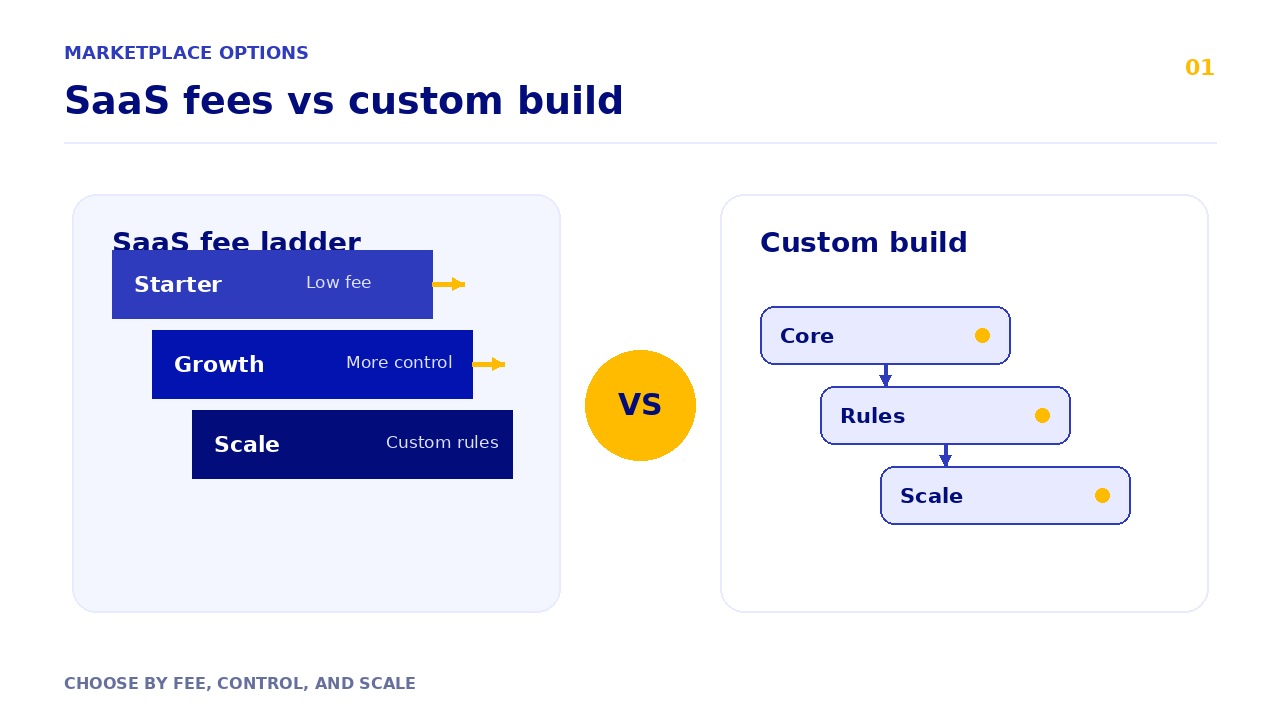
How it shows up: your subscription tier climbs as you grow, transaction based fees take a slice of every order, and the total is rising faster than your margin. You have done the math and the platform now costs more than it saves.
What fits: an owned platform is the structural fix, build cost is largely fixed, so your unit economics improve as volume rises rather than degrade. That means either a commerce framework (Medusa.js, and similar open source foundations) or a fully custom build. Self hosted open source marketplace software also solves the fee problem, though you inherit maintenance either way.
What does not fit: switching to another fee based SaaS. Among Sharetribe alternatives, that move relocates the ceiling rather than removing it, the same crossover arrives later at a different vendor.
Reality check: owning has real recurring costs, infrastructure and a standing engineering function. The comparison that matters is stacked fees versus build plus run over two to three years at your projected volume.
A useful gut check for this ceiling: pull your last six months of platform invoices and plot fees as a percentage of gross merchandise value, not as an absolute number. If that percentage is flat as volume grows, you are looking at a fixed cost, annoying but not urgent. If it is climbing, you have found the specific shape of ceiling that most Sharetribe alternatives searches are actually chasing, and the fix is architectural, not another discount tier.
Ceiling 2 – Customization: The platform decides what you can build

How it shows up: the feature your marketplace needs is not possible, or requires developer work inside constraints someone else set. Your roadmap has items marked “can’t.” The workaround pile grows every quarter.
What fits: this is the ceiling that most clearly justifies an owned platform among Sharetribe alternatives. A commerce framework gives you solved fundamentals (catalog, cart, orders, payments integration) with your own code on top, you add vendor logic, commission rules, and workflows shaped to your model rather than around it. Marketplace starters built on those frameworks can shorten the path if your model is close to standard B2C; the more unusual your model, the less a starter’s assumptions help.
What does not fit: a “more flexible” SaaS. Flexibility inside someone else’s product is still a bounded box; you have already learned what that feels like.
Ceiling 3 – model fit: Your marketplace is not the shape the platform assumes

How it shows up: the platform is fine, but your business is not a standard two sided B2C marketplace. You are running B2B flows with quotes and credit terms, a services model with complex scheduling, a rental model with deposits and returns, or multi country operations with per market payouts and tax logic.
What fits: either a specialist platform built for your specific vertical (worth checking, vertical SaaS exists for bookings, rentals, and B2B procurement), or a custom build. The vertical option is underrated: if a platform exists that assumes your model natively, it beats building your own for years.
What does not fit: general purpose marketplace SaaS of any brand. If your shape does not match the category’s assumptions, changing vendors within the category changes little, which is the trap most Sharetribe alternatives lists never mention.
Model mismatch is the ceiling founders most often misdiagnose as a features problem. If every workaround you have built involves manually re-entering a quote, chasing a credit approval by email, or reconciling a payout schedule your platform cannot express, the issue is not one missing checkbox in settings, it is that the platform’s entire data model assumes a shape your business does not have. No amount of searching through Sharetribe alternatives listicles fixes a model mismatch; only a platform (owned or vertical) built for that shape does.
The dimension the lists leave out: what migrating would actually cost you

It is worth naming the failure mode too, because it shows up in almost every Sharetribe alternatives search: teams treat the category, not the ceiling, as the decision. They compare Sharetribe against three other SaaS platforms on a feature grid, pick the one with the most checkmarks, and migrate straight into the same fee curve or the same customization wall a year later, just under a different logo. The ceiling question has to come before the vendor question, every time.
Every alternative on every list looks equally reachable in a feature table. They are not. Before shortlisting, price the move itself.
Data portability: Sharetribe provides real data access, its Integration API exposes users, listings, transactions, and messages, and Console exports core data as CSV. That is genuinely better than platforms that trap you, and it means the constraint on your migration is the destination’s data model, not the source.
Vendor re-onboarding: passwords never migrate (no platform exports hashes), and payment accounts may need re-verification depending on the destination. Every step you ask sellers to take is churn risk, the single biggest hazard in marketplace migration.
Search equity: your rankings live on your current URLs. A destination that forces a different URL structure means a full redirect map, doable, but budget it.
Time to parity: how long until the new platform does everything the old one did? On SaaS to SaaS, weeks. On a custom build, months. That gap is a real cost, and it belongs in every honest comparison of Sharetribe alternatives, not just the feature grid.
One more variable worth pricing honestly: your team’s appetite for owning infrastructure. Among Sharetribe alternatives, the owned-platform route (framework or custom) trades a monthly SaaS bill for a standing engineering function, hosting, monitoring, deployments, and someone who answers when something breaks at 2am. That is not a reason to avoid it if your ceiling is real, but it is a cost that belongs in the same spreadsheet as the fees you are trying to escape.
A quick way to narrow the list
| If your ceiling is… | Look at… | Avoid |
|---|---|---|
| Fees scaling with volume | Owned platform (framework or custom); self-hosted open source | Another fee-based SaaS |
| Features you can’t build | Commerce framework + custom vendor logic | “More flexible” SaaS |
| Model mismatch (B2B, rentals, services, multi-market) | Vertical specialist SaaS, or custom | General-purpose marketplace SaaS |
| Nothing structural, just friction | Optimize where you are | Migrating at all |
That last row is real. If your honest read is that the pain is annoying but flat, and your model still fits, migration is an expensive answer to a cheap problem. the signals that distinguish structural ceilings from temporary friction help you tell the two apart before you start comparing Sharetribe alternatives at all.
Where we fit, plainly
We build custom marketplaces, mostly on Medusa.js, for founders whose model has outgrown what a rented platform can express. That is our bias, stated up front. It also means we say “stay where you are” to a fair number of people who ask us, because a platform you are not yet outgrowing is the cheapest one available.
If your ceiling is real and the destination is an owned platform, discuss your project with us, we will map your model against what you would have to build, and tell you honestly if a lighter option would serve you better. And if the destination is Medusa specifically, a decision-level guide to that route is the next thing worth reading.
FAQ
What are the best alternatives to Sharetribe?
It depends on which limit you hit. For fee economics: an owned platform (commerce framework or custom build) or self hosted open source. For features you can’t build: a framework based custom platform. For a model mismatch: a vertical specialist platform or custom. There is no single best answer among Sharetribe alternatives, only the right one for the specific ceiling.
Can you export your data from Sharetribe?
Yes, Sharetribe’s Integration API provides access to users, listings, transactions, and messages, and Console exports core data as CSV. Data portability is generally not the constraint; the destination’s data model and vendor re-onboarding are.
Should I move from Sharetribe to a custom marketplace?
Only if the ceiling is structural: fees outpacing margin, features blocked by platform design, or a model the platform can’t express, and only after validating demand. If the pain is flat rather than scaling, optimizing where you are is usually the better economics.
Is Sharetribe good for scaling marketplaces?
It is built for launching and validating quickly, which it does well. Scaling exposes its trade-offs: fee structures that grow with volume, and customization bounded by platform design. Whether those become blockers depends on your margins and how standard your model is.