


WooCommerce and Wix are two of the most common starting points for a marketplace, and for good reason: both let a founder ship a working multi-vendor store in a week without writing a line of backend code. The trouble shows up later. A WooCommerce or Wix marketplace that felt fast and flexible at launch can, twelve or eighteen months in, start fighting you on the exact things that matter most: page speed under real vendor and order volume, how much a vendor can actually do without your team stepping in, and how much of your roadmap gets spent patching plugins instead of building features. This isn’t a verdict that a WooCommerce or Wix marketplace is a bad choice to start with. It’s a map of where each platform’s ceiling actually sits, so you can tell a fixable friction point apart from a structural limit worth migrating away from.
Where a WooCommerce marketplace hits its ceiling

The plugin stack becomes the product
WooCommerce itself is just a store. Multi-vendor behavior on a WooCommerce marketplace comes from a third-party plugin (commonly Dokan or WC Vendors) layered on top of a dozen other plugins handling shipping rules, tax calculation, search, and vendor payouts. Each plugin update is a small risk to compatibility with every other plugin in the stack, and diagnosing “which plugin broke checkout this time” becomes a recurring line item on the team’s calendar instead of a one-off. None of this is a knock on any specific plugin; it’s what happens when a single-vendor store’s architecture gets extended, rather than rebuilt, into a multi-vendor one.
Performance degrades as vendor and catalog counts grow
WordPress and WooCommerce’s underlying database schema wasn’t designed with tens of thousands of SKUs across hundreds of vendors in mind. Queries that feel instant with 500 products from a single seller get noticeably slower once a WooCommerce marketplace is running 50,000 products from 300 vendors, particularly on category pages, filtered search, and the vendor-side order dashboard. Standard fixes exist (object caching, a dedicated search index, database tuning) but each one is itself a small engineering project, not a plugin toggle.
Vendor experience stays thin
On a typical WooCommerce or Wix marketplace, vendor dashboards bundled with marketplace plugins cover the basics: list a product, see incoming orders, view a payout total. They rarely stretch to what sellers actually ask for on a maturing WooCommerce marketplace: bulk CSV import and export, seller-managed discount codes, multi-warehouse inventory, or payout reporting that reconciles cleanly with their own books. Building those in means commissioning custom development on top of a plugin that was never architected to be extended that far, which tends to be more fragile and more expensive than building the same feature on a platform designed for it.
Operational burden shifts onto your team
Hosting, security patching, plugin license renewals, backups, and uptime monitoring all become your team’s responsibility on a self-hosted WooCommerce marketplace, in a way they simply aren’t on a managed SaaS platform. That’s a fair trade when the team wants the control it buys. It’s a real cost when the team would rather spend that time on product.
Where Wix hits a harder wall

A Wix marketplace runs into limits sooner, and they’re less fixable. Wix is a closed, fully hosted platform: there’s no server access, no ability to install a true multi-vendor backend, and no path to swap in a different database or search layer when the built-in one isn’t enough. The marketplace-style apps available in Wix’s app market are built for a handful of sellers listing a modest catalog, not for the real vendor onboarding, tiered commission splitting, or payout automation a growing WooCommerce or Wix marketplace eventually needs. Where a WooCommerce marketplace can usually be pushed further with enough engineering effort, a Wix marketplace tends to hit its ceiling and simply stop, because the platform itself doesn’t expose the hooks needed to go further.
Four signals you’ve outgrown WooCommerce or Wix as a marketplace
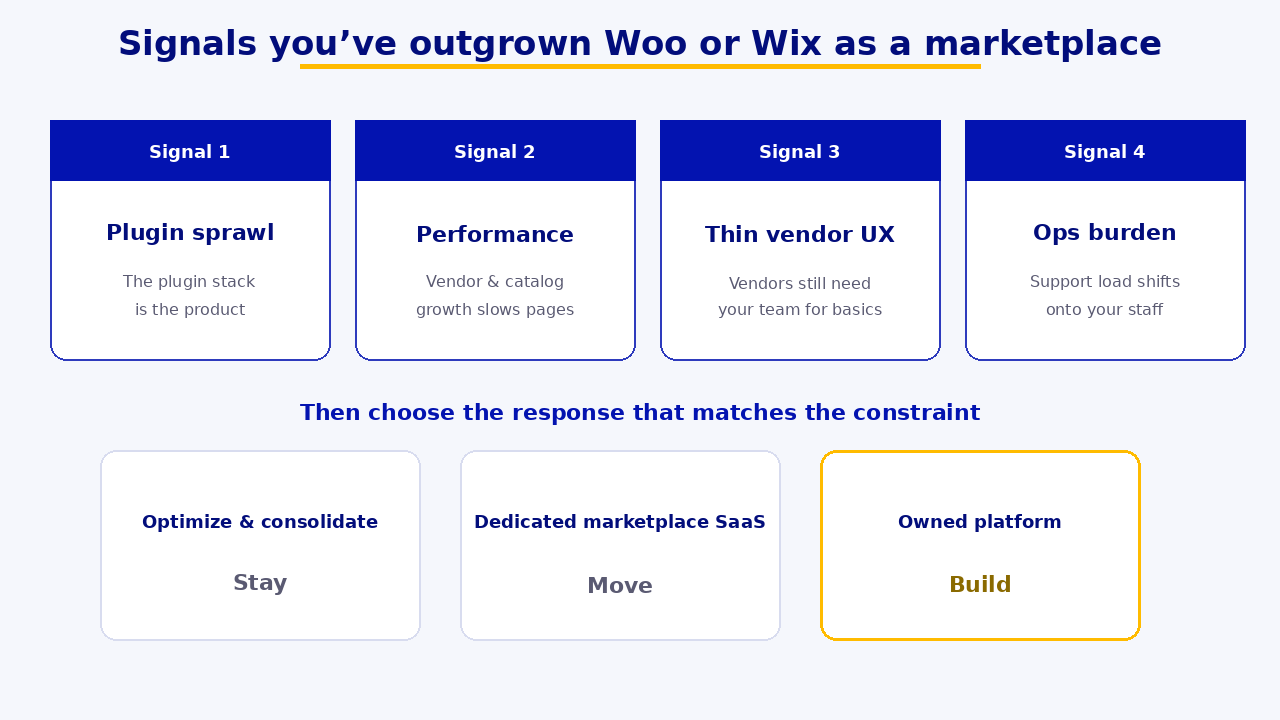
- Vendors regularly ask for features (bulk import, custom pricing rules, their own promotions) that require a developer to hand-build rather than a setting to flip.
- Page load times climb as your catalog and vendor count grow, even after caching and image optimization have already been tried.
- Your team spends more sprint time on plugin maintenance and compatibility fixes than on anything from the actual product roadmap.
- Commission and payout logic needs to branch, such as per-vendor rates or tiered splits, beyond what the plugin or app natively supports.
One of these on its own is usually a fixable friction point for a WooCommerce or Wix marketplace. Two or more happening at the same time is a reasonably strong signal that you’ve outgrown WooCommerce or Wix as a marketplace platform, and that the next sprint of engineering time is better spent on a migration than another workaround.
What to do when you outgrow WooCommerce or Wix as a marketplace

Option 1: consolidate and optimize what you have
If the pain is mostly performance and plugin sprawl rather than missing functionality, consolidating down to a smaller, better-maintained plugin stack and investing in caching and search infrastructure can buy meaningful runway before a full migration is warranted. This is the right call when the core marketplace mechanics (vendor onboarding, commission, payouts) are still working, and the complaint is really about speed and stability.
Option 2: move to a dedicated marketplace SaaS
A dedicated marketplace platform trades some flexibility for a purpose-built vendor experience, commission engine, and payout system out of the box, without the plugin-compatibility overhead of WooCommerce. We’ve covered the signs it’s time to make this specific move in more detail in outgrowing your no-code marketplace, and where a dedicated SaaS platform itself eventually hits its own ceiling in a separate piece on Sharetribe alternatives.
Option 3: build on an owned platform
When the roadmap calls for deep customization, such as branching commission logic, a genuinely custom vendor experience, or integration with existing ERP or fulfillment systems, an owned, headless platform is usually the better long-term fit than either WooCommerce or a dedicated SaaS. Medusa.js is a common choice here for teams moving off a WooCommerce or Wix marketplace; is Medusa.js right for your marketplace? A decision framework walks through when that trade-off actually pays off, and Medusa.js vs Shopify for marketplaces compares it against the other common owned-platform starting point.
It helps to be specific about what “outgrowing” means for a WooCommerce or Wix marketplace, because the term gets used loosely. It doesn’t mean the platform is broken, and it doesn’t mean the original decision to start there was wrong. Most marketplaces should start on WooCommerce, Wix, or a similarly fast platform, because validating demand with real vendors and real orders matters more in month one than architectural purity. Outgrowing the platform means the constraints that used to be background noise, plugin updates, page speed, a vendor asking for a feature the dashboard can’t do, have started showing up every sprint instead of once a quarter. That shift in frequency is the actual signal, more than any single incident.
Cost is usually the first question once a team decides to move off a WooCommerce or Wix marketplace, and it’s worth separating two different costs: the cost of the migration itself, and the ongoing cost of whatever replaces it. A dedicated marketplace SaaS tends to have a lower migration cost and a predictable subscription cost, which is why it’s the more common next step from WooCommerce or Wix. An owned, headless platform has a higher upfront build cost but no platform ceiling to hit again later, which is why teams with a genuinely custom roadmap tend to land there eventually even if they pass through a SaaS platform first.
How to decide without over-building
The mistake to avoid in either direction is moving too early or too late. Migrating off WooCommerce or Wix before you’ve actually hit a structural limit means paying for flexibility you don’t need yet. Waiting too long means the migration itself gets harder, because more vendors, more historical order data, and more custom workarounds have to be carried across. The four signals above are a reasonable checkpoint: if your team can point to two or more of them happening this quarter, it’s worth scoping what a move off WooCommerce or Wix as a marketplace platform would actually cost, even if the decision is to wait another two quarters.
Frequently asked questions
Can I just keep adding plugins to fix a WooCommerce marketplace?
Up to a point on a WooCommerce or Wix marketplace. Each additional plugin adds another compatibility surface, so the fix eventually becomes the problem: more update conflicts, more support tickets, more time spent diagnosing which plugin caused a checkout bug. Consolidating the stack usually helps more than adding to it.
How do I know if it’s WooCommerce or Wix, or just my own setup, that’s the problem?
Check whether the limitation is something a configuration change or better hosting could fix, or something the platform itself doesn’t support at all (like Wix’s lack of server access, or WooCommerce’s plugin-dependent commission logic). If no amount of configuration solves it, that’s a platform ceiling, not a setup problem.
Is Wix ever a fine long-term choice for a marketplace?
For a very small, low-complexity marketplace (a handful of vendors, simple flat commission, no need for custom vendor tooling), Wix’s built-in apps can hold up for a while. Once vendor count, catalog size, or commission complexity grows, its closed architecture becomes the limiting factor.
What does migrating off a WooCommerce or Wix marketplace actually involve?
In practice: exporting product, vendor, and order history; mapping commission and payout logic to the new platform; rebuilding vendor onboarding flows; and running both platforms in parallel briefly to validate data before cutting traffic over. Search rankings and existing URLs also need a redirect plan so the migration doesn’t cost SEO equity.