


Arcadier and CS-Cart are two of the more capable dedicated marketplace SaaS platforms, which is exactly why teams that outgrow a no-code tool tend to land there next. Both give you a real vendor onboarding flow, commission handling, and a multi-vendor storefront without a from-scratch build. The catch is that “dedicated marketplace SaaS” still means SaaS: a shared platform with its own boundaries. For most marketplaces those boundaries never matter. For a growing subset, usually the ones scaling fastest, they start to. This is a practical look at where Arcadier and CS-Cart alternatives become worth evaluating, and how to tell a temporary friction point from a structural one.
Why a purpose-built marketplace SaaS still has a ceiling

Arcadier and CS-Cart were built to serve a broad range of marketplaces well, not any single marketplace perfectly. That’s a reasonable trade-off for most teams in year one: getting to market with proven vendor and commission tooling beats a slower, fully custom build. The ceiling shows up later, once a marketplace’s specific commission structure, transaction shape, or integration needs start to diverge from what the platform was generalized to support. At that point, evaluating Arcadier and CS-Cart alternatives isn’t a sign anything was chosen wrong originally, it’s the normal next step for a marketplace that’s grown past what any one SaaS platform generalizes for.
Where the distance from the platform actually shows up

Commission and payout logic
Both platforms support standard percentage-based commission out of the box. Where teams start looking at Arcadier and CS-Cart alternatives is tiered commission by vendor category, volume-based rate changes, or commission that needs to be split three or more ways (platform, vendor, referral partner) rather than the standard two-way split.
Transaction shape
A straightforward buy-now marketplace fits either platform comfortably. Marketplaces with a less standard transaction shape, recurring/subscription orders between buyer and vendor, quote-then-invoice B2B flows, or bookings with deposits, tend to be where teams first feel the platform pushing back.
Regional and multi-market operation
Running in a single country with one currency and one tax regime is well supported. Expanding into a second market with a different payment gateway, currency, or tax treatment is where the generalized platform logic starts requiring workarounds rather than configuration.
Data and integration depth
Both platforms expose an API, but neither was built assuming deep, real-time integration with an external ERP, WMS, or a custom analytics pipeline. Syncing inventory or order data a few times a day usually works fine; syncing it in real time, or building a two-way sync with a system of record outside the platform, tends to be the point where API rate limits and data-shape mismatches become a daily annoyance instead of an edge case.
Customization boundaries
Theme and storefront customization goes further on some plans than others, but the vendor dashboard, checkout flow, and admin panel are largely fixed by the platform. If the roadmap calls for a materially different vendor experience or checkout flow than what either platform ships, that’s a customization boundary rather than a configuration gap.
It’s worth naming a pattern that shows up often when teams start researching Arcadier and CS-Cart alternatives: the search usually starts as “which platform is better” and ends as “no dedicated SaaS platform generalizes for our specific case.” That reframe matters, because it changes the evaluation from a feature-by-feature comparison of Arcadier and CS-Cart alternatives into a question of whether the marketplace has actually outgrown the entire SaaS category, not just one vendor within it.
How teams typically discover they need Arcadier and CS-Cart alternatives

In practice, the trigger is rarely a single dramatic failure. It’s usually a support ticket that comes back “not currently supported,” repeated two or three times across a quarter for different requests: a commission tier the platform doesn’t model, a regional payment method the checkout flow doesn’t support, a report the admin panel can’t generate without a manual export. Each one alone is a minor inconvenience. Three or four of them in the same quarter is the actual signal to start evaluating Arcadier and CS-Cart alternatives seriously, rather than filing another support ticket and waiting.
It also helps to involve whoever owns vendor relationships early in that evaluation, not just engineering. Vendors on Arcadier or CS-Cart have gotten used to a specific dashboard and payout cadence; whatever alternative gets chosen needs a migration plan for them too, not just for the underlying data.
The temporary-vs-structural test
Before scoping a migration, it’s worth separating friction that’s temporary from friction that’s structural. A temporary friction point has a workaround: a manual export/import, a support ticket to the platform vendor, a slightly awkward but functional process. A structural limit has no workaround, only a decision to build around it permanently or move off the platform. If a team has been living with a workaround for over a quarter and the workaround itself is starting to need its own maintenance, that’s usually a structural limit wearing a temporary-looking disguise.
Three realistic options once you hit the ceiling
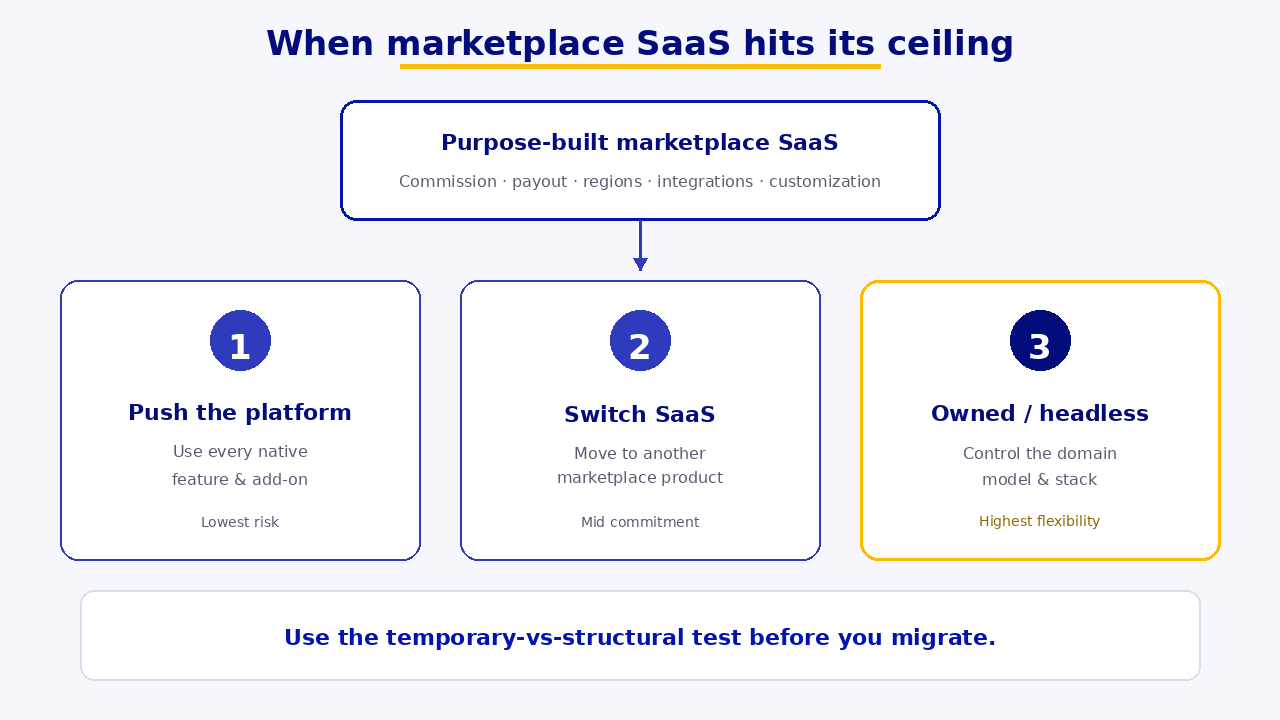
Option 1: push the platform’s limits further
Custom development on top of Arcadier or CS-Cart’s API, combined with process workarounds for what the API doesn’t expose, can extend a platform’s useful life meaningfully. This is the right first move when only one or two of the distance points above apply, rather than most of them at once.
Option 2: move to another dedicated marketplace platform
Sometimes the fix is simpler than leaving the SaaS category entirely: a different dedicated marketplace platform may generalize differently in a way that happens to fit your specific commission or transaction shape better. This is worth evaluating before assuming a full custom build is required, particularly if the gap is narrow (for example, commission logic alone).
Option 3: move to an owned, headless platform
When multiple distance points apply at once, commission complexity, non-standard transaction shape, and deep integration needs together, an owned platform built on something like Medusa.js tends to be the more durable fix, because it removes the platform’s generalization boundary entirely rather than working around it. Building a marketplace with Medusa.js covers what that build actually involves before committing to it, and if the marketplace specifically operates in Singapore, the compliance and payment-rail considerations are covered in how to build a marketplace in Singapore.
Arcadier and CS-Cart alternatives at a glance
This is a directional comparison, not a pricing sheet, confirm current plans and licensing terms directly with each vendor before deciding.
| Dimension | Dedicated SaaS (Arcadier / CS-Cart) | Owned platform (e.g. Medusa.js) |
|---|---|---|
| Time to launch | Fast, mostly configuration | Slower, real build required |
| Commission logic | Standard models, limited branching | Fully custom, any logic |
| Vendor dashboard | Fixed, platform-defined | Custom to your vendors |
| Integration depth | API-limited, batch-friendly | Deep, real-time by design |
| Ongoing cost model | Predictable subscription | Engineering and hosting cost |
| Best fit | Standard marketplace mechanics | Non-standard, complex mechanics |
The right read of this table isn’t “owned platforms are better.” It’s that a dedicated SaaS optimizes for getting a standard marketplace running fast, and an owned platform optimizes for fitting a specific, non-standard marketplace exactly. Most marketplaces genuinely fit the standard case for years. The point of tracking the distance signals above is knowing which side of that line your marketplace is actually on, rather than assuming Arcadier and CS-Cart alternatives are always the next step just because the platform occasionally says no.
A note on migration cost
Moving off Arcadier or CS-Cart carries a real cost, most of it in data migration (vendor records, historical orders, payout history) and in rebuilding whatever commission and workflow logic had been configured on the old platform. Weigh that cost against the ongoing cost of the workaround you’d otherwise keep maintaining. For marketplaces evaluating this exact trade-off from the no-code side rather than the SaaS side, the broader signals of outgrowing a platform are covered in our piece on outgrowing a no-code marketplace.
One more practical filter before committing time to a full evaluation: check whether the limitation you’ve hit is specific to your marketplace’s vendors and transaction volume, or whether it would also constrain a marketplace roughly your size in general. Vendor-specific asks (a single seller wanting an unusual payout schedule, for instance) are often better solved with a manual process than a platform migration. General constraints that would trip up any marketplace at your scale are the ones worth taking to a full Arcadier and CS-Cart alternatives evaluation.
Frequently asked questions
Are Arcadier and CS-Cart interchangeable alternatives to each other?
Not exactly. Both are dedicated marketplace SaaS platforms, but they generalize differently around commission logic, storefront customization, and pricing structure, so switching between them is worth evaluating specifically for whichever limit you’ve hit, rather than assumed to solve it.
How do I know if I need Arcadier and CS-Cart alternatives, or just a plan upgrade?
Check the platform’s own higher-tier plans first. If the limit you’re hitting (commission complexity, integration depth, transaction shape) isn’t solved by any available plan, that’s a platform ceiling rather than a pricing one, and alternatives are worth evaluating.
Is a full custom build always the right alternative?
No. A full owned build makes sense when several distance points apply at once. If the gap is narrow, such as commission logic alone, evaluating a different dedicated SaaS platform first is usually cheaper and faster.
What should I confirm before committing to a specific alternative platform?
Licensing and pricing terms directly with the vendor, since these change and shouldn’t be assumed from older reviews; API rate limits against your actual integration needs; and a realistic data migration plan for vendor, order, and payout history.