


Ecommerce web development Singapore: what you are actually commissioning
A Singapore retailer runs a double-points campaign with PayNow instant cashback. Traffic spikes at 9 PM, the checkout crashes, and the PayNow QR flow fails because the development team made wrong assumptions about how real-time gateway callbacks work. This is the kind of problem that ecommerce web development in Singapore either prevents or causes, depending on who builds the store.
Commissioning ecommerce website development in Singapore means engaging a development company to deliver a full sales-ready online store built for local customers. That includes local payment rails (PayNow, cards, wallets), correct GST treatment at the prevailing rate of 9%, compliance with the Personal Data Protection Act (PDPA), inventory and fulfilment tuned to Singapore logistics, and admin tooling suited to local operations. You are choosing an approach (hosted vs custom), a technical stack, a partner’s capability, and scope (catalogue size, promotions, B2B or B2C). You are not just buying web design or a theme.
What does a “good” ecommerce site mean for a Singapore brand?

A good ecommerce store produces predictable revenue, operates without frequent manual fixes, and gives internal teams the tools to run operations without calling the development team daily. It is not only a beautiful homepage.
Core capabilities Singapore brands typically need: a catalogue and search that let shoppers find products quickly; fast performance on mobile (mobile-optimised websites are a baseline expectation); a trustworthy checkout with transparent pricing and native efficient payment methods; accurate handling of GST; and dependable flows for fulfilment and order management.
Once a store passes a few dozen orders per day, back-office workflows matter as much as the storefront. Stock synchronisation with warehouses or retail locations, returns handling, and finance exports to accounting software become daily concerns. Engineering teams see stores fail less from traffic spikes and more from edge cases: a promotion that applies twice on a partial refund, a shipping rule that breaks for bundled products, or a PayNow callback that creates a duplicate order.
Non-negotiables for any successful ecommerce build in Singapore:
- Clear, accurate price display including GST
- Local payment methods (cards, PayNow, digital wallets) available and reliable
- Order-fulfilment routing and inventory sync with local warehouses or retail locations
- Admin tools for promotions, refunds, and variant management
- Monitoring and error-handling for checkout, gateway callbacks, and external dependencies
Hosted, open-source, headless or custom build: which ecommerce approach fits which Singapore business?
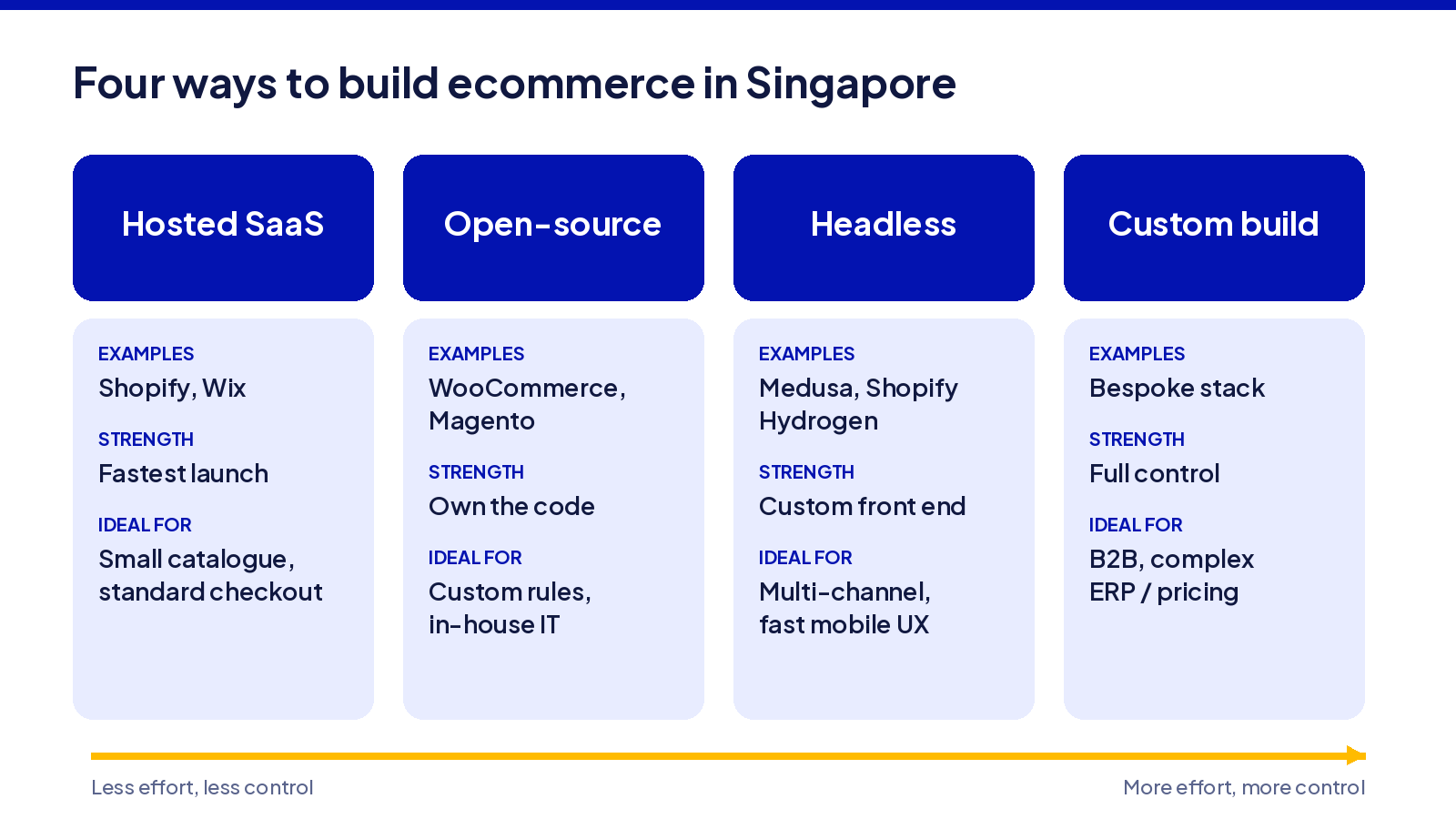
Four broad approaches exist for ecommerce website development. Hosted platforms (Shopify, BigCommerce) are ready-made stores you rent, extended through plugins and apps. Open-source monoliths (WooCommerce, Magento) give you source code to customise but bring maintenance overhead. Headless setups separate the frontend user interface from the backend commerce logic via APIs. Fully custom commerce backends are assembled from components: a Next.js storefront, a commerce engine, a content management system, and custom admin tooling.
A small D2C brand with under 200 SKUs and straightforward promotions can launch an online store quickly on a hosted ecommerce platform. A regional distributor with thousands of SKUs, multi-warehouse inventory and B2B pricing tiers is better served by a headless or composable commerce architecture. A multi-brand retailer running custom promotion rules, loyalty tiers, and credit terms almost always needs custom ecommerce development with its own backend.
What starts simple (“use the hosted coupon engine”) becomes unmaintainable the moment you stack bank promos, newsletter vouchers, loyalty discounts, and minimum-spend thresholds in Singapore’s promotion-heavy retail environment. That is the point where hosted plugin ecosystems break down.
Comparison of ecommerce build approaches for Singapore brands
| Option | What it is good at | Where it breaks | What you give up |
|---|---|---|---|
| Hosted platform (e.g. Shopify) | Speed to launch; large plugin ecosystem; managed hosting services | Complex promotion stacking; custom B2B pricing; multi-warehouse inventory sync | Control over data model; ability to modify core checkout logic; full code ownership |
| Open-source monolith (e.g. WooCommerce, Magento) | Full source code access; large community | Security patching burden; performance under load without dedicated engineering; plugin conflicts on upgrade | Operational simplicity; you take on server management, updates, and security yourself |
| Headless commerce (separate frontend + commerce backend) | Independent frontend and backend releases; multiple storefronts sharing one catalogue; flexibility for mobile and web platforms | Requires a confident development team; no visual admin “preview”; higher initial build effort | Out-of-the-box admin experience; the website builder simplicity of hosted platforms |
| Custom commerce backend (e.g. Next.js + Medusa.js + custom admin) | Full control over promotion logic, B2B flows, multi-currency, regional expansion | Longer initial timeline; requires defined scope and experienced engineers | Speed of first launch; pre-built app marketplace; plug-and-play integrations |
Singapore-specific requirements your ecommerce build must handle from day one
Local tax, payments, and data protection rules shape architecture decisions as much as any creative web design choice. No platform choice removes the need to handle these correctly. Businesses selling online need to be registered with the Accounting and Corporate Regulatory Authority (ACRA). Enterprise Singapore’s Technical Reference 76 (TR 76), updated in September 2025, sets out recommended practices for e-commerce, including accurate display of discounts and promotions, easy access to merchant terms and anti-scam measures for e-marketplaces.
These requirements must be built into order flows, checkout UI, and admin dashboards from day one. In production, it is very hard to retrofit correct GST, tax invoices, and structured customer account details after a year of trading on a store that only stored gross prices with no separate tax lines.
Payments and settlement: PayNow, cards, wallets and reconciliation
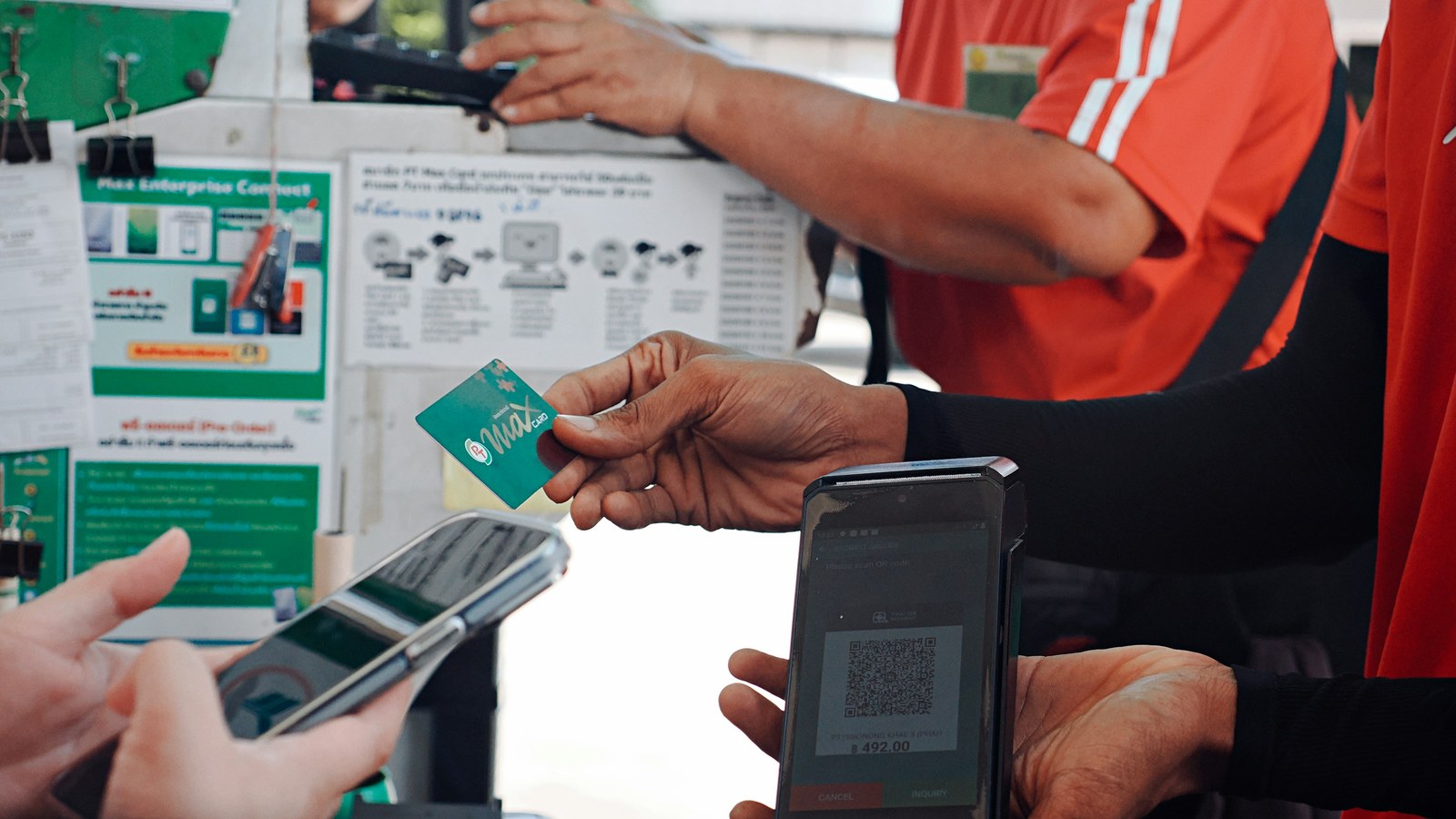
Singaporean consumers expect fast and frictionless payment options during checkout. Typical methods include local credit and debit cards (Visa, Mastercard, Amex), PayNow QR, wallets like GrabPay and PayLah!, and occasional bank transfers for B2B.
The build needs to handle authorisations, failed payments, refunds, and reconciliation of gateway payouts with internal order records for finance teams. On the technical side, payment gateway webhooks must be processed reliably: confirming payment, handling retries, and ensuring idempotent operations so a retry never creates a duplicate order.
In production, more time is spent debugging edge cases between gateway callbacks and accounting or ERP exports than on the initial payment gateway integration itself.
GST at 9% and invoicing rules
Singapore’s GST moved from 8% to 9% on 1 January 2024.
Common patterns: many Singapore ecommerce websites use tax-inclusive display prices so consumers see the total, but invoice lines must still show GST separately for accounting. B2B customers need their company name and Unique Entity Number (UEN) on tax invoices. Overseas supplies may be zero-rated or excluded depending on classification.
The architectural implication: tax rates must be configurable by region, product type, and supply type. Hard-coding a rate inside templates creates a time bomb. A store that keeps only gross prices with GST baked in has to re-price its entire catalogue manually when the rate changes, because it has no tax-exclusive base prices to recalculate from.
PDPA, consent and customer data handling
Businesses in Singapore must comply with the Personal Data Protection Act (PDPA), which governs the collection, use, and disclosure of personal data. E-commerce websites must provide transparent policies regarding terms of service and privacy. Readers should confirm specifics with legal or compliance advisers.
Technical implications: consent flags for marketing emails, audit trails recording who accessed what data, secure storage of addresses and order history, and clear flows for account deletion. Engineers treat logging and admin-access controls as part of PDPA thinking, not just encryption.
A subtle risk: a misconfigured payment plugin can log full cardholder data (PAN) in application logs, which then become exposed through a non-secured staging server. To protect customer data, access to production logs and admin panels needs to be restricted and audited from the start.
B2B needs: quotes, credit terms and corporate invoicing
Half of B2B sales in Singapore are conducted on credit terms, and most payments fall due within two months, according to Atradius.
Typical Singapore B2B ecommerce flows include quotations before orders, purchase orders, credit terms, and consolidated monthly invoicing statements. Features a B2B ecommerce build may need: company accounts with multiple users, approval workflows for large orders, negotiated price lists per business account, credit limit enforcement, and exportable statements for finance teams.
Many of these requirements cannot be added cleanly with plugins on other ecommerce platforms and often drive the choice of headless or custom backends. “Simple” tiered pricing and credit limits become unmanageable within weeks if they live in a spreadsheet rather than a structured commerce system.
What really drives timeline and budget in a Singapore ecommerce build?
The raw ecommerce platform choice matters, but scope, integrations, and content readiness usually dominate schedule and cost. No specific prices follow; only the drivers a founder or ecommerce lead can use to anchor agency quotes and compare proposals.
Catalogue size and merchandising rules
A few dozen SKUs with simple options behave very differently from tens of thousands of SKUs with variants, bundles, and pre-orders. The complexity lies in variant logic, configurable products, regional catalogues, and merchandising rules like auto-filling collections based on attributes.
Synchronising the catalogue and inventory with external systems (POS, warehouse management) adds integration complexity. A mismatch between the ecommerce store and the warehouse system discovered on launch day is far more expensive than testing sync flows in week three.
Promotions, discounts and loyalty schemes
Singapore brands often run overlapping promotions: bank card discounts, newsletter vouchers, platform-wide sales, member-only pricing. Each extra rule (“not valid with other promos”, minimum spend thresholds, brand exclusions) multiplies the development process and testing effort.
Engineers need time to encode and test edge cases around cart thresholds and refunds, which often surprises non-technical stakeholders. A promotion that correctly excludes one category but then breaks when a partially refunded order crosses below the minimum spend is the kind of bug that appears only in production, after launch.
Integrations: ERP, accounting, logistics and marketplaces
Common systems a Singapore ecommerce site connects to include ERP or inventory management, accounting (e.g. Xero), last-mile logistics, and regional marketplaces (Shopee, Lazada). Singapore’s compact size makes same-day and next-day delivery a common expectation, and many brands use third-party logistics (3PL) providers rather than running their own fleet.
Integration complexity depends on data volume, API quality, and how close to real-time the sync must be. A “simple ERP integration” can consume more weeks than building the storefront if the ERP API is undocumented or its responses are inconsistent.
Content, UX and internal approvals
Delays often come not from the software development but from content: product photos, copy, legal policy texts, translations, brand approvals. If group-level stakeholders need to sign off on ecommerce website design, plan for multiple review cycles on designs, copy, and flows.
Engineers can build faster than content can be produced. Early alignment on content ownership and timelines reduces idle time and keeps the website development process on track.
Non-functional needs: performance, availability and monitoring
Local consumer expectations in Singapore include mobile-optimised design and fast load times.
Meeting performance targets consistently requires CDN configuration, caching, and observability tools. Cloud platforms enable ecommerce websites to scale with traffic fluctuations during peak campaigns like 11.11 sales. A common failure mode: discovering during a major campaign that product search is the real bottleneck, not page rendering, because search queries were never load-tested separately.
Questions to ask any ecommerce development partner before you sign
These are not trick questions. Whether you are comparing an ecommerce website development company, a development company in Singapore or an offshore team, the same questions apply. They surface how a development team thinks about risk, trade-offs, and ownership. Pay attention to how clearly engineers explain failure modes (for example, “if a payment gateway webhook is dropped, what happens to the order?”) and how they describe rollbacks.
Platform and architecture
- Which approach are you proposing (hosted, open-source, headless, custom) and why does it suit our catalogue size, promotions complexity, and B2B vs B2C mix?
- What happens if we outgrow this in three years? Can we migrate parts, or does everything need rebuilding?
- Which parts of the system will we own: code, infrastructure accounts, data, documentation?
Seek answers that reference your specific business needs, not generic platform slogans.
Integrations and data flows
- Which external systems need to exchange data and how often (ERP, logistics, marketplaces)?
- What happens if one system is offline? What retry strategies, queues, and monitoring are in place?
- How will we reconcile differences between systems (e.g. orders in the gateway vs records exported to accounting)?
A serious development company will talk about retry strategies, queues, and monitoring, not just “we integrate with X”.
Security, PDPA and operational access
- How will customer data be stored and accessed? Who on your team can see production data?
- How do you log and monitor access and changes (e.g. who modified discounts or prices)?
- What compliance steps have you taken regarding PDPA?
Verify regulatory interpretations with your legal or compliance team, but the development agency should demonstrate awareness of PDPA basics without prompting.
Ownership, code, and handover
- Who owns the code, infrastructure accounts, and documentation from day one?
- What is included in handover? Are there staging environments, architecture diagrams, and setup scripts?
- How easy is it for another development team to take over? Ask for examples of past handovers.
A custom website built without documentation and clear ownership boundaries becomes expensive to maintain when teams change.
Support, SLAs and failure handling
- What post launch support is included (bug fixes, patches, website maintenance)?
- How quickly do you respond if checkout fails in production?
- How do you manage rollbacks if a deployment causes errors? Do you use feature toggles, staging, blue-green deploys?
Listen for concrete practices: incident channels, weekly updates, named contacts. Ongoing support and maintenance services matter more than launch-day celebrations.
What a typical ecommerce project plan looks like for a Singapore brand
A greenfield build for a Singapore retailer or distributor typically runs 8 to 16 weeks across several stages, with weekly demos. This is an example sequence, not a fixed template. Real progress is measured in working features (checkout, promotions, integrations), not just design deliverables. Schedule integration work early; the most painful surprises always appear at the end when sync with external systems is left until the final sprint.
Discovery and definition (1–2 weeks)
Activities: stakeholder interviews about business goals, mapping current operations, listing catalogue rules and promotion types, identifying all external systems and B2B workflows.
Deliverables: a prioritised feature list, initial information architecture, confirmation of non-functional expectations (performance, availability, mobile responsiveness).
Architecture and UX design (2–3 weeks)
Set the technical architecture (platform choice, data model, hosting) alongside UX wireframes for key flows: catalogue browse, product pages, cart, checkout, account. Decisions about how tax display works, how company accounts function, and which ecommerce solutions to use should be settled here, not during the development process.
This phase also covers design and content management system decisions. Whether building on a hosted ecommerce website builder or a custom stack, the information architecture and user interface patterns established here determine how smoothly the build proceeds.
Implementation and integration (4–8 weeks)
Workstreams run in parallel: frontend build, commerce backend setup, payment and logistics integration, content management setup, and admin tools (managing promotions, price lists, invoices, customer management).
Weekly demos should show real flows with staging data: placing orders, issuing refunds, generating invoices. The development team will usually wire basic happy paths first, then layer in edge cases: promotion stacking, partial refunds, multi-address shipping.
Testing, training and soft launch (2–3 weeks)
Functional tests across browsers and devices, performance checks from Singapore and neighbouring countries. Internal user acceptance testing with the client team doing real tasks: creating promotions, editing products, processing refunds, CMS training for content editors.
A soft launch or limited release to a subset of website visitors or loyalty members before a major campaign reduces risk. Higher order volumes only go smoothly if the build has been tested under realistic conditions first.
Go-live, warranty and continuous improvement
Launch involves a content freeze window, a rollback plan, and monitoring dashboards for the first days. A typical warranty period covers defect fixes at no extra charge (often around two months), plus options for ongoing maintenance and continuous improvement.
After launch, the most valuable work is often small usability fixes and admin flow improvements that save staff hours every day.
How we approach complex ecommerce builds for Singapore clients at KVY TECH
KVY TECH is a senior-led boutique software development firm in Ho Chi Minh City. We build production-grade software for Singapore brands, focused on ecommerce, applied AI, and internal systems. Every engineer working on the client’s code sits in one office; clients speak directly to engineers.
Projects start with fixed-scope builds with a defined outcome, weekly written updates, working demos, and a named WhatsApp contact. Our stack preferences for commerce include Next.js storefronts, Medusa.js commerce backends, Payload CMS, PostgreSQL, and Redis. Local payment methods, GST calculation, and multi-currency support are treated as architecture decisions from week one, not as plugins. We have completed 30+ projects for Singapore clients across ecommerce and other domains.
JML Singapore Pte Ltd outgrew off-the-shelf tooling because promotion logic was full of workarounds, regional expansion required real multi-currency support, and local payment methods had to work reliably. We recommended Medusa.js over a faster-to-ship SaaS platform and delivered in 12 weeks a production storefront with custom promotions, multi-currency, local payment integration, and custom admin.
KVY offers D2C ecommerce development services for consumer-facing direct-to-consumer stores and B2B ecommerce development services for the complexity of corporate quotes, credit terms, and account price lists. Promotion logic, caching and GST calculation are tested together before launch, not validated in isolation.
Frequently asked questions about commissioning ecommerce development in Singapore
How long does it take to build a new ecommerce site for a Singapore brand?
A straightforward hosted build with a small catalogue can launch in a few weeks. A headless or custom build with payment gateway integration, ERP connections, and B2B flows typically takes 8 to 16 weeks. Catalogue complexity, integrations, and content readiness change the timeline more than the raw platform choice. Early decisions around promotions, GST handling, and B2B workflows can either compress or extend later stages of the website development process.
Which ecommerce platform is best for Singapore businesses?
There is no single best option. Popular ecommerce platforms in Singapore include Shopify, WooCommerce, and Magento (Adobe Commerce). A hosted ecommerce platform suits a straightforward catalogue with simple promotions and a desire for fast launch. Custom or headless setups fit complex B2B requirements, multi-region expansion, or promotion logic that goes beyond what plugins can maintain. Key considerations: planned regions, promotion complexity, B2B needs (quotes, credit terms), and whether the team has technical expertise or prefers managed services.
How should a Singapore ecommerce site handle GST and overseas orders technically?
Store tax configuration separately from product prices. Record tax lines on each order so invoices reflect the correct GST at the time of purchase. Overseas orders may have different tax rules and shipping expectations; logic should be explicit in thecommerce system rather than hidden in templates. Confirm tax treatments with your accountant, while ensuring the platform supports configuration changes without code rewrites. The prevailing GST rate is 9%, and the system should accommodate future rate changes without catalogue-wide re-pricing.
What ongoing work should we expect after launch?
Typical tasks include security and dependency updates, minor feature changes, performance tuning, and occasional new integrations. Digital marketing and SEO work build on the same foundation, so analytics and tracking belong in scope from launch. Most teams also iterate on promotions, UX, and operations based on real online sales data, which requires a predictable way to request and ship changes. A documented handover and clear access to code and infrastructure make it possible to change development partners later.
Next step
Tell us what you are building. We reply within one working day.