


Most D2C brands don’t need composable commerce. That’s an unusual way to open an article about it, but it’s the honest starting point, because the term has become one of those labels attached to almost any platform change, whether or not the underlying architecture actually shifted. Stripped of the buzzwords, composable commerce means something specific: instead of running your storefront, search, checkout, and content on one bundled platform, you assemble it from separate, best-of-breed services connected through APIs. That’s a real architectural choice with real trade-offs, not a maturity badge you earn by growing revenue. This article explains what it actually means, what it solves, what it costs, and how to tell whether your brand is one of the ones that genuinely needs it, or one of the many that don’t yet.
What composable commerce actually means
A traditional ecommerce platform bundles everything: catalog, cart, checkout, content, and often search, all running inside one system with one release cycle. Composable commerce unbundles those pieces. Product information lives in a dedicated PIM, content lives in a headless CMS, search runs on a dedicated search service, checkout is its own component, and a storefront layer calls each of them through an API and assembles the page a shopper sees. Nothing about that description requires a specific vendor; it’s an architectural pattern, not a product.
What it actually solves
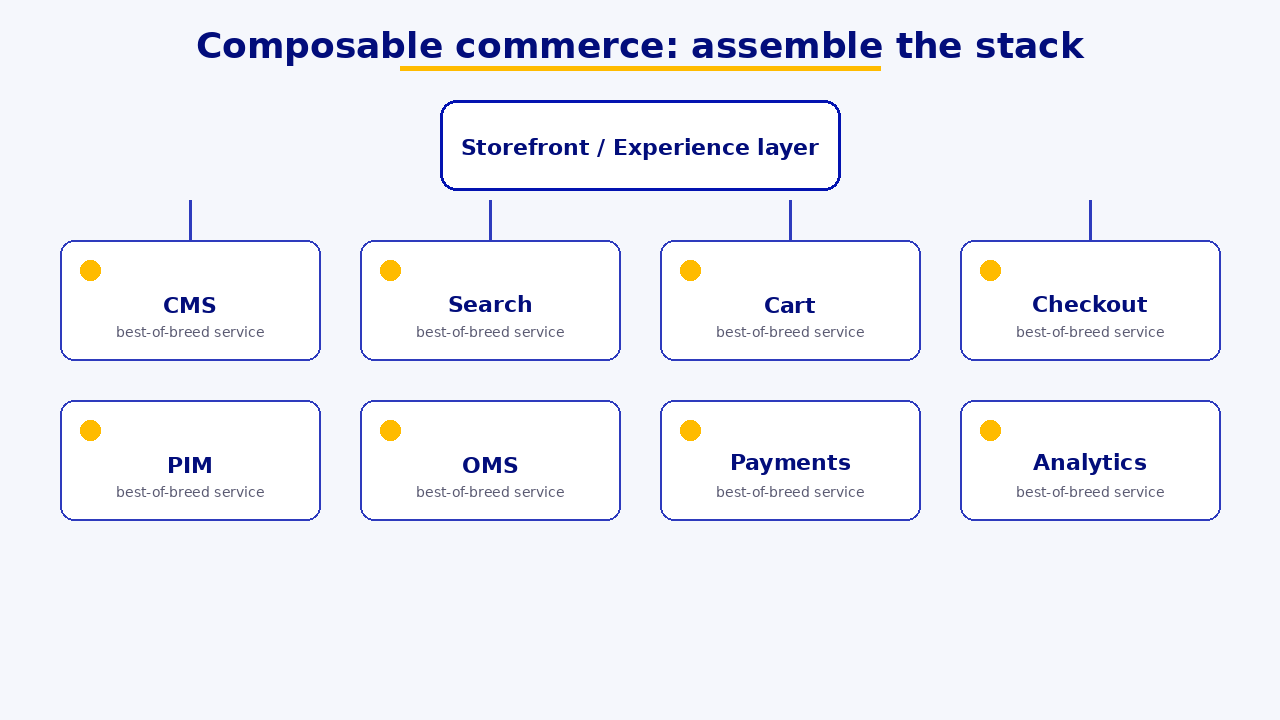
Two terms get used almost interchangeably here, and they’re not quite the same thing. Headless commerce means the front end is decoupled from the back end: you build a custom storefront on top of your platform’s API instead of using its built-in theme layer, but the back end is still one bundled system underneath. Composable commerce goes further. It decouples every major function, not just the front end, into separately swappable services, each with its own vendor, release cycle, and API. The architectural principle behind this approach has a name: MACH (Microservices, API-first, Cloud-native, and Headless), and it’s worth understanding the acronym even if your team never adopts every letter of it literally.
- Your storefront genuinely can’t do something your business needs, and no app or plugin closes the gap: a highly custom configurator, a non-standard subscription model, or a checkout flow your platform’s app ecosystem simply doesn’t support.
- One component of your stack is weak enough to cost you sales, and replacing just that piece, search that can’t handle your catalog, or a CMS your content team fights daily, is worth more than replacing everything else around it.
- Your operations have outgrown the platform’s shape entirely: multiple brands, multiple regions, or a B2B and D2C channel that need different logic than one platform’s data model assumes.
This kind of architecture earns its added complexity when it solves one of three real problems, not as a general growth strategy or a hedge against some vague future need.
If none of those three apply to your brand today, an unbundled architecture is solving a problem you don’t have yet, at a cost you’ll still pay regardless of whether the problem ever shows up.
What it costs, honestly

The parts of this decision that get talked about least in vendor pitches are the ones that matter most once a brand has actually committed to it.
Permanent engineering ownership is the biggest one. A bundled platform ships updates, patches, and new features on its own release cycle, largely without your involvement. An unbundled stack is your team’s responsibility to integrate, monitor, and keep working when any one of its services changes its API. That’s not a one-time migration cost, it’s an ongoing headcount cost for as long as the stack exists, and it doesn’t shrink once the initial build is done.
The total cost is also harder to see upfront. A single platform’s pricing page tells you roughly what it costs. A stack assembled from several vendors spreads that cost across multiple invoices, integration work, and the engineering time to hold it all together, which makes it easy to underestimate until the first year’s bills and internal hours are added up in one place.
Complexity doesn’t disappear when you unbundle, it moves. A bundled platform hides a lot of integration complexity inside itself, invisibly, on the vendor’s side. This approach doesn’t remove that complexity, it moves it onto your own team, in exchange for the flexibility to change any one piece independently of the rest.
And speed trades in the opposite direction from what most brands expect going in. This kind of build is typically slower to launch, since there’s more to design and integrate before day one, in exchange for being faster to change later, once the foundation is actually in place. Brands that expect it to be faster out of the gate are usually disappointed within the first quarter.
Who genuinely needs it

A brand is a reasonable candidate when several of the following are true at once: multiple markets or brands running on meaningfully different logic, a catalog or configuration need no off-the-shelf platform handles well, an internal engineering team able to own ongoing integration work indefinitely, and at least one of the three real problems above, not a vague sense that the brand should be more flexible.
A brand is probably not a candidate yet if the honest answer is closer to: the current platform is annoying but functional, the team doesn’t have spare engineering capacity, or the motivation is mostly that this architecture sounds more modern than what’s already running. For a lot of brands in that middle group, the more accurate move is to stay on their current platform and unbundle just one piece, usually search or content, rather than rebuilding the entire stack at once. That’s a real, common middle path, and it’s often skipped because the topic tends to get pitched as all-or-nothing. If your platform itself is the constraint rather than one component of it, the point where a brand genuinely outgrows Shopify is worth reading before deciding which direction fits.
It’s worth separating this from a related but distinct decision: moving off a multi-tenant SaaS platform entirely onto an owned, custom-built platform. That’s not the same choice as unbundling into a composable stack, and brands sometimes conflate the two because both involve leaving the comfort of a single vendor’s ecosystem. Building on an owned platform gives full control over the entire codebase rather than assembling third-party services, which is a heavier commitment still, and usually only makes sense once a brand has outgrown what even a composable stack of managed vendors can offer.
How to decide without the buzzwords

Three questions cut through most of the noise around this topic. First: is there a specific capability you can name that your current platform cannot support, or is the motivation more general and hard to pin down? Second: does your team have the engineering capacity to own integration work indefinitely, not just during a migration project? Third: would unbundling one component solve the actual problem, or does the limitation genuinely span your whole stack? An unbundled architecture makes sense when the answers point toward a named, structural limitation and a team ready to own the result. It doesn’t make sense as a response to a platform that’s merely imperfect.
Two related questions come up often enough to be worth a direct answer here rather than a full detour. If your brand operates across Southeast Asia, the trade-offs land differently than most of the mostly Western commentary on this topic suggests, largely because of engineering economics and payment fragmentation; that’s covered in how these trade-offs play out for brands operating in Southeast Asia. And if Shopify specifically is the platform you’re evaluating against, the honest version of that comparison, without vendor talking points, is covered separately as well.
The short version
This kind of architecture is a real choice with a real cost: permanent engineering ownership, a total cost that’s harder to see upfront, complexity that moves rather than disappears, and a slower launch in exchange for more flexibility later. It solves three specific problems well: a capability gap, one weak component, or operations that have structurally outgrown a single platform’s shape. Outside of those three, unbundling one piece while staying on your current platform is usually the more honest, and cheaper, move for a D2C brand.
If you’re trying to work out which category your brand actually falls into, that’s a conversation worth having before committing to either direction. Get in touch and we’ll walk through it with you.
Frequently asked questions
What is composable commerce?
Composable commerce is an approach where a brand assembles its storefront from separate, best-of-breed pieces (search, checkout, CMS, product catalog) connected through APIs, instead of running all of those functions inside one bundled platform.
What is the difference between headless and composable commerce?
Headless commerce means the front end is decoupled from the back end so you can build a custom storefront on top of your platform’s API. Composable commerce goes further: it decouples every major function, not just the front end, into separately swappable services.
What does MACH mean?
MACH stands for Microservices, API-first, Cloud-native, and Headless. It’s the architectural principle behind composable commerce: independent services connected by APIs, running in the cloud, with no bundled front end.
Do D2C brands need composable commerce?
Most don’t, at least not fully. It earns its cost when a brand has hit a specific, structural limit (catalog complexity, one weak component, or operations that have outgrown the platform’s shape), not simply because the brand is growing.