


Shopify is very good, and most brands asking this question should stay. That’s worth saying plainly before anything else, because “when do I outgrow Shopify” gets asked constantly by brands who haven’t actually hit a structural limit, they’ve just had a frustrating week with a buggy app or a support ticket that took too long. This article is about the smaller group who have hit a real one, and about how to tell the difference before spending months and a meaningful budget on a migration that wasn’t necessary.
This isn’t a Shopify criticism piece. It’s one of the most reliable ecommerce platforms available, and the vast majority of D2C brands, including many well past eight figures in revenue, run their entire business on it without ever hitting the limits described below. The goal here is simply to help the smaller group that has actually hit one of those limits tell it apart from a platform that’s merely imperfect, since the two problems call for very different responses.
One scope note before going further: this article is about single-seller D2C brands outgrowing Shopify, not multi-vendor marketplaces. Those are genuinely different problems with different symptoms. A marketplace running multiple sellers, commissions, and vendor-specific fulfillment on Shopify hits a much earlier and different wall than a D2C brand does, because Shopify’s entire data model assumes one seller. If that’s your situation, the marketplace-specific comparison is the more useful read than this one.
Where Shopify genuinely stops fitting

Five patterns show up again and again in brands that have actually outgrown Shopify, as distinct from brands that are simply frustrated with it on a given day.
- Product or catalog complexity: highly configurable products, complex bundles, or a catalog structure Shopify’s data model wasn’t built to represent cleanly, forcing awkward workarounds through metafields or duplicate listings.
- Multi-market operations: different pricing, tax logic, or fulfillment rules per region that go beyond what Shopify Markets handles out of the box, especially once a brand operates across several SEA or ASEAN markets at once.
- Integration depth: an ERP, WMS, or custom backend that needs a level of two-way sync no app in the App Store provides reliably, so data ends up drifting out of sync between systems.
- Checkout control: a checkout flow, step, or business rule Shopify’s checkout, even on Plus, won’t let you customize, whether that’s a custom payment sequencing or a loyalty redemption step.
- App-stack tax: a stack of a dozen-plus paid apps whose combined monthly cost, plus the fragility of stacking them together, has started to rival the cost of a custom build, with each app update carrying its own risk of breaking another.
Any one of these on its own is usually manageable with a workaround. It’s when two or three compound at once, each one making the others harder to work around, that the platform itself starts to feel like the constraint rather than any single missing feature.
Temporary or structural? The same test as always

The question that separates a real reason to leave from a bad week is the same one that comes up in every platform-limits conversation: is this temporary or structural? A temporary limit is annoying but workable: a manual process, a slightly clunky app, a feature you’ll add next quarter that closes the gap. A structural limit doesn’t go away with a workaround, it compounds, and it gets more expensive to fix the longer it’s ignored, because more of the business gets built around the workaround rather than around a proper fix. The full diagnostic for telling the two apart walks through the specific signals in more depth; the short version is that if the same limitation keeps costing you time or sales every single week with no sign of the workaround holding, it’s structural, not temporary.
Running this test honestly before deciding anything else saves most brands from a costly, unnecessary migration. It’s far cheaper to fix a temporary limitation with a better app or a process change than to rebuild a storefront around a problem that turns out to have a much smaller fix once someone actually looked closely at it.
The options, in increasing order of commitment
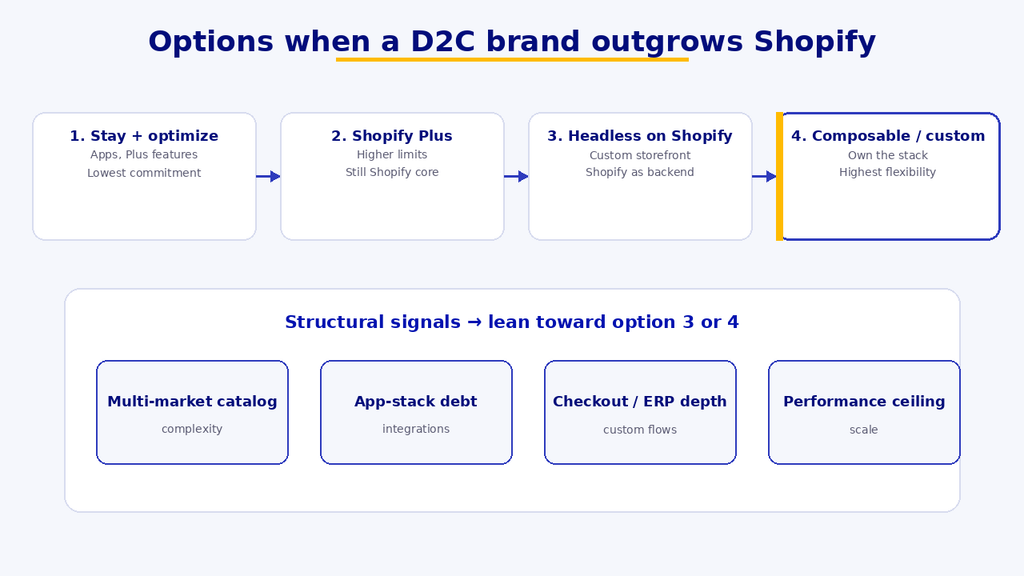
- Optimize what you have. A surprising number of “we’ve outgrown Shopify” problems are actually app misconfiguration, unused apps slowing the storefront, or a theme that was never properly tuned. This is the cheapest option and worth ruling out first, before any bigger commitment.
- Move up to Shopify Plus. Plus solves scale, checkout customization within Shopify’s own checkout, and some multi-market complexity, while keeping you on the platform and its existing app ecosystem. It doesn’t fix a genuinely structural limitation in the underlying data model, it just buys more room before that limitation is hit again.
- Unbundle one weak component into a composable stack rather than replacing the whole platform. If the limitation is narrow, search, content, or one specific integration, this is usually the right-sized move rather than a full rebuild. What composable commerce actually involves covers when this makes sense and when it doesn’t for a brand in your position.
- Move to a fully owned platform. The heaviest option, and the right one only when the limitation spans the whole stack rather than one piece of it. Building on an owned platform means full control over the entire codebase, at the cost of taking on everything Shopify currently handles for you behind the scenes.
Once a limitation is confirmed as structural, brands generally work through four options, roughly in order of how much commitment, and cost, each one represents.
What moving away from Shopify actually costs

Whichever of the four options a brand lands on beyond simple optimization, the honest cost is rarely just the build itself. Migrating years of order history, customer accounts, and app integrations takes real engineering time even when the new setup is objectively better. Every app in the current stack needs a replacement or a reason it’s no longer needed, and each one is its own small project. Search engine rankings and existing backlinks need careful handling through the transition so organic traffic doesn’t take a hit during the cutover. And the team needs to learn a new admin, new deployment process, and new set of failure modes, which costs productivity for a few weeks even on a smooth migration.
None of that means brands that have genuinely outgrown Shopify should stay. It means the decision should be made with the full cost in view, not just the cost of the new platform’s build, so the option chosen actually matches both the size of the limitation and the size of the team available to carry it through.
Signals it’s time to consider option 4
Moving to a fully owned platform is rarely the first move, and it shouldn’t be. It’s worth seriously considering only when several of the following are true at once: catalog or configuration complexity that even a composable stack still can’t cleanly represent, multi-market or multi-brand operations that need fundamentally different logic per market rather than a shared template, an app-stack cost that has genuinely crossed over what a custom build would cost annually once support and maintenance are included, and an internal or partner engineering team ready to own the result long-term rather than just through a launch.
For Southeast Asian brands specifically, the calculus shifts further, because regional engineering costs and payment fragmentation change the math in ways that Western case studies rarely account for. How these trade-offs actually play out for SEA brands weighs headless and composable approaches against staying on Shopify with that regional context factored in, rather than assuming the same numbers that apply to a US or European brand.
If you’re trying to work out which of these four options actually fits, rather than defaulting to the most dramatic one out of frustration, a technical audit is the practical next step: a structured look at whether your Shopify limitation is temporary or structural, and which option matches the size of the problem you actually have, not the size of the problem it feels like on a bad day.
Frequently asked questions
How do I know if my brand has outgrown Shopify?
Look for a structural signal, not a frustrating day: product or catalog complexity Shopify’s data model can’t represent, multi-market operations that need different logic per region, integration depth beyond what apps can handle, or an app-stack cost that’s climbed past what a custom build would cost.
Should I move to Shopify Plus or leave Shopify entirely?
Shopify Plus solves scale and checkout customization problems while keeping you on the platform. It doesn’t solve a structural limitation in the data model itself. If the constraint is structural, Plus buys time, not a fix.
What’s the difference between outgrowing Shopify as a D2C brand versus as a marketplace?
A single-seller D2C brand hits limits around catalog complexity, checkout control, and multi-market operations. A multi-vendor marketplace hits a different, earlier wall: Shopify’s data model isn’t built for multiple sellers, commission splits, or vendor-specific fulfillment.
What are the options if I’ve outgrown Shopify?
In increasing order of commitment: optimize what you have, move up to Shopify Plus, unbundle one weak component into a composable stack, or move to a fully owned platform. Most brands should work through them in that order rather than jumping straight to the last one.