


Most articles comparing headless commerce vs Shopify are written from a Western vantage point: US or European engineering costs, US or European payment methods, one home market with a straightforward path to a second. Southeast Asia doesn’t share those assumptions, and a brand operating in Singapore, Vietnam, Indonesia, or across several SEA markets at once will find that the trade-offs land differently enough to change the decision. This article assumes you’ve already established that your limitation is structural rather than temporary; start there if you haven’t ruled that out yet.
None of this is a case against Shopify in the region. Plenty of successful SEA D2C brands run entirely on it, including several operating across multiple markets at once. The point of this comparison is narrower: for the specific subset of brands that have confirmed a real, structural limitation, the calculus for what to do next looks different here than it does in the guides written for a US or European audience, and that difference is worth understanding before signing off on either direction.
The three real trade-offs
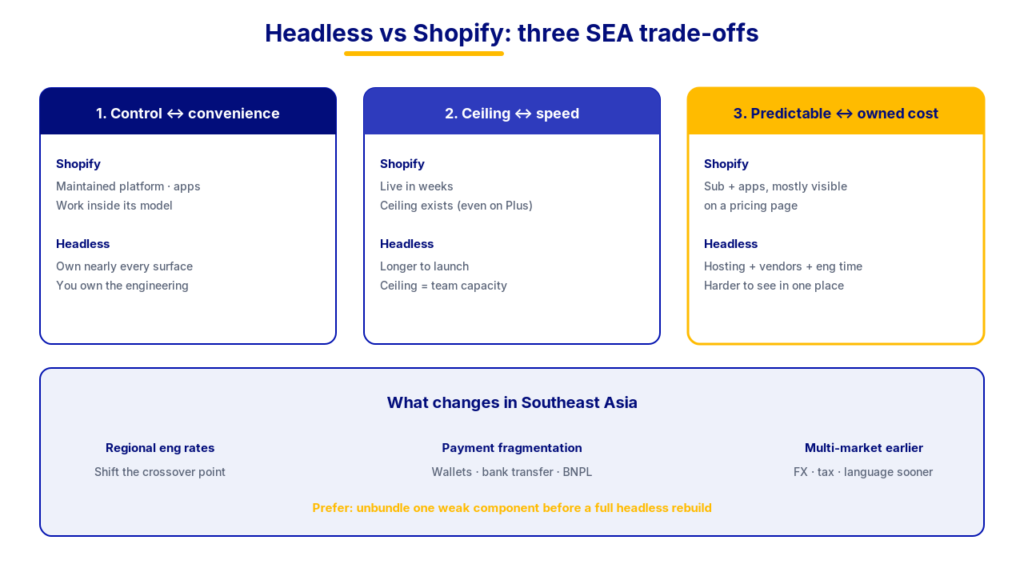
Strip away the vendor marketing on both sides and the headless commerce vs Shopify decision comes down to three honest trade-offs, not a simple better-or-worse comparison.
Control for convenience: Shopify gives you a maintained platform, a wide app ecosystem, and low ongoing engineering overhead, in exchange for working within its data model and checkout assumptions. Headless commerce gives you control over nearly every part of the experience, in exchange for owning the engineering work that Shopify otherwise does for you.
Ceiling for speed: Shopify gets a store live in weeks, with the trade-off that its customization ceiling, while genuinely high on Plus, still has limits. A headless build takes longer to reach launch because more has to be designed and integrated from scratch, but the ceiling on what it can eventually do is set mainly by your team’s capacity rather than the platform’s assumptions.
Predictable versus owned cost: Shopify’s cost is a subscription plus app fees, mostly visible upfront on a pricing page. A headless stack’s cost is spread across hosting, vendors, and ongoing engineering time, which is real money but harder to see in one place until it’s added up across a full year.
What changes when you’re operating in Southeast Asia

Regional engineering economics shift the calculus first. Building and maintaining a headless commerce stack with a Vietnam-, Philippines-, or Indonesia-based engineering team typically costs meaningfully less than the same scope of work would with a US or Western European team, which changes the crossover point at which headless commerce becomes cost-competitive with staying on Shopify. That cost logic is worth understanding in full before comparing quotes, since it’s the single biggest variable Western comparisons leave out entirely.
Payment fragmentation is heavier here than most Western comparisons account for. Beyond cards, SEA shoppers routinely expect e-wallets, bank transfers, and buy-now-pay-later options that vary meaningfully by country, from GrabPay and GCash to country-specific bank transfer rails. Shopify supports many of these through its regional payment method integrations and app ecosystem, but a headless build gives you more control over exactly which methods appear at checkout in which market, which matters more here than in a single-currency Western storefront.
Multi-market complexity also tends to arrive earlier for SEA brands than for brands expanding across a single large market like the US. A brand selling into Singapore, Malaysia, and Vietnam simultaneously is juggling different currencies, tax rules, and languages well before it reaches the revenue scale where a Western brand would first consider multi-market complexity at all. The Singapore-specific version of this question goes deeper into what that looks like for one of the region’s more mature markets.
One caveat worth stating plainly: engineering talent supply is real but uneven across the region. Strong engineering teams exist in Vietnam, the Philippines, and increasingly across the region more broadly, but hiring or contracting a team capable of owning a headless stack long-term takes more diligence in some SEA markets than it would in, say, Singapore or a Western tech hub.
That diligence pays off either way. A regional team that genuinely understands the payment and market fragmentation described above will build a better headless commerce foundation than a generalist team applying a playbook written for a single-market Western storefront, and the difference tends to show up months later in exactly the areas, checkout conversion by market, payment method coverage, that a rushed comparison overlooks at decision time.
| Dimension | Shopify | Headless / composable |
|---|---|---|
| Time to launch | Fastest; themes and apps get you live in weeks | Slower; more to design and integrate before day one |
| Ongoing engineering need | Low; platform handles most maintenance | Ongoing; your team owns integration and uptime |
| Cost structure | Predictable subscription plus app fees | Spread across vendors, hosting, and engineering time |
| Customization ceiling | High with Plus, limited by platform assumptions | High; limited mainly by team capacity, not platform |
| Checkout control | Fixed on standard plans, more flexible on Plus | Fully custom, at the cost of building it yourself |
| Multi-market handling | Good via Shopify Markets up to moderate complexity | Built to spec, better for genuinely divergent markets |
| Talent required to run it | Shopify-familiar developers, widely available | Broader engineering skillset, harder to hire regionally |
| Risk if something breaks | Platform-level support and uptime guarantees | Your team’s responsibility to diagnose and fix |
| Best fit | Most D2C brands, including large ones | Brands with a confirmed structural limitation and capacity to own it |
Read that table with the SEA context from the previous section layered on top, not as a standalone scorecard. The “cost structure” and “talent required” rows in particular land differently for a Ho Chi Minh City or Manila-based team than they would for a US or European one, which is exactly why a comparison written for a Western audience can point a SEA brand toward the wrong answer.
The middle path most brands should consider first

Rather than jumping straight to a full headless commerce build, most brands in SEA are better served by unbundling one weak component while staying on Shopify. Composability in stages covers what that actually looks like: keeping the platform for what it does well and replacing just the piece that’s genuinely holding you back, rather than rebuilding the entire stack at once.
A full move to a fully owned platform, the heaviest end of the headless commerce spectrum, is worth considering only once the limitation spans more than one component and your team is ready to own it long-term. What building on an owned platform actually involves covers that route in more detail for brands that have confirmed they’ve reached that point.
How to decide
Four questions, asked in the SEA context specifically rather than a generic Western framework, cover most of what matters. First: have you confirmed the limitation is structural, not a workaround away from being fine? Second: does regional engineering cost make a custom build genuinely more affordable than it would be for a brand hiring Western talent, given your specific market? Third: does your payment and market complexity actually require the flexibility headless commerce offers, or does Shopify’s existing regional support already cover it? Fourth: is unbundling one component, rather than a full headless rebuild, the smaller move that solves the actual problem?
If you want a second opinion tailored to your specific markets and constraints rather than a generic framework, a roadmap session is the practical next step: we’ll look at what you’ve actually hit a limit on, and which side of the headless commerce vs Shopify trade-off genuinely fits.
Frequently asked questions
Is headless commerce better than Shopify?
Neither is universally better. Headless commerce trades convenience for control: slower to launch, more engineering ownership, but a higher customization ceiling. Shopify trades some control for speed and low ongoing maintenance. The right choice depends on whether you’ve hit a structural limitation Shopify can’t solve.
Is headless commerce more expensive than Shopify for SEA brands?
Usually cheaper to build and run with a regional engineering team than the same project would cost with a Western team, because engineering costs are typically lower, but it still costs more in total than staying on Shopify unless a structural limitation is actually forcing the move.
What changes about this comparison for brands operating in Southeast Asia?
Three things: regional engineering talent changes the cost math for building custom, payment method fragmentation across SEA markets is heavier than in the West, and multi-market complexity (currency, tax, language) tends to arrive earlier for SEA brands expanding across the region than for brands operating in a single large market.
How do I decide between Shopify and headless commerce?
Start by confirming whether your limitation is structural rather than temporary. If it is, weigh your team’s capacity to own ongoing engineering work, then choose the smallest move that solves it, often unbundling one component rather than going fully headless.