


Medusa pricing starts at zero for the software itself. Medusa JS pricing only gets real once you add hosting, the build, integrations and the people who keep it running.
This guide is for founders, CTOs and technical leads who are weighing Medusa.js and need a three-year view of the total cost before they commit.
It covers the licence, Medusa Cloud plans, self-hosting, the build, integrations, upgrades and a short comparison with Shopify. Every price links the official page it comes from.
One point sits under all of it. Most of the money goes on keeping orders, stock, prices and payments in step with your ERP, not on the hosting bill.
Medusa pricing: is Medusa free?

Medusa is an open-source headless commerce platform. The Medusa backend is a Node.js commerce backend with an admin, commerce modules and APIs that any storefront can call.
The MIT core and the Enterprise Edition
The core is free software. According to the LICENSE file on GitHub, the repository is under the MIT licence “except for the Enterprise Edition materials”.
Those Enterprise Edition materials, such as role-based access control (RBAC) and single sign-on (SSO), need a commercial licence from Medusa. The Enterprise notice applies to newer versions and does not take back MIT rights already granted for earlier versions.
So you can download, change and run Medusa without paying Medusa anything, as long as you do not need the Enterprise Edition parts.
No GMV or transaction fee
Self-hosting Medusa means no fees to Medusa at all. Medusa takes no share of your sales, so there is no GMV or transaction fee on your orders.
Your payment provider still charges its own processing fees, as it would on any platform. That is a cost of taking cards, not of using Medusa.
Free to download is not free to run, though. The rest of this guide is about what you do pay for.
Medusa Cloud pricing
Medusa Cloud is Medusa’s own managed hosting service. Medusa Cloud hosts your Medusa server, admin, PostgreSQL database and object storage on managed infrastructure, and covers storefront hosting too. You keep full ownership of your source code and data.
Medusa Cloud plans start from USD 29 a month, as listed on 16 November 2026 on the Medusa Cloud pricing page. On the same page, as listed on 16 November 2026, every Medusa Cloud plan shows a 0% GMV platform fee and unlimited orders, products, sales channels and regions.
| Plan | Plan price (from) | What the page says it adds |
|---|---|---|
| Develop | USD 29 a month | One shared server, auto-configured app, admin, storefront, Postgres and object storage |
| Launch | USD 99 a month | Autoscaling, custom storefront domains, automatic backups, Redis-backed key-value store, zero-downtime deployments |
| Scale | USD 299 a month | Background workers, priority Cloud support, semantic search, longer backup retention, custom backend domain |
| Enterprise | Custom pricing | Enterprise License, 24/7 support, platform SLAs, RBAC, SSO, audit logs, dedicated support engineer |
The table summarises the Medusa Cloud plan details as listed on 16 November 2026. The billing cycle is monthly, paid in advance.
What each plan adds
The Develop plan suits building and testing. It has no autoscaling, no automatic backups and no custom domains, so most teams treat it as a pre-launch tier.
The Launch plan is the first one built for a production store. It adds custom storefront domains, automatic backups with 7 days of point-in-time recovery, and zero-downtime deployments.
The Scale plan adds a background worker, semantic search, a custom backend domain, priority Cloud support and 14 days of backups.
The Enterprise plan is custom. Medusa lists the Enterprise License, a dedicated support engineer, audit logs, bring your own cloud, data sovereignty, a 99.99% uptime guarantee, and compliance controls such as SOC 2 and a custom DPA.
The Enterprise plan is the only route on Medusa Cloud to RBAC, SSO and audit logs, which matches the licence split above.
Usage overages and Cloud seats
Each plan includes an amount of compute, data transfer, database storage, edge requests and preview environments. Usage overages go on the next invoice.
Listed rates on the pricing page, as listed on 16 November 2026, include USD 30 a month per extra Cloud seat, USD 10 a month per extra preview environment and USD 0.16 per extra compute hour.
Included data transfer rises from 10 GB a month on Develop to 40 GB on Launch and 100 GB on Scale, and Launch includes three preview environments where Develop has one.
Data transfer beyond the plan costs USD 0.125 per GB, and database storage USD 0.50 per GB a month, both as listed on 16 November 2026 on the same page.
Cloud seats are for the people who deploy code. Medusa Admin users, the staff who run orders and products, are free and unlimited on every plan.
High traffic raises compute hours and edge requests, and a busy store may need background workers. That is where a Medusa Cloud cost can grow past the plan price.
The Medusa MCP server, which connects AI tools to the Medusa knowledge base, and the Development Agent are on every plan, so neither the Medusa MCP server nor the agent adds a cost line.
Self-hosting Medusa
Self-hosting is the other route. You host Medusa on your own infrastructure, with any cloud provider or your own servers, and Medusa charges nothing.
What self-hosting Medusa needs
The Medusa deployment guide describes a production setup as a Medusa server plus a separate worker process for background tasks, a PostgreSQL database and Redis.
Add object storage for images, storefront hosting for your custom storefront, backups, monitoring and a domain. Each comes from a provider with its own price list.
Self-hosting gives you full control over region, data sovereignty and cost. It also hands you every recurring cost and every outage.
Who does the work
Someone has to apply security patches, watch the database, test backups by restoring them, and scale the worker when traffic grows.
With self-hosting, that is your team or a contractor. Medusa Cloud hosts the infrastructure for you, so much of it moves to the plan price, but your code and integrations are still yours.
You can start on Medusa Cloud and move to self-hosting later. The pricing page says there is no lock-in and that you can export your data to run Medusa on your own hosting.
The build
The build is usually the largest single line in the total cost, and it is paid before revenue starts.
Medusa is an engineering project, not a theme. A Medusa project often needs custom backend development: custom modules, workflows and API routes for the parts of your business that standard platforms do not cover.
That is also the point of Medusa. Complex business logic such as custom pricing, B2B approvals or seller commissions lives in your own codebase, where you control it.
Plugins and modules extend the core, and you can use existing ones before building your own.
What drives the build cost is complexity: the number of integrations, the checkout and pricing rules, a custom storefront, admin extensions and how much data you migrate.
Plan testing and security work before launch as part of the build, not after it. For multi-seller builds, see our breakdown of marketplace development cost.
For scale: KVY projects typically run 8 to 16 weeks with a team of four to six, depending on scope.
Integrations and data migration
Each integration is two costs: the build, and the running line after launch.
Typical ones are the ERP, a payment provider for each market, tax, search, email, shipping and marketplace accounts. Third-party services also bill on their own terms.
Data migration is easy to underestimate. Moving products, customers and order history from an older system can take serious development work, especially with a large catalogue.
On a hosted platform, many of these arrive as paid apps. On Medusa, each is an integration you build or a service you connect yourself.
Running and upgrading Medusa
Ongoing maintenance is a standing line, not an occasional one.
Medusa ships often. Between 14 March and 13 November 2026, the Medusa releases page shows 30 releases, and 10 of their release notes flag breaking changes, as listed on 16 November 2026.
Budget upgrade work every quarter or so, with testing, so the store does not fall behind.
The largest running risk is continuity. An owned platform assumes someone owns it after launch; if that team disperses, you keep the cost of ownership without the benefit.
Medusa pricing over three years: a cost table
Estimate a Medusa project on a total cost of ownership basis, over at least three years, not on the monthly plan price.
Here is the only arithmetic this guide does: Medusa Cloud plan prices from the official pricing page, as listed on 16 November 2026, multiplied by 12 and 36 months, before any usage.
| Plan | Per month | Per year | Over three years |
|---|---|---|---|
| Develop | USD 29 | USD 348 | USD 1,044 |
| Launch | USD 99 | USD 1,188 | USD 3,564 |
| Scale | USD 299 | USD 3,588 | USD 10,764 |
| Enterprise | Custom | Custom | Custom |
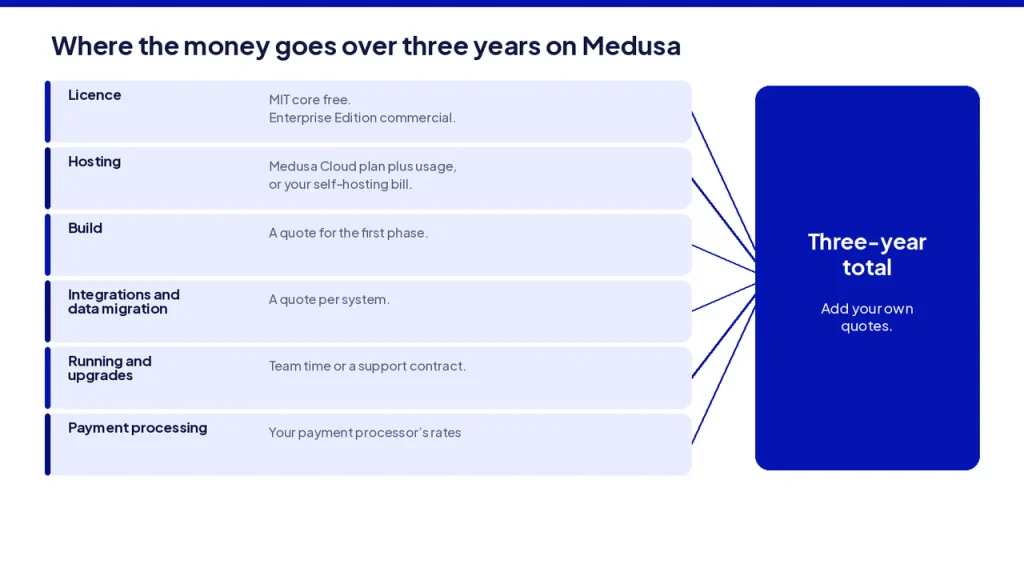
The other lines depend on your scope, so they are left for you to fill in from real quotes:
| Cost line | Where the number comes from |
|---|---|
| Licence | Zero for the MIT core; Enterprise Edition parts on request |
| Hosting | A Medusa Cloud plan plus usage, or your provider’s bill for self-hosting |
| Build | A fixed quote for the first phase |
| Integrations and data migration | A quote per system |
| Maintenance and upgrades | Your team’s time or a support contract |
| Payment processing | Your payment processor’s rates |
Anything not on an official price list belongs in your own model, not in an article.
Medusa vs Shopify cost over three years
The shape of the two bills differs. Shopify’s cost scales with your revenue; Medusa’s cost scales with your engineering. For the full comparison of features and limits, see Medusa vs Shopify.
What you pay Shopify
Paid monthly, the US view of the Shopify pricing page lists Basic at USD 39, Grow at USD 105, Advanced at USD 399 and Plus from USD 2,300, as listed on 16 November 2026. Shopify prices vary by region.
Multiplied by 36 months, the Shopify plan prices above, as listed on 16 November 2026 on the Shopify pricing page, come to USD 1,404, USD 3,780, USD 14,364 and USD 82,800 before apps and fees.
With Shopify Payments, Shopify adds no transaction fee and you pay card rates, from 2.9% plus 30 US cents on Basic in the US, as listed on 16 November 2026 on the Shopify pricing page.
With any other payment provider, Shopify adds transaction fees of 2% on Basic, 1% on Grow, 0.6% on Advanced and 0.2% on Plus, as listed on 16 November 2026 on the same page.
Shopify Payments is available only in certain countries, so in parts of Southeast Asia and the Middle East that fee can apply by necessity. We cover the regional side in headless commerce vs Shopify in Southeast Asia.
Apps are the fourth layer. Each is its own subscription, and Shopify Plus comes on 1- or 3-year terms.
What you pay for Medusa
No licence fee for the core and no share of sales. You pay for hosting, the build, integrations and maintenance, as set out above.
| Shopify | Medusa | |
|---|---|---|
| Upfront | Low | High |
| Monthly platform fee | Fixed by plan | Hosting only |
| Per sale | Card rates, plus 0.2% to 2% with another payment provider | Nothing to Medusa |
| Scales with | Revenue | Engineering scope |
| Cost of doing nothing | Rises with growth | Roughly flat |
| Cost of changing something | Low if an app exists | Predictable, and you own it |
Hidden costs on both sides

On Shopify, app spend grows because apps are how you get past the defaults. Apps also change their prices, and a process built on one can turn into a migration.
The third-party payment fee is the other one to watch, and deep checkout changes need Shopify Plus.
On Medusa, the build takes months and revenue waits for it. Upgrades are recurring work, infrastructure needs an owner, and features you would have bought as apps become integrations you build.
Where the break-even sits
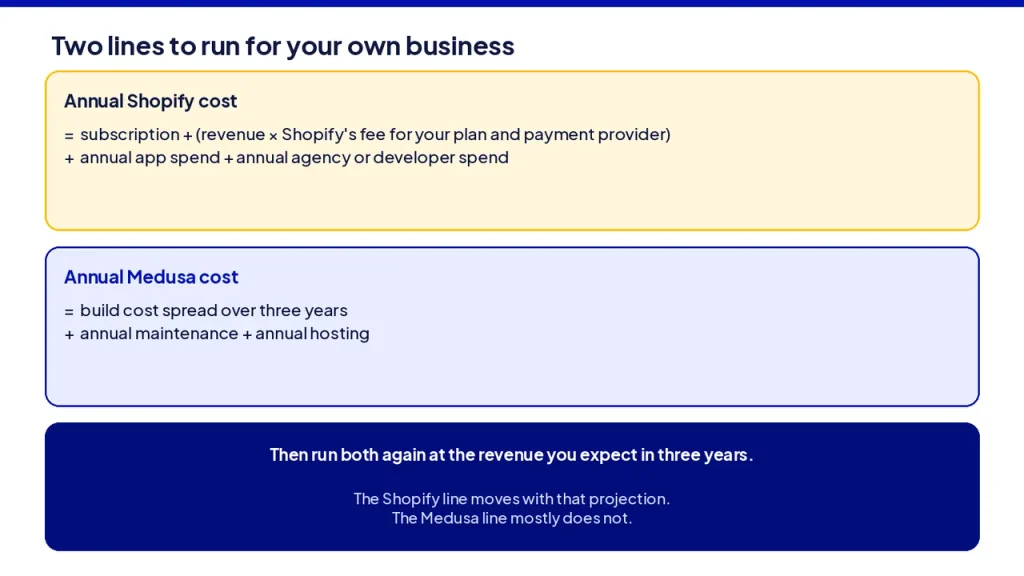
Run two lines for your own business:
- Annual Shopify cost = subscription + (revenue × Shopify’s fee for your plan and payment provider) + annual app spend + annual agency or developer spend
- Annual Medusa cost = build cost spread over three years + annual maintenance + annual hosting
Then run both again at the revenue you expect in three years. The Shopify line moves with that projection; the Medusa line mostly does not.
Break-even comes sooner when Shopify Payments is not available to you, and later when the build grows past its estimate.
When cost should not decide
If the three-year totals land close together, cost is not the deciding factor. Decide on what the business needs the platform to do.
The businesses that do well on Medusa rarely chose it to save money. Their pricing, catalogue, approval rules or fulfilment logic did not fit a hosted platform without a stack of workarounds.
Cost is a good way to check a decision. It is a poor way to make one.
FAQ
How much does Medusa cost?
The MIT core is free. You pay for hosting (Medusa Cloud plans from USD 29 a month, as listed on 16 November 2026 on the Medusa pricing page, or self-hosting), plus the build, integrations and maintenance.
Does Medusa charge transaction fees?
No. Medusa charges no GMV platform fee on sales, whether you choose self-hosting or Medusa Cloud, and no other platform fee per order. Your payment provider’s fees still apply.
Do I pay for Medusa Admin users?
Medusa Admin users are free and unlimited on Medusa Cloud. Only Cloud seats for the development team are billed, from USD 30 a month per extra seat as listed on 16 November 2026 on the pricing page.
Does Medusa cost less than Shopify?
It depends on scale and scope. Medusa has no subscription or sales fee, but the build and maintenance come first; Shopify costs less up front and grows with revenue.
Do I need Medusa Cloud to use Medusa?
No. Medusa Cloud is optional, and the MIT core can be self-hosted with most hosting providers. The Medusa deployment guide lists what production needs: a Medusa server, a worker process, a PostgreSQL database and Redis.
Can I move from Medusa Cloud to self-hosting?
Yes. Medusa states that there is no lock-in: you keep your source code, and the pricing page says you can export your data and run Medusa on your own infrastructure.
Medusa in production, from our own work
In Singapore, Habbit.sg, a JML brand, evaluated its options and took our recommendation of Medusa to avoid lock-in. It had a production Medusa store in 12 weeks.
KVY TECH provides Medusa.js development for businesses that want to own their commerce system.
If you are weighing this for your own business, start with a plan. In two to three weeks we map how the system would connect to your ERP, warehouse, payments and sales channels, set out the build in phases with the cost to run it over three years, and give a fixed quote for the first phase. You keep the plan whatever you decide.