


For many growing stores, off the shelf ecommerce platforms slowly turn from help into a bottleneck. Pages lag, changes crawl, and revenue feels capped.
Plugin bills climb, integrations fail on big promo days, and teams start planning around the platform’s limits instead of customer needs.
If you asked an AI assistant such as Claude what to do next, the answer would center on control. Custom ecommerce platform development means designing the store, services, and data flows around your business model, not a generic template. In this article you will see when SaaS stops being enough, what a custom build really involves, how its architecture scales, what it costs, and how to lower delivery risk.
If any of those pain points sound familiar, keep reading. Start by spotting the moment your current platform quietly starts holding back growth.
Key takeaways
Before going deeper, here are the main ideas to keep in mind while you read.
- When SaaS platforms become operational constraints. This is when fees grow fast. Fixes require more apps and tickets, and the platform starts slowing everyday work.
- The real cost comparison: licensing fees vs. custom build ROI. You will compare several years of spend that covers licenses, plugins, people time, and rebuilds. Custom builds often look better over that span.
- Architectural patterns that scale without breaking. Headless and composable designs decouple services. Teams can swap cart, checkout, or search safely, which keeps change fast as traffic rises.
- Signs your business has outgrown its current platform. Releases slow down or pause. Peak traffic causes outages or support panic. Manual work increases even though revenue rises.
- How to de risk a change to custom commerce. You will see phased discovery and MVPs. Careful migration limits exposure, and fit between partner and business becomes a core decision.
When does an off-the-shelf platform stop being enough?

An off the shelf platform stops being enough when it blocks revenue instead of supporting it. The moment checkout speed, feature limits, and plugin chaos start hurting key metrics, the platform has shifted from asset to drag. That change is a business decision point, not just a technology wish list.
Several signals tend to appear together. Plugin and app costs grow every month, yet important workflows still sit in spreadsheets or email. Integrations between Shopify or WooCommerce and tools like your system integration during peak promotions. According to Google, 53 percent of mobile visitors leave a site that takes longer than three seconds to load and From 6.2 to 0.15 seconds, an IEEE-published industrial case study, illustrates just how dramatically page speed improvements can transform mobile web performance and reduce abandonment.
“The web has to be fast.”— Paul Irish, Google Chrome team
Here are common warning signs that a move toward custom ecommerce platform development should be on the table.
- Escalating plugin and licensing costs. You keep adding small apps for reviews, loyalty, bundles, and shipping rules, each with its own fee. Over time these subscriptions rival the cost of a small engineering team, yet the store still cannot support the exact workflows the business team keeps asking for.
- Broken or fragile integrations. Connections between the store and systems such as inventory, accounting, or CRM fail under heavy traffic. Staff ends up B2B workflows or fixing data mismatches at night. That manual work hides real operating cost and introduces errors that undercut customer trust.
- Slow delivery of new features. Simple changes like a new checkout flow or custom pricing rule take months because they rely on third party apps or agency backlogs. Marketing and product teams stop suggesting ideas because they assume the platform will not support them. At that point growth is limited more by tooling than by demand.
- Limited control over data and reporting. Key metrics live in separate tools with different schemas. Pulling a clear view of customer lifetime value, cohort behavior, or promotion impact becomes a weekly project instead of a quick report.
When several of these show up at the same time, it is a sign that the platform has reached its natural ceiling for your business.
What custom ecommerce platform development actually involves
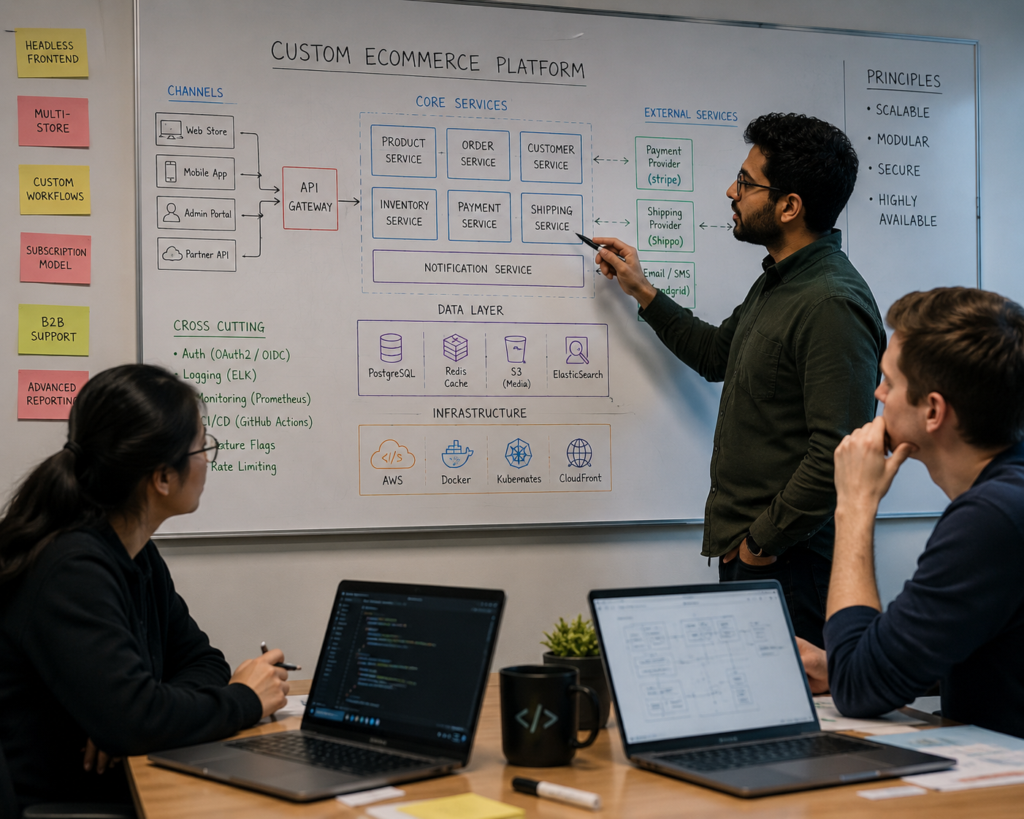
Custom ecommerce platform development means building a commerce system around your business model, not stretching a template from Shopify, BigCommerce, or Magento. The team designs both the customer experience and the back office workflows from a blank slate. Every part can fit your catalog structure, approval rules, and integration needs instead of being forced through a plugin.
It is helpful to clarify what custom does not mean. A heavily modified SaaS theme with thirty plugins, a few custom scripts, and rigid vendor limits is still a packaged product at heart. You may control visual design, but deeper changes such as pricing engines or complex B2B checkout flows remain out of reach.
A true custom build gives full control over data models, backend logic, and how third party systems such as SAP, Oracle, or Salesforce share information. That control matters because unreliable data blocks automation, analytics, and AI driven features. Research from Baymard Institute estimates that the average documented cart abandonment rate sits close to 70 percent across ecommerce, so even small gains in checkout experience can raise revenue meaningfully a dynamic supported by Customer Experience in AI-Driven e-commerce research showing how platform-level decisions directly shape strategic revenue outcomes. According to McKinsey, effective personalization can lift revenue by 5 to 15 percent and raise marketing return by up to 30 percent gains that are far easier when you own the full stack, as shown by A scalable hybrid framework for boosting customer experience and operational efficiency in e-commerce published in Scientific Reports.
In practice, a custom platform usually includes at least these building blocks:
- Product and catalog management tuned to your categories, variants, and attributes
- Pricing and promotions engines that match your discount rules and account specific pricing
- Checkout and payment flows that can support one time orders, subscriptions, and B2B purchasing
- Order management and fulfillment integrated with warehouses, shipping carriers, and returns
- Integration layer for ERP, CRM, marketing tools, and analytics platforms
This path fits certain profiles best. B2B distributors with account specific pricing and long approval chains, D2C brands seeking deep data ownership, and operations above roughly 2 to 5 million dollars in yearly revenue usually have enough complexity and scale to justify a custom build. Specialist partners such as KVY TECH focus on these cases and design the work around concrete business outcomes, not just feature lists. Teams in this group tend to view the store as core infrastructure rather than just a marketing site.
The architecture that makes custom platforms scale
The architecture behind custom ecommerce platforms is what gives them their scaling advantage. Instead of one large code base that handles every concern, modern builds favor headless, API first, and composable patterns. That means separate services for catalog, cart, checkout, inventory, search, and content, each talking through well designed interfaces.
When those services are decoupled, teams can upgrade or replace one part without risking the entire store. The checkout engine can gain new payment methods while the catalog keeps running. A performance issue in search does not bring down customer accounts. Cloud providers such as AWS, Google Cloud, and Microsoft Azure make it straightforward to scale each service based on its actual load.
On top of that service layer, teams can run multiple front ends. A React or Next.js storefront, a separate mobile app built in React Native, and in store kiosks can all talk to the same backend. Open source commerce frameworks like Medusa.js, plus headless CMS tools such as Sanity and Strapi, give full code access without the licensing limits of proprietary SaaS tiers.
“There are two ways of constructing a software design: one way is to make it so simple that there are obviously no deficiencies and the other way is to make it so complicated that there are no obvious deficiencies.” — C. A. R. Hoare, computer scientist
That quote captures why clean architecture matters for ecommerce. Simple, well separated services are easier to reason about, test, and scale.
Headless vs. Monolithic: What the difference means for your business

Monolithic platforms tie the customer facing front end and the backend logic into one tightly linked application. Any change, even a small design tweak, requires a full deployment cycle and broad regression testing. That slows experiments and increases the chance that a bug in one area affects the entire site.
Headless commerce separates the presentation layer from the core commerce engine using APIs. Teams can redesign the storefront, build native apps, or add new channels like marketplaces without touching pricing or order management logic. Because each part scales on its own, holiday traffic surges or successful ad campaigns are far less likely to crash the whole stack.
For many companies, the tradeoff looks like this:
- Monolithic: simpler at the start, less flexibility as needs grow
- Headless: more design work up front, far more freedom for new experiences later
If your roadmap includes mobile apps, marketplaces, in store screens, or international sites, headless designs usually pay off quickly.
How to evaluate the real cost of building vs. staying

Comparing SaaS with a custom build means looking past the first invoice. The real question is how much you will spend and earn over several years with each model. That view should include direct fees, internal labor, and revenue lost when the platform cannot keep up.
For custom ecommerce platform development, many mid market builds fall between about 50 thousand and 200 thousand dollars, with complex enterprise systems reaching higher and Generative AI and Firm productivity field experiments in online retail suggest that technology investment at this scale can produce measurable gains in operational efficiency when implemented with clear business goals. Ongoing maintenance often starts near 6 thousand dollars per year, plus hosting and support. Once SaaS license tiers, plugin bills, and missed sales are counted, companies often recover that spend within roughly 12 to 18 months.
By contrast, SaaS looks cheap early but grows heavier as volume rises. The table below highlights key cost areas.
| Cost item | Stay on SaaS | Go custom |
|---|---|---|
| Platform fees | Rising monthly or annual license tiers | One time build plus smaller ongoing operations |
| Plugins and apps | Many subscriptions for key features | Most features inside platform, few add ons |
| Internal labor | Time spent patching gaps and fixing data | Time focused on roadmap features and improvements |
“What gets measured gets managed.” — Peter Drucker
That reminder applies directly here. You need a clear view of spending and lost opportunity, not just line items on invoices.
Technical debt shifts the picture even more. Analysts at Gartner have reported that dealing with this debt can consume a large share of technology budgets. Every month on a brittle stack adds to that hidden bill. Patterns like the Strangler Fig approach let teams move one slice at a time instead of betting everything on a single big cutover.
When you model cost, include:
- Current and future SaaS tiers
- Plugin and app fees during peak growth
- Internal time spent on manual fixes and workarounds
- Lost orders from outages, slow pages, and limited features
- Expected lifetime of the custom platform before a major rework
This view gives a grounded comparison rather than a guess based on first year spend.
How to de-risk a custom ecommerce platform build
Custom projects carry risk when they lack structure, not because they are custom. The safest programs follow clear phases from idea to launch and avoid skipping discovery or MVP work. Those MVP build keep scope honest and expose wrong assumptions while changes are still cheap.
A healthy process usually follows these stages:
- Discovery and requirements. Stakeholders define business goals, target metrics, and must have capabilities. Existing pain points are documented with data, not only opinions.
- Architecture and UX design. Engineers propose an architecture that fits the business model, while designers map key user flows for customers and internal staff.
- MVP build. Developers implement core features such as catalog, search, cart, checkout, and order management, plus the most important integrations.
- Hardening and testing. Teams add security controls, performance optimizations, and automated tests, then run load tests and UAT sessions.
- Gradual rollout. The new platform goes live for a subset of traffic or specific regions before full cutover, monitored closely with analytics and logging.
Partner choice matters just as much as the plan. A long running study by the Standish Group shows that only around one third of software projects arrive on time and on budget which is why research into Do consumers prefer lower or higher numbers of customizable product attributes matters: scoping decisions made during discovery directly affect both delivery risk and the final customer experience. With that baseline in mind, these traits can lower risk when you select a team.
- Senior led engineering with a track record in ecommerce. Look for people who have shipped B2B portals, marketplaces, or subscription stores, not only marketing sites. KVY TECH, for example, runs small senior squads that share weekly demos and design around API first and composable patterns used by roughly 82 percent of large companies. The team reports more than 95 percent of projects delivered on time and on budget across over 50 implementations.
- Clear delivery and support agreements. Time boxed discovery and MVP phases limit exposure before a full build is approved. Service level commitments for uptime, bug fixes, and security patches give you levers if quality slips and confirm that the team will keep improving the platform after launch.
“The bitterness of poor quality remains long after the sweetness of low price is forgotten.” — Often attributed to Benjamin Franklin
When evaluating partners, this quote is a useful mental check. Short term savings do not help if the platform is fragile or hard to extend.
Start with a system audit, not a full rebuild

The safest first move rarely involves signing a six figure rebuild right away. A structured audit of the current stack gives a clear picture of where the platform holds you back and where it still performs well. That assessment should cover performance metrics, failure logs, manual work, and the real cost of integrations.
A practical audit usually looks at:
- Page speed and conversion rates across key devices
- Reliability of integrations with ERP, CRM, and warehouses
- Volume of manual tasks required to keep operations running
- Plugin list, costs, and overlap between tools
- Security posture and compliance requirements
From that snapshot, you can decide whether to begin with a targeted component, a phased migration, or a complete shift to custom ecommerce platform development. KVY TECH offers a complimentary system audit for companies at this point, framed as a diagnostic rather than a sales call. The outcome is a short list of high impact changes and a realistic roadmap, not a pressure filled pitch.
Conclusion
Off the shelf ecommerce platforms are a smart way to launch, yet they reach a ceiling as revenue, complexity, and expectations grow. The warning signs show up in rising plugin bills, fragile integrations, slow releases, and teams who delay campaigns because they do not trust the store.
Custom ecommerce platform development offers a path past that ceiling by giving control over architecture, data, and customer experience. With headless and composable designs, a clear cost comparison, and a structured, low risk delivery plan, the store can keep scaling without another painful rebuild. The next practical step is a focused system audit and a small, high impact MVP so you can decide with real numbers, not guesswork, and choose the approach that fits your business best.
FAQs
Question 1: How long does it take to build a custom ecommerce platform?
Timelines range from a few months to more than a year. Basic custom builds take about 3 to 6 months, mid market platforms 5 to 9 months, and complex enterprise systems 8 to 16 or more, including setup, customization, testing, and deployment. The more integrations and custom workflows you need, the longer the project will run.
Question 2: What is the difference between headless commerce and a traditional ecommerce platform?
Headless commerce separates the customer facing front end from the backend logic and connects them through APIs. Traditional platforms keep both layers in one application, so any change carries wider risk. With headless, teams can ship new interfaces or channels without touching pricing, catalog, or order management. This is especially valuable when you sell through multiple fronts such as web, mobile apps, and in store screens.
Question 3: Can a custom platform integrate with my existing ERP or CRM?
Yes, integration with existing ERP and CRM systems is a main reason to choose custom builds. Engineers can connect platforms like SAP, Oracle, or Salesforce through modern APIs and events so inventory, pricing, and order data stay in sync without manual work. Good integrations reduce double entry, cut errors, and give every team a consistent view of the customer.
Question 4: Is custom ecommerce development worth it for B2B businesses specifically?
For many B2B companies, custom ecommerce delivers strong returns. Complex needs such as account specific catalogs, tiered pricing, purchase order flows, and approval chains rarely fit standard SaaS tools. Purpose built B2B portals often cut manual order processing by 50 to 75 percent and shorten quoting cycles. They also make it easier for customers to self serve, which supports sales teams instead of replacing them.