


An ecommerce business setup Dubai founders are planning is usually described as a licence decision. It is presented as a menu, mainland or free zone or e-Trader, with a fee attached to each, and the guidance stops once you have picked one.
The licence is the first thirty days. What it quietly decides is who you are allowed to sell to, who will open a merchant account for you, whose name goes on the invoice, and how much of that you can change later without rebuilding. This article is about that second part.
Ecommerce business setup Dubai: The three licence routes
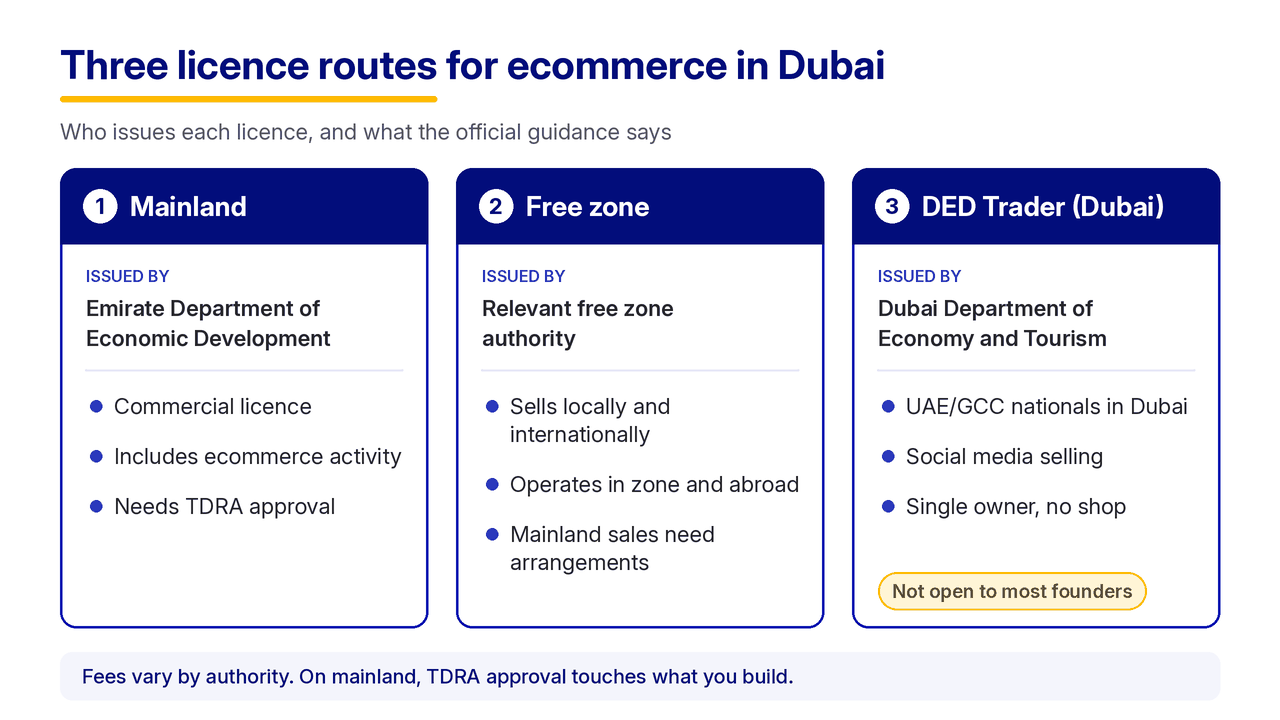
Ecommerce in the UAE runs under Federal Decree-Law No. 14 of 2023 on trading by modern technological means, which puts online businesses under broadly the same framework as traditional ones. Three routes exist, and the official UAE government portal sets out what each one is.
| Route | Issued by | What the official guidance says |
|---|---|---|
| Mainland | The emirate Department of Economic Development | A commercial licence that includes ecommerce activity. All ecommerce licences require the approval of the Telecommunications and Digital Government Regulatory Authority |
| Free zone | The relevant free zone authority | Specialised licences allowing sale of products and services online, locally and internationally. Free zone companies operate within the free zone and internationally. Selling directly on the UAE mainland may need a local distributor, or additional approvals or arrangements |
| DED Trader (Dubai) | Dubai Department of Economy and Tourism | Available to UAE and GCC nationals residing in Dubai. Covers business activity through social media networks. The holder cannot open a shop or issue visas, it is registered under a single owner, and that owner alone carries liability |
Two things in that table are worth pausing on, because most ecommerce business setup Dubai guidance skips them.
The DED Trader route is limited to UAE and GCC nationals residing in Dubai. A large share of the content written about the cheapest way to get an ecommerce licence in Dubai describes a route most founders reading it cannot take.
Mainland ecommerce licences carry a TDRA approval step. That is a regulatory approval touching the thing you are building, not only the company that owns it.
Fees are set by each authority, vary by activity and package, and are published by the authority issuing them. We are not company formation advisers, and the numbers move.
What the licence decision changes downstream
Four consequences of the ecommerce business setup Dubai choice, in the order they usually bite.
Who you can sell to. A free zone entity operates within its zone and internationally. Selling directly into the UAE mainland is a separate arrangement. For a storefront aimed at UAE consumers, that is not a paperwork detail. It determines whether your primary market is reachable from your primary entity.
Whose name is on the invoice. Every order produces a document naming a legal entity with a tax registration number. If you hold two entities, one free zone and one mainland, something in your system has to decide which one owns each order, and that decision has to be consistent, auditable and applied before the invoice is generated rather than afterwards.
Whether a payment provider will underwrite you. Providers run their own review of your ecommerce business setup Dubai paperwork. Merchant onboarding checks the licence, the legal entity, the bank account and the live website against each other. A mismatch between the trade name on the licence and the name on the storefront is the kind of thing that stalls an application for weeks.
What restructuring costs. Changing entity later means a new tax registration number, new invoice sequences, a new merchant account, and a decision about historical orders that already carry the old entity details. None of that is impossible. All of it costs far less before there are orders than after.
What ecommerce business setup Dubai guidance leaves out about the storefront

This is the part of an ecommerce business setup Dubai that belongs to the build rather than to the company, and it is where the setup guidance goes quiet.
Federal Decree-Law No. 14 of 2023 applies to anyone trading through modern technological means within the UAE, or whose services are received from outside it, and free zone entities are covered when selling outside their boundaries. Its obligations land directly on your storefront.
- Full price disclosure before purchase. Terms, conditions, prices, logistics fees and digital payment charges have to be shown upfront, and fees not disclosed cannot be added afterwards. In a checkout carrying cash on delivery and buy-now-pay-later, where a COD handling fee and a provider charge may both apply, this is a design requirement, not a footer link.
- A detailed invoice for every purchase. Not a confirmation email. An invoice, every time.
- Licence and contact details displayed publicly, alongside an accessible complaints route with a contact number and a way to track a complaint.
- A secure digital environment meeting the cybersecurity standards set by the competent authority.
- Consumer data handled under UAE data protection law, not shared without consent.
- Return and exchange rights for goods that arrive defective, incomplete, damaged or not as described.
Read that list as a backlog rather than a legal summary, because it is the part of an ecommerce business setup Dubai that turns into sprints. Price transparency across every payment method, an invoice generator, a complaints workflow with state, and a returns flow that knows why an item came back are all features someone has to build. Building them into the first release costs far less than retrofitting them after a regulator or a customer asks.
VAT registration and what it does to your system

The Federal Tax Authority sets two thresholds, and they apply whichever ecommerce business setup Dubai route you took. Registration is mandatory when taxable supplies and imports exceed AED 375,000 over the previous twelve months, or are expected to exceed that in the next thirty days. Voluntary registration becomes available above AED 187,500.
One line in the FTA guidance matters more than the thresholds for anyone selling into the UAE from outside it: non-resident businesses making any taxable supplies in the UAE must register regardless of the value of those supplies. There is no threshold to grow into.
Once registered, the storefront side of your ecommerce business setup Dubai issues tax invoices rather than receipts. That means a tax registration number on the document, VAT calculated and shown per line, and invoice numbering that does not restart or repeat.
It also puts you on the e-invoicing path. From 1 January 2027, UAE businesses with annual revenue of AED 50 million or more must issue B2B invoices as structured data through an accredited service provider, with everyone below that threshold following on 1 July 2027. We covered what that means for a storefront in UAE e-invoicing. The law already requires a detailed invoice for every purchase. The mandate changes what that invoice has to be made of.
Ecommerce business setup Dubai: Platform choice in four questions
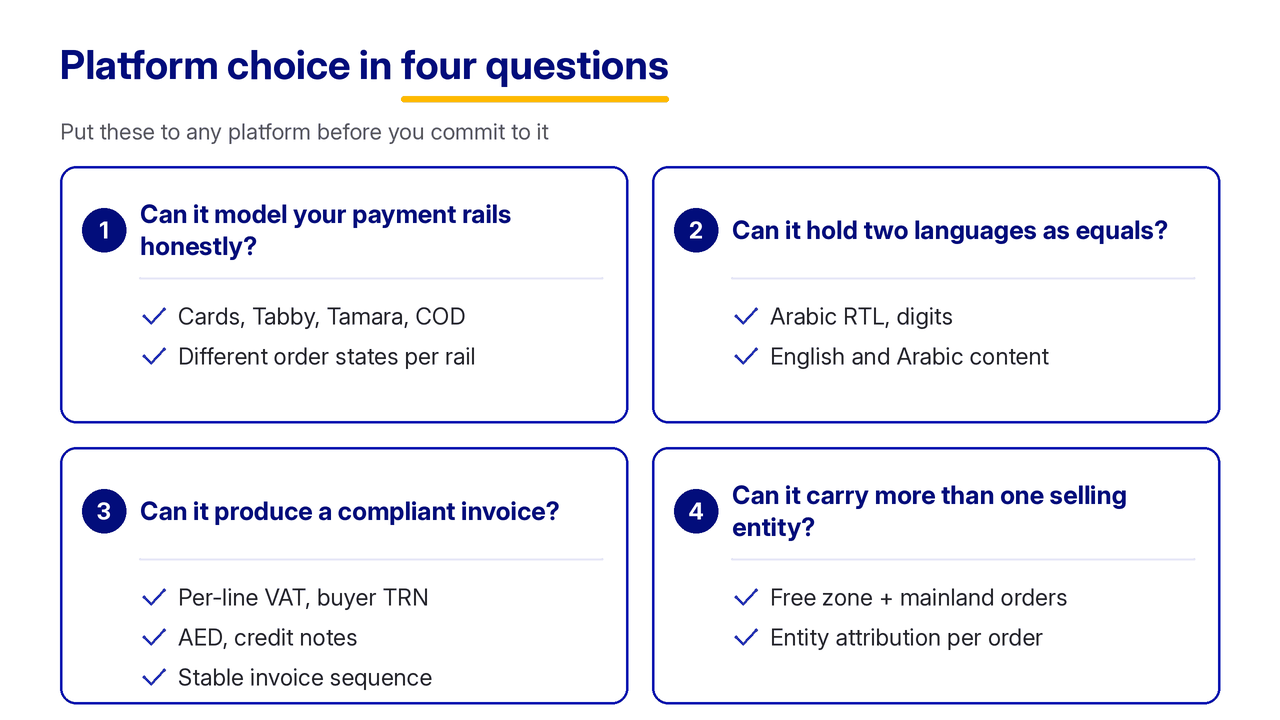
Platform comparisons usually turn into feature tables. In an ecommerce business setup Dubai the decision is narrower than it looks, and it comes down to what the platform lets you control.
Can it model your payment rails honestly? Cards, Tabby, Tamara and cash on delivery each move through different states, and capture happens at a different moment on each, as we set out in UAE checkout payment methods. A platform that represents payment as a single paid flag will need work-arounds from the first month.
Can it hold two languages as equals? If Arabic is in scope, direction, digits and mixed-script order data are structural, not cosmetic. Retrofitting Arabic and RTL storefronts onto a build made for English is most of a rebuild.
Can it produce a compliant invoice? Per-line tax, AED equivalents, a buyer tax registration number, credit notes that reference an original document, and a stable invoice sequence. Ask this before signing, not in 2027.
Can it carry more than one selling entity? If a free zone company and a mainland company are both plausible within two years, the platform has to attribute orders to entities without a spreadsheet in the middle.
A platform that answers all four may still be the wrong fit for other reasons, and no ecommerce business setup Dubai checklist replaces a proper evaluation. A platform that fails three of them will be replaced.
What to build first, and what can wait
First, because they are structural: the order and invoice data model, entity attribution, tax fields, currency handling with the AED rate stored at order time, and the payment state machine.
Second, because the law requires them and customers use them: price disclosure across all methods, invoice generation, the complaints route, the returns flow.
Later, safely: loyalty, subscriptions, personalisation, marketplace sellers, a second market.
The ordering is not about importance. It is about which decisions are expensive to reverse, and in an ecommerce business setup Dubai the expensive ones all sit at the bottom of the stack. Adding a loyalty programme in month nine is a project. Changing which entity owns historical orders in month nine is an archaeology exercise.
The hard part: Launching on one entity and restructuring later

The common path in an ecommerce business setup Dubai teams run quickly is a free zone company because it was fast, a storefront built against it, and eighteen months later a mainland presence because most customers are in the UAE.
What that costs, in the order it surfaces: a second tax registration number and a rule for which entity owns which order; a second merchant account and a period where both are live; historical invoices that name an entity no longer making those sales; VAT filings split across two registrations mid-year; and a product catalogue that may now need to exist under both.
None of this is a reason to pick differently at the start. It is a reason to know which of these your system can absorb, and to leave entity attribution as a field in the data model rather than an assumption baked into it. A field you never use costs nothing. An assumption costs a migration.
How KVY approaches it
We build commerce systems for teams whose software decisions carry real consequences. Tax identity, entity attribution, currency handling and payment behaviour are architecture decisions we settle in the first weeks, not plugins added later. Bolting them on is how commerce builds fall apart in month six. That is the heart of our custom ecommerce development work.
For a Dubai launch that means we ask which entity will hold the licence and whether a second one is plausible, before the data model is drawn. It is a five-minute conversation at the start and a migration if it happens at the end.
We are not company formation or tax advisers. Which licence and which entity suit your business are questions for a licensed adviser. What we can answer in writing during procurement, rather than after, is what an ecommerce business setup Dubai decision does to the system you are about to build.
Frequently asked questions
What licence do I need for an ecommerce business in Dubai?
Three routes exist: a mainland commercial licence including ecommerce activity from the Department of Economic Development, which also requires TDRA approval; a free zone licence from the relevant free zone authority; or, for UAE and GCC nationals residing in Dubai, the DED Trader licence covering activity through social media networks.
Can a free zone company sell to customers in the UAE mainland?
Official guidance states free zone companies operate within the free zone and internationally, and that selling directly on the UAE mainland may need a local distributor, or additional approvals or arrangements. For a storefront aimed at UAE consumers this affects which entity can serve the primary market.
Who can get an e-Trader or DED Trader licence in Dubai?
UAE and GCC nationals residing in Dubai. The licence covers business activity through social media networks, is registered under a single owner, does not permit opening a shop or issuing visas, and leaves liability with the owner.
When do I have to register for VAT in the UAE?
Registration is mandatory when taxable supplies and imports exceed AED 375,000 over the previous twelve months or are expected to exceed it within thirty days. Voluntary registration is available above AED 187,500. Non-resident businesses making any taxable supplies in the UAE must register regardless of value.
What does UAE ecommerce law require my website to do?
Federal Decree-Law No. 14 of 2023 requires prices, terms, logistics fees and digital payment charges to be disclosed before purchase, a detailed invoice for every purchase, publicly displayed licence and contact details with a complaints route, a secure digital environment meeting the competent authority standards, consumer data handled under UAE data protection law, and return rights for goods that are defective, incomplete, damaged or not as described.
Tell us what you are building and which entity it sits on. We have written up the system side of ecommerce business setup Dubai so you do not have to discover it mid-build. We reply within one working day.