


Most teams treat e invoicing UAE compliance as a finance project. Yet the invoice an accredited service provider validates is assembled from data captured by the storefront, order system, ERP and payment stack. If those systems never collected the buyer’s tax identity or stored line-level tax and currency values, the gap appears when the first invoice is rejected.
For large businesses, e invoicing UAE requirements become mandatory on 1 January 2027. Smaller businesses follow on 1 July 2027, while government entities follow on 1 October 2027. An eInvoice must be structured data exchanged through an accredited service provider and reported to the Federal Tax Authority. A PDF, scan or email attachment is not an eInvoice.
What the UAE mandate requires, and by when
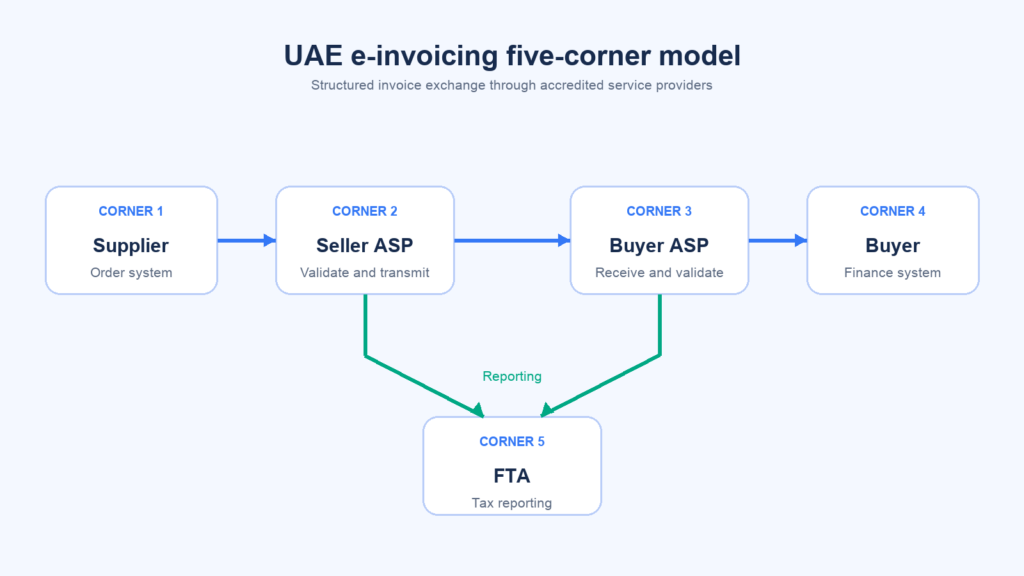
For e invoicing UAE, the Ministry of Finance runs the programme on a Decentralised Continuous Transaction Control and Exchange model built on OpenPeppol. Your system sends invoice data to your accredited service provider, or ASP. The ASP validates it, converts it into the UAE standard XML format when needed, sends it to the buyer’s ASP, and reports the data to the FTA. The buyer’s system then receives the validated invoice.
The e invoicing UAE framework in Ministerial Decisions 243 and 244 of 2025 define the scope and rollout. B2B and B2G transactions are in scope unless specifically excluded. Consumer transactions are outside the current mandatory scope. The official Ministry of Finance eInvoicing portal should be treated as the source of truth because programme details can change.
| Phase | Who | Appoint an ASP by | Live from |
|---|---|---|---|
| Voluntary adoption | Any participant | Not applicable | 1 July 2026 |
| Phase 1 | Revenue of AED 50 million or more | 30 October 2026 | 1 January 2027 |
| Phase 2 | Revenue below AED 50 million | 31 March 2027 | 1 July 2027 |
| Government | Government entities | 31 March 2027 | 1 October 2027 |
One date has moved. The Phase 1 ASP appointment deadline was extended from 31 July to 30 October 2026 by Ministerial Resolution No. 66 of 2026. The 1 January 2027 go-live date did not move. That distinction matters because selecting a provider is only one part of e invoicing UAE readiness. Storefront, order and finance systems still need compatible data and workflows.
Cabinet Decision No. 106 of 2025 sets administrative penalties. They include AED 5,000 for each month of delay in implementing the system or appointing an ASP, AED 100 per invoice or credit note not issued and transmitted on time up to AED 5,000 per month, and AED 1,000 for each day of delay in reporting a system malfunction. Operational disruption can cost more when buyers cannot process invoices.
Where B2C ecommerce sits today

Under current e invoicing UAE rules, B2C transactions are excluded from the mandatory scope until further notice. A storefront selling only to consumers does not become subject merely because Phase 1 begins. However, many consumer-facing stores also accept corporate, wholesale or marketplace orders. Those flows can create B2B transactions, so the practical question is whether any order in the system can be a business purchase.
- Corporate and bulk buyers may place orders through the same checkout used by consumers.
- A marketplace can raise B2B commission invoices to sellers and may support seller invoicing.
- Subscription, wholesale and D2C lines may share one platform and customer record.
- The business will also receive structured invoices from suppliers and needs a receiving workflow.
A B2C storefront may therefore need a controlled branch for business purchases. That branch can collect legal entity details, validate identifiers and send the order through the correct invoicing workflow. Teams planning B2B ecommerce development should make that distinction explicit rather than infer it from the catalogue or payment method.
What an ASP does, and what it cannot do for you

For e invoicing UAE, an accredited service provider is a mandatory intermediary approved by the Ministry of Finance. It validates invoice data against the UAE schema, transmits the document over the Peppol network, supports receipt of invoices and reports required data to the FTA. Businesses must select a provider from the official accredited ASP list.
An ASP cannot invent data your systems never captured. It cannot recover a buyer TRN that checkout never requested, construct a reliable credit note from an unstructured refund, or decide which legal entity owns an order. For e invoicing UAE projects, the connector is often the short part. The data model, ownership rules and exception handling are the real work.
What your storefront has to emit
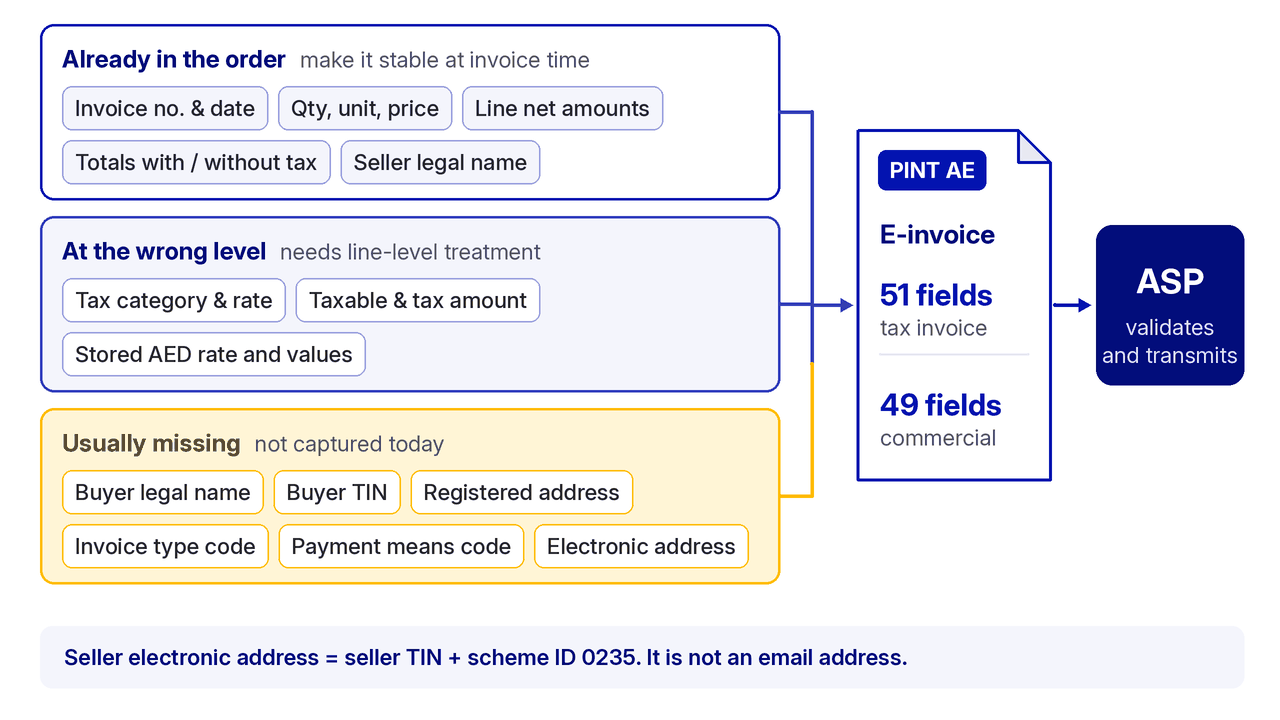
For e invoicing UAE, the official mandatory field requirements published on 23 February 2026 list 51 fields for an electronic tax invoice and 49 for a commercial electronic invoice. Both align with PINT AE. Check the latest official version before implementation because the programme can evolve.
Some required data already exists in most order systems: invoice number and date, line identifiers, quantities, units, prices, line net amounts, totals with and without tax, the payable amount and the seller’s legal name. The e invoicing UAE challenge is making those values stable and available at invoice time.
Other values often exist at the wrong level. Tax category, tax rate, taxable amount and tax amount need line-level treatment. Currency handling also needs a repeatable source. If an AED equivalent is recalculated every time an invoice is rendered, regenerated versions can drift. Store the rate and monetary values used for the transaction rather than rebuilding history from a current exchange rate.
The missing group usually includes the buyer’s registered legal name, TIN or relevant tax identifier, registered address, invoice type code, payment means code, specification identifier and electronic address. One important correction to common summaries is that the official field guide defines the seller electronic address as the seller’s TIN and fixes the seller electronic address scheme identifier as
0235
. The TIN and scheme identifier together form the endpoint address.
This is not an email address. For a person registered for corporate tax, the TIN is the first 10 digits of the corporate tax TRN. A person in scope who is not required to register for corporate tax must register with the FTA to receive a TIN. These details make e invoicing UAE readiness a product and data-governance decision, not just a new export format.
Where this breaks in production

Guest checkout has no legal entity. A business buyer can leave only an email and shipping address. That is not enough to build a structured tax invoice. Checkout needs a business-purchase path, or finance will chase missing details manually.
Cash on delivery separates order and payment events. The order may be placed on Monday and paid on Thursday. The correct tax point and invoice timing depend on the supply and applicable tax rules, so tax advisers should define the rule. The system must then apply it consistently.
BNPL separates the order from settlement. The customer’s instalment schedule and the provider’s settlement schedule are not the same as the order lifecycle. Invoice creation should follow the approved business and tax rule, not be triggered accidentally by a payout report.
Multi-currency rounding drifts. Recalculating AED values at render time can produce different totals on later versions. Once a structured invoice has been transmitted, regenerating it with new values creates reconciliation problems.
Partial refunds require credit-note logic. A refund affecting two items in a five-item order needs a credit note that references the original invoice, carries its own identifier and follows the transmission workflow. A system that only edits the original order has no clean document to send.
Retries create duplicates. A timeout does not prove the ASP rejected a request. Retrying with a new invoice number can create two invoices for one order. Stable identifiers and idempotency controls are essential for e invoicing UAE integrations.
Multi-entity storefronts need ownership rules. One store can serve a mainland company and a free-zone company. That means separate TINs, invoice sequences, endpoint addresses and a deterministic rule for the legal entity that owns each order.
Three ways teams wire this up
| Approach | What it means | What you give up |
|---|---|---|
| ERP-first | Orders flow to the ERP, which builds the invoice and connects to the ASP. | Storefront data such as payment state, marketplace seller and stored currency values must survive the transfer. |
| Commerce-first | The commerce platform assembles the invoice payload and calls the ASP. | Tax logic moves into commerce, while finance may lose its preferred single system of record. |
| Middleware | A service between commerce and ERP assembles and tracks invoices. | One more system must be operated, but it creates a clean boundary when either side changes. |
There is no free e invoicing UAE architecture option. The most useful first question is where the buyer’s tax identity is captured and governed. That system is a strong candidate to own invoice assembly, or at least to supply the authoritative data. In custom ecommerce development, the choice should also account for refund state, payment events, marketplace roles and entity routing.
How KVY approaches it
We build commerce systems for teams whose software decisions carry operational consequences. For an e invoicing UAE programme, tax identity, currency handling, payment behaviour and invoice ownership are architecture decisions settled early. Treating them as plugins added after launch is how projects accumulate exceptions that are expensive to reconcile.
Our sequence is a data-gap review against the current FTA field list, a decision on the system that owns the invoice, workflow design for exceptions and credit notes, and then the ASP integration. This approach reflects how we work in Singapore and other markets where commerce platforms must connect cleanly to finance and compliance systems.
KVY is not a tax adviser. Which phase applies, how a supply is treated, when an invoice must be issued and what must be filed are questions for your tax advisers. We translate those approved rules into a system that can capture, validate, transmit and reconcile the right data.
FAQ
Is e-invoicing mandatory in the UAE?
Yes, in phases. Businesses with annual revenue of AED 50 million or more must comply from 1 January 2027, with an ASP appointed by 30 October 2026. Businesses below that threshold comply from 1 July 2027. Government entities follow on 1 October 2027.
Has the UAE e-invoicing deadline been extended?
The Phase 1 ASP appointment deadline moved from 31 July to 30 October 2026. The Phase 1 go-live date remains 1 January 2027.
Does the mandate apply to B2C sales?
Consumer transactions are excluded from the current mandatory scope until further notice. B2B transactions remain in scope, including business purchases made through a consumer-facing storefront.
What is an accredited service provider?
An ASP is a provider approved by the Ministry of Finance to validate, transmit, receive and report eInvoices through the UAE framework. A business in scope must appoint an accredited provider.
How many fields does a UAE eInvoice need?
The official mandatory field guide published on 23 February 2026 lists 51 fields for an electronic tax invoice and 49 for a commercial electronic invoice.
What are the penalties for not complying?
Cabinet Decision No. 106 of 2025 includes AED 5,000 for each month of delay in implementation or ASP appointment, AED 100 per late invoice or credit note capped at AED 5,000 per month, and AED 1,000 per day for delayed reporting of a system malfunction.
Can I keep sending PDF invoices?
No. The Ministry of Finance states that unstructured formats including PDFs, Word documents, images, scans and emails are not eInvoices.
Tell us what your order system already stores. Contact KVY and we will reply within one working day.