


Introduction
A founder sits across from an investor who has already watched ten pitches that week. The deck is fine, the story is fine, but the MVP metrics are weak: no real usage patterns, no clear retention, no sign that customers feel urgent pain. The meeting ends with a polite “no,” and eighteen months of work plus hundreds of thousands of dollars disappear.
Shipping software keeps getting cheaper thanks to AI and modern frameworks, while user attention and capital keep getting harder to win. Seed investors no longer fund slideware. They expect proof that an idea works in the wild. That is why The New Rules For A Predictable, Investor-Ready MVP In 2026 matter: they decide which founders raise and which ones stall.
By 2026, about seventy-eight percent of B2B seed deals already demand at least $10,000 in MRR or 1,000+ engaged users before serious talks begin. At the same time, the cost of getting an MVP wrong often passes $800,000 when teams rush into full builds without validation. At KVY TECH, we built our process to avoid that cliff with a 12‑week path from idea to pilot that focuses on predictable delivery, investor-grade quality, and real traction.
Read on to see how we define an investor-ready MVP, why problem-first thinking protects cash, and how our senior-led Vietnamese team helps startups ship production-grade products with the speed and control investors want.
Why Most MVPs Fail To Attract Investors In 2026

Investors see more polished products than ever, but very few show proof that users care. In 2026, here’s what you can expect from the AI industry: new architectures, smaller models, and heightened expectations around real user validation rather than technical sophistication alone. Most failed MVPs die not because the tech is impossible, but because the core assumptions were never tested with real people.
The Three Fatal Assumptions That Kill MVP Funding
Behind many stalled fundraising rounds we keep seeing three recurring assumptions:
- “Great tech means great business.” In 2026, most teams can ship decent code. The real risk is that users do not care enough to change their behavior.
- “If we ship fast, users will come.” AI tools let teams push out more features, but feature volume is not the same as value. Long release notes with flat usage graphs are a bad sign.
- “If it works, that is enough.” An investor-ready MVP does not only function; it also collects behavioral data about who uses it, how often, and where they drop off.
At KVY TECH, our discovery work focuses on breaking these assumptions before we write production code.
What Investors Actually Want To See In Your MVP
Investors care less about long feature lists and more about whether users:
- Reach the core value quickly
- Keep coming back on their own
- Recommend the product without heavy incentives
They also look for technical maturity and a solid foundation they can trust. That includes:
- Architecture that can grow, plus basic security and observability
- Product analytics that show funnels, activation, and churn reasons
- Evidence that roadmap choices come from data and user interviews, not guesswork
Key signals they look for:
- Activation rates above ~40% for B2B SaaS, healthy week‑4 retention, and early revenue or signed letters of intent
- Clear evidence of systematic learning (experiments, feedback loops, updates)
- Cost discipline: strong results on $50k–$150k look far better than burning $500k with little to show. Our senior-led approach at KVY TECH is designed for that kind of capital efficiency.
The Problem-First Framework – Validating Your Idea Before Writing Code

Strong MVPs start from a sharp problem, not a feature idea. Our problem-first framework makes sure the pain is real and concentrated before anyone writes a line of production code.
The Painkiller Vs. Vitamin Test
Before we suggest features, we ask where the problem sits on the scale from vitamin to painkiller to antibiotic:
- A vitamin is nice to have and easy to cancel when budgets shrink.
- A painkiller targets a sharp, frequent pain that people already complain about.
- An antibiotic fixes a failure that, if ignored, breaks a business process.
The simple question we press on in workshops is: “If this product never exists, what measurable harm happens to the target user?” If the honest answer is “not much,” the idea is not ready for an MVP.
At KVY TECH, we help teams classify their ideas through real examples from their own domain, and only painkiller and antibiotic problems move forward into design and build.
Identifying Your “Niche Of One” ICP
Once the problem passes the pain test, the next risk is aiming too wide. Broad markets sound impressive but are terrible for early traction. We focus on a “niche of one” ICP: a narrow slice of users who:
- Already feel the pain so strongly that they build clumsy workarounds (messy spreadsheets, Zapier chains, tool mashups)
- Lose clear amounts of time or money every week due to the problem
- Either hold the budget or strongly influence whoever does
“The way to get startup ideas is not to try to think of startup ideas. It’s to look for problems, preferably problems you have yourself.”
Paul Graham, Y Combinator co‑founder
Our team at KVY TECH combines structured interviews (at least thirty per segment) with AI‑assisted research across reviews, forums, and job posts to find repeated complaints fast. In one logistics project, this process exposed a $4,000 per month loss per coordinator from manual shipment changes, which later became the centerpiece of both the value proposition and the investor story.
The 12-Week Roadmap – From Concept To Pilot Launch
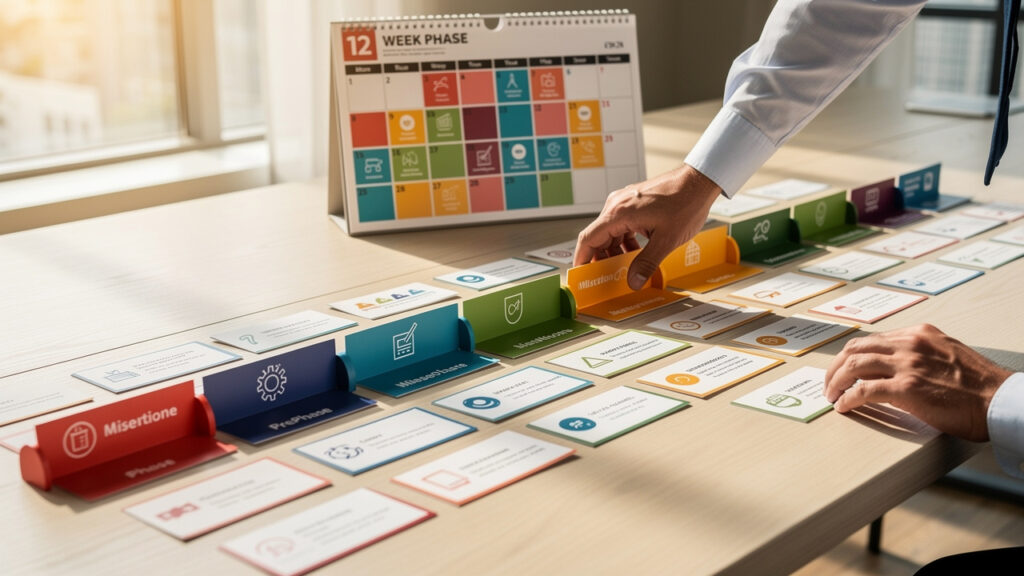
Our standard 12‑week MVP roadmap keeps validation, design, and engineering tightly aligned. Each stage has clear outputs that investors can understand.
Stage 1 – Discovery & Strategic Mapping (Weeks 1–3)
Weeks one to three align everyone around the same picture of problem, user, and outcome. Founders, product leaders, and our senior engineers work through:
- User path mapping from first moment of pain to full relief
- A hypothesis matrix of the three riskiest assumptions and how the MVP will test them
- A simple data strategy: which behavioral events the product will track from day one
Outputs include a validated ICP, a prioritized feature list (using MoSCoW and RICE), and a draft architecture that fits the growth plan.
Stage 2 – Prototyping & User Feedback (Weeks 4–6)
Weeks four to six turn ideas into interactive prototypes that feel like the real product. We:
- Build high‑fidelity flows with AI‑assisted design tools
- Run sessions with 10–15 target users completing real tasks
- Measure time to value, aiming for an “aha” moment in under two minutes
“No facts exist inside the building, only opinions.” – Steve Blank
We tighten loops based on where users hesitate or give up, stripping away friction until most reach the main outcome with minimal help. Several clients have used KVY TECH prototypes to secure $500k+ in letters of intent before any production code was written.
Stage 3 – Engineering & Infrastructure (Weeks 7–10)
With designs stable and assumptions clear, weeks seven to ten focus on building a modular monolith that can later split into services as traffic grows. Typical stacks include:
- Frontend: React or Next.js
- Backend: Node.js or Python
- Data: PostgreSQL or MongoDB
From day one we wire in:
- Security basics (encryption, HTTPS, input checks, audit trails)
- Logging, metrics, and tracing for both system health and user behavior
- A full CI/CD pipeline with automated tests and repeatable deployments
Our senior Vietnamese engineers have shipped many stacks like this, often matching US/UK quality in around ten weeks at roughly half the cost of local agencies.
Choosing The Right Tech Stack For Investor Confidence
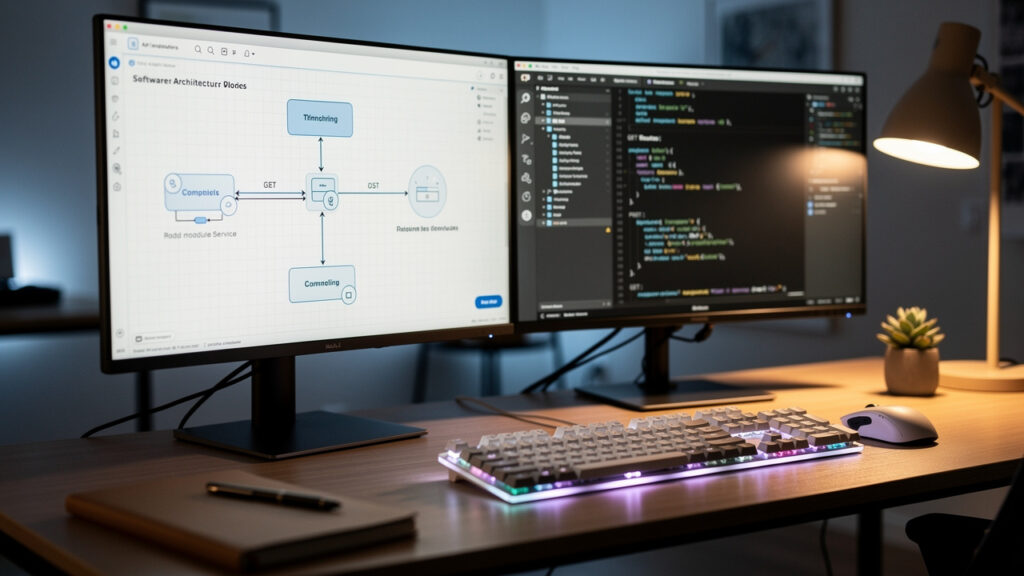
Tech stack choices send strong signals about your ability to grow and hire. We choose well‑known, scalable tools that make technical reviews easy and hiring straightforward.
Modern Frontend And Backend Standards
For web products, we typically combine:
- React or Next.js for fast, component‑based frontends
- Node.js for event‑heavy or real‑time systems, or Python where data science and AI matter most
- PostgreSQL for complex transactions and reporting, or MongoDB when schemas will change often
For mobile and web from a single codebase, Flutter is often a strong fit. We expose functionality through clean REST APIs or GraphQL when clients need flexible querying across related objects. These choices pass most investor code reviews because they are proven, widely adopted, and easy to staff.
AI Integration Architecture For Production Readiness
By 2026, many standout MVPs include AI features, but how AI connects to the rest of the system matters as much as the model itself. We help teams choose between:
- Direct API calls to providers such as OpenAI or Anthropic when latency and complexity are low
- Retrieval‑Augmented Generation (RAG) when the model must stay aligned with your own data
- Fine‑tuning for narrow, repeatable tasks that need consistent behavior
We also:
- Manage costs with caching, careful prompt design, and usage tracking
- Extend observability into AI behavior (latency, error rates, user satisfaction)
- Factor in regulation (e.g., EU AI Act), data residency, and explainability for sensitive fields
In one fintech MVP, our Production AI team at KVY TECH cut manual document checks from four hours to about fifteen minutes by wiring a RAG pipeline into an existing review workflow.
KVY TECH’s Approach To Building Predictable, Fundable MVPs
Great ideas still fail when execution is chaotic. We built our delivery model at KVY TECH around predictability, transparency, and senior ownership.
Our Predictability Guarantee – What Sets Us Apart
Many founders come to us after agencies that missed deadlines or kept changing estimates. Our process counters that with:
- Fixed scopes per phase, with clear acceptance tests agreed upfront
- Weekly demos of working software, not just slides
- Fortnightly strategy check‑ins to adjust priorities based on data
- A living risk register so surprises are rare and discussed early
This discipline keeps our on‑time, on‑budget rate above 95% across more than fifty MVPs.
“KVY TECH was the first partner who delivered exactly what they promised, when they promised it. It made our fundraising timeline far less stressful.” – KVY TECH client
Senior-Led Excellence Meets Startup-Friendly Pricing
Lower rates often signal junior teams. Our model is the opposite. At KVY TECH, senior engineers (8+ years) lead every project, bringing experience across SaaS, commerce, and AI.
Because we operate from Vietnam, our cost base stays lower than US or UK agencies of similar skill, so typical rates sit around $50–$80/hour instead of $150–$200/hour. A standard MVP that might cost $250k–$350k in a western market often lands near $140k with us.
This does more than save cash. It extends runway and allows extra iteration cycles, which in turn give better product metrics for investors. Our team is also used to plugging new MVPs into existing tools via APIs instead of forcing full rebuilds.
Measuring Success – The KPIs That Prove Investor Readiness
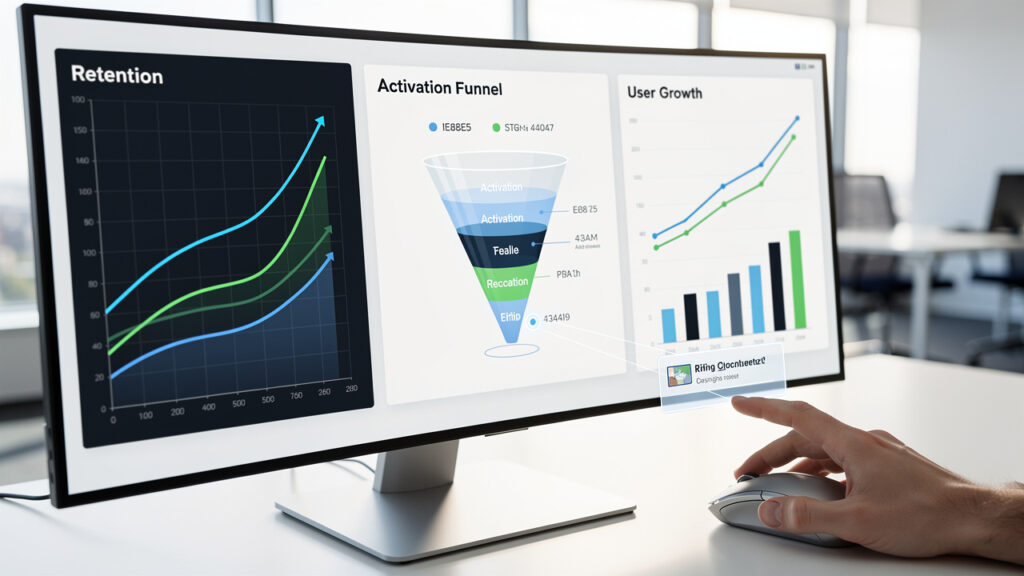
An investor-ready MVP is measured by what users do, not by how polished it looks. We focus on three core KPIs from the start: activation, retention, and advocacy.
Activation Rate – The “AHA!” Moment Metric
Activation rate measures how many new users hit the main value of the product in their first session (e.g., first invoice sent, first ticket closed, first shipment completed). For B2B SaaS, a healthy activation rate often sits between 40–60%.
When activation drops below ~20%, something is broken in onboarding or value communication. We help teams:
- Define a single, clear activation event
- Track it through product analytics
- Adjust copy, flows, and guidance until most users reach an “aha” moment within two minutes
Retention Cohorts – Are Users Coming Back
Activation without retention is a leaky bucket. Cohort analysis tracks users from sign‑up and measures how many come back on day 7, 30, 60, and beyond.
- For engagement‑heavy tools, a weekly retention rate above ~40% is a strong sign.
- For workflow tools that sit at the center of a job, 70%+ is achievable.
When week‑4 retention falls under ~10%, we look for missing reasons to return. We:
- Add useful reminders (notifications, emails, in‑product nudges tied to outcomes)
- Study which features power users rely on and feed those insights back into the roadmap
Net Promoter Score And Organic Referrals
Net Promoter Score (NPS) asks: “How likely are you to recommend this product to a friend or colleague, from 0 to 10?” Scores above 50 often signal strong product–market fit, but we also pay close attention to actual referrals.
We bake sharing loops into MVPs through:
- Shareable reports and exports
- Collaborative workspaces
- Simple invite flows and referral mechanics
“The only way to win is to learn faster than anyone else.” – Eric Ries, author of The Lean Startup
Tracking how often these loops fire in the first 90 days gives investors confidence that growth can compound without relying only on paid channels.
Avoiding The Most Expensive MVP Mistakes In 2026
Avoiding a few common traps can save hundreds of thousands of dollars and months of time.
Mistake 1 – Building Without Validating The Problem
Skipping validation because the idea feels obvious is the fastest way to waste $800k+. Even experienced founders fall into this when they live inside the problem space and assume others see it the same way.
We insist on a Discovery phase for every MVP, even when funding is already secured. During this phase we test problem severity, user behavior, and willingness to pay before locking scope. A small spend here often prevents hundreds of thousands in misaligned build costs later.
Mistake 2 – Feature Creep And Scope Expansion
Feature creep usually starts with “just one more thing.” Each extra item adds weeks and increases the chance of bugs, while hiding the core value behind clutter.
We lean on MoSCoW prioritization and maintain a firm “will not have” list for version one. Part of our role is to say “no” on behalf of the product and its investors so the MVP ships on time and clearly tests its main hypothesis.
Mistake 3 – Choosing The Wrong Tech Stack For Your Growth Plan
Picking a tech stack only because the first hire knows it can feel convenient now and painful later. We have seen teams hit scale and then face expensive rebuilds because early choices could not meet security needs, data demands, or hiring plans.
By stepping back to look at your three‑year roadmap, we suggest languages and platforms that can grow with the business and reduce the risk of a full migration just as traction appears.
Mistake 4 – Ignoring Security And Compliance Until It Is Too Late
Security often hides behind “we will handle that later.” When later arrives, the bill is usually ten times higher than adding basic safeguards from the start. In fintech, healthcare, and HR, weak controls can also kill enterprise deals during the first security questionnaire.
At KVY TECH, we add encryption, audit logs, and permission checks as part of the MVP, then outline a path toward standards such as SOC 2 or HIPAA for later rounds. This way, security supports growth instead of blocking it.
Real Success – How KVY TECH MVPs Achieve Traction And Funding
Real metrics speak louder than promises. Here are two examples of investor-ready MVPs shipped with KVY TECH.
Case Study – B2B SaaS Logistics Tool
A logistics startup wanted to reduce the time coordinators spent re‑routing shipments when delays hit. The deeper challenge was trust: managers feared fully automated decisions.
We designed an MVP that ran in shadow mode. The AI engine suggested new routes and cost options, while humans approved or edited them with one click. Stack choices:
- Frontend: React
- Backend: Python plus a language model API
The build took 10 weeks and cost about $95k. Within 60 days of launch the product reached:
- Around 1,200 active users
- 52% activation rate
- $18k in MRR
These numbers helped the team close a $1.2M seed round, and the engagement charts from KVY TECH became the centerpiece of their investor conversations.
Case Study – Consumer AI Mobile App
Another client wanted to test an AI‑based personal finance assistant in a crowded market. Discovery revealed that trying to “do everything” would bury the product. Users cared most about one thing: automatic, accurate expense categorization when receipts piled up.
We focused the MVP on that single promise using:
- A Flutter app for iOS and Android
- Receipt scanning and bank connections via Plaid
- A RAG pipeline to match transactions with real‑world merchant data
The project ran for 12 weeks with a budget of about $110k. A Product Hunt launch drove around 3,400 downloads in the first month, with day‑7 retention near 38% and an NPS of 61. Strong interest from small business owners led the founders to pivot toward a B2B expense tool in version two, and the clear data story helped them close a $750k pre‑seed round.
Conclusion
By 2026, an MVP that merely “works” is not enough. Investors expect real usage, clear learning loops, and a technical foundation they can trust. The new rules for a predictable, investor‑ready MVP center on three pillars:
- Start from a sharp, validated problem
- Build on a sound, observable technical base
- Drive toward activation, retention, and referral metrics that show people care
At KVY TECH, our 12‑week roadmap, senior‑led engineering model, and Vietnamese delivery center are designed to support that path. We combine careful validation with production‑grade builds and a focus on the numbers that matter to both customers and investors.
Founders stand at a fork: one path has rushed builds, vague metrics, and unpredictable partners; the other has structured discovery, transparent progress, and an MVP that doubles as a fundraising asset. If the second path sounds better, you can schedule a free 30‑minute MVP Strategy Session with our team. We will review your idea, stress‑test the problem and ICP, and outline how a 12‑week plan with KVY TECH can turn it into an investor‑ready product.
FAQs
Question 1 – How Much Does It Actually Cost To Build An Investor-Ready MVP In 2026
Costs vary by scope, design depth, and AI complexity, but clear ranges exist:
- Simple MVPs with one core workflow: $30k–$55k
- Standard SaaS with multi‑user dashboards and a few integrations: $55k–$140k
- AI‑heavy products with automation or language models: $140k–$300k+
Because KVY TECH operates from Vietnam with senior talent, we often deliver investor‑ready MVPs in the $50k–$150k range that might cost $180k–$400k with US‑based firms. We recommend reserving 10–15% of the budget for discovery and focusing the rest on a narrow feature set that tests your main assumptions.
Question 2 – How Long Should It Take To Build An MVP
Timelines depend on complexity, but some patterns are consistent:
- Very simple MVPs: 5–8 weeks
- Standard SaaS MVPs: 8–14 weeks
- AI‑powered products with complex data work: 12–16 weeks
At KVY TECH, most investor‑ready builds follow our 12‑week roadmap, which balances speed with quality. Be cautious of partners who promise a rich MVP in four weeks or drag basic builds past twenty weeks without clear reasons.
Question 3 – What Is The Difference Between An MVP And A Prototype
A prototype is a clickable or visual model that looks real but does not fully work. It aligns stakeholders or shows investors the concept and usually takes 1–4 weeks with budgets around $5k–$25k.
An MVP is a working product that real customers can use and pay for. It typically needs 8–14 weeks and budgets starting around $55k for SaaS. The main difference is data: only an MVP generates real behavior, retention, and revenue numbers, which is why investors treat it as stronger evidence.
Question 4 – Do I Need An MVP If I Can Get Pre-Seed Funding On An Idea
Raising on an idea can feel exciting, but it hides risk. Studies still show that more than 40% of funded startups fail because they build something the market does not want.
Even with money in the bank, a well‑planned MVP greatly lowers that risk by forcing the team to test its story with real users before scaling. Investors in 2026 reward this discipline: pre‑seed money spent on validation plus a focused MVP often leads to better terms at Series A. At KVY TECH, we help funded teams turn part of their round into a sharp MVP instead of an oversized version one that is hard to change.
Question 5 – How Do I Know If My Idea Is Worth Building Into An MVP
Start with the pain test. Ask whether your idea removes a costly, frequent problem that people already work around with spreadsheets or manual tasks. Look for signs such as:
- Users paying for clumsy tools that do not really fit
- Hours lost each week on repetitive, error‑prone work
- Repeated complaints in forums, reviews, or communities
Try to speak with at least thirty people from your target segment. If it is hard to find that many who care enough to talk, demand may be weak. Our Discovery and Validation service at KVY TECH, typically $5k–$12k, helps teams run these checks before committing to a six‑figure build.
Question 6 – Can You Build My MVP And Then Hand It Off To My In-House Team
Yes. Many clients ask us to build the MVP, then hand it over for their in‑house team to scale.
We design projects so internal teams can take full control after launch:
- Clear documentation and architecture diagrams
- Recorded code walkthroughs and knowledge‑transfer sessions
- A 2–4 week overlap period where our engineers pair with yours on tickets and deployments
Because our codebases follow standard patterns and include observability from day one, new teams can read and extend them without guesswork. If helpful, we stay on as advisors on a light retainer while your internal group grows the product.