


Predicting the future has always been the ultimate high-stakes game in business. But what if you could turn dry, analytical forecasts into a concrete action plan in a matter of seconds? Welcome to the era where algorithms don’t just tell you what might happen-they draft the script for how you should dominate that future.
In 2026, the wall between “knowing” and “doing” has finally crumbled. The fusion of predictive analytics and generative artificial intelligence is no longer a luxury for tech giants; it is the new standard for any organization aiming to remain relevant in a hyper-volatile market.
For decades, predictive models have functioned like a high-end compass-accurate, but requiring a human to actually walk the path. We knew there was an 85% chance of a supply chain disruption or a 20% spike in customer churn, but the bridge from that percentage to a real-world campaign or a logistics pivot remained manual, slow, and prone to error.
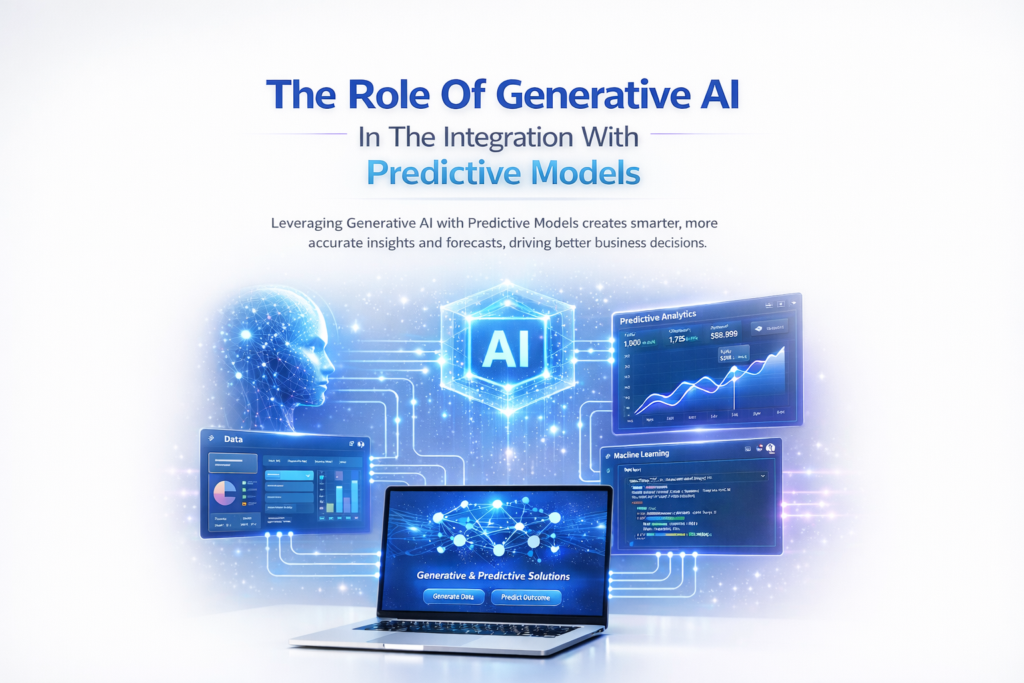
The integration of Generative AI changes the fundamental chemistry of data. It acts as the “executive brain” that sits atop the “analytical eyes” of predictive models. According to recent 2026 industry benchmarks, enterprises that have successfully implemented this dual-layered AI approach see a 45% faster response time to market shifts compared to those relying on traditional dashboards alone.
Generative AI integration: From static forecasts to autonomous execution
When we discuss Generative AI Integration, we aren’t just talking about putting a chatbot on top of an Excel sheet. We are talking about a deep architectural synergy where the output of a predictive engine becomes the prompt for a generative one.
Translating complex probability into strategic narrative
Predictive models speak in vectors, tensors, and probabilities. Most stakeholders speak in goals and strategies. Generative AI serves as the ultimate translator. Instead of presenting a CTO with a raw risk score, the integrated system generates a comprehensive executive summary, explaining why the risk is increasing and outlining three specific mitigation paths based on historical company data.
Autonomous scenario planning and stress testing
One of the most powerful trends this year is the use of GenAI to create synthetic “stress environments.” By taking the baseline forecast from a predictive model, GenAI can simulate thousands of “what-if” scenarios-ranging from sudden geopolitical shifts to local power outages-allowing businesses to battle-test their strategies before spending a single dollar.
Hyper-personalization at an industrial scale
If a predictive model identifies a segment of users likely to upgrade their subscription, the Generative AI Integration layer doesn’t just flag them for a sales call. It automatically generates a personalized video message, drafts a custom discount offer based on that specific user’s browsing history, and schedules the delivery for the exact minute the user is most likely to be active.
The technical pillars: How developers build the bridge
For the developers and architects behind these systems, the challenge is moving beyond simple API calls to creating a unified data loop.
Multimodal data enrichment
Modern predictive models are no longer limited to structured rows and columns. By integrating GenAI, systems can now “read” unstructured data-such as legal contracts, social media sentiment, or even satellite imagery-and convert these into high-quality features for the predictive engine. This multimodal approach has boosted forecast accuracy by an average of 15% in sector-specific applications like real estate and agriculture.
The rise of agentic workflows
The current shift is moving toward “Agents” rather than “Tools.” In an integrated environment, the predictive model acts as the trigger. For example, if a model predicts a stock-out for a specific component, the AI Agent (powered by GenAI) proactively reaches out to alternative suppliers, negotiates terms based on pre-set parameters, and presents a finalized contract for human approval.
Addressing the latency and hallucination gap
A major hurdle for CTOs remains the reliability of generative outputs. To combat this, 2026 has seen the rise of “Predictive Guardrails.” These are secondary analytical models that cross-reference every piece of content or action generated by the AI against the original predictive data to ensure the machine isn’t “hallucinating” a reality that the data doesn’t support.

Quantifying the impact: 2026 performance metrics
The following data represents the average performance gains observed in firms that have moved toward full integration:
| Metric | Traditional Predictive Analytics | Integrated GenAI & Predictive | Improvement |
| Decision Cycle Time | 4 – 6 Days | < 60 Minutes | ~98% Reduction |
| Resource Utilization | 62% | 88% | +26% Efficiency |
| Customer Retention Rate | +3% Yearly | +12% Yearly | 4x Growth |
| Operational Costs | Baseline | -30% | Significant Savings |
Strategic considerations for the CTO’s roadmap
As a technology leader, the goal isn’t just to “add AI,” but to weave it into the fabric of the company’s decision-making process.
Prioritizing small over large models
While GPT-sized models are impressive, many CTOs are finding more success in integrating Small Language Models (SLMs). These models are faster, cheaper to run on-premise, and can be fine-tuned specifically for the company’s proprietary predictive datasets, ensuring higher security and lower latency.
The democratization of data
Integration allows every department-from HR to Marketing-to interact with complex predictive insights through natural language. This “democratization” means that the Data Science team is no longer a bottleneck for every minor query, allowing them to focus on high-level architectural improvements rather than generating routine reports.
Ethical AI and the human-in-the-loop
As AI begins to suggest and execute actions, the role of the human shifts from “worker” to “editor.” Establishing clear ethical frameworks and “kill-switches” for autonomous actions is a top priority for 2026. Every automated decision must be traceable back to the predictive data that triggered it.
The future: Towards self-healing business systems
We are rapidly approaching the concept of the self-healing enterprise. In this stage of evolution, the integration of generative and predictive models allows a company to sense a problem, predict its impact, and generate a solution before the human staff even realizes something was wrong.
Whether it’s automatically re-routing a shipping fleet to avoid a storm or re-allocating cloud server capacity before a traffic spike hits, the synergy of these two technologies is creating a more resilient, responsive, and intelligent global economy.
At KVY, we are actively building the foundation for self-healing business systems by combining advanced generative AI with predictive analytics to help organizations anticipate disruptions and respond in real time. Our solutions empower enterprises to automate decision-making, enhance operational resilience, and scale intelligently in an increasingly dynamic environment.
Ready to explore how self-healing systems can transform your business? Contact our team today to discuss your needs.

FAQ: Understanding generative AI integration and predictive models
1. How does Generative AI Integration differ from using AI models independently? Traditionally, AI models operated in silos. Predictive models provided the “what” (data forecasts), while humans had to figure out the “how” (execution). Integration creates a seamless loop where the predictive engine identifies a trend or risk, and the generative layer immediately drafts the content, code, or strategy to address it. It moves the workflow from raw insight to instant action.
2. Can Generative AI actually improve the accuracy of my existing predictive models? Yes, in two primary ways. First, GenAI can process unstructured data (like customer emails or social media) to create new, high-quality features for predictive engines. Second, it can generate Synthetic Data to fill gaps in your datasets, allowing predictive models to learn how to handle rare “black swan” events where historical data is insufficient.
3. What are the main benefits for a CTO in merging these two technologies?
The primary benefits include a significant reduction in the Decision Cycle Time, lower operational overhead, and the democratization of data. By adding a generative layer, non-technical stakeholders can query complex predictive databases using natural language, freeing up the data science team for high-level architectural work.
4. How does this integration impact the customer experience (CX)?
It enables Hyper-Personalization at scale. Instead of sending generic “at-risk” emails to customers likely to churn (as identified by a predictive model), the integrated system can generate unique offers, personalized video messages, or custom landing pages in real-time that specifically address each individual’s behavior and pain points.
5. What are the biggest technical hurdles for developers during implementation?
The most critical challenges are Latency and Hallucination Control. Running heavy LLMs alongside complex predictive workloads requires optimized infrastructure. Developers must also implement strict “Guardrails” to ensure the generative layer does not misinterpret the statistical outputs of the predictive model or “hallucinate” facts that contradict the data.
6. Is it expensive to deploy integrated Generative and Predictive systems?
While the initial setup for infrastructure and fine-tuning can be high, the 2026 trend is shifting toward Small Language Models (SLMs). These specialized models are much cheaper to run and can be hosted on-premise, offering a faster ROI (Return on Investment) by drastically reducing cloud compute costs and manual labor hours.
7. How can organizations ensure data privacy when using Generative AI with proprietary data?
CTOs are increasingly adopting Retrieval-Augmented Generation (RAG) and on-premise deployments. This allows the AI to “consult” private predictive data without ever sending it to public servers. Using federated learning or private cloud instances ensures that sensitive business intelligence remains behind the company’s firewall.
8. Will this integration eventually replace human decision-makers?
No, it changes the human role from “producer” to “editor.” While the system can predict risks and generate solutions, humans are still essential for high-level strategic oversight, ethical judgment, and managing complex relationships. The goal is to remove the “grunt work” of data synthesis so leaders can focus on high-impact creativity and strategy.