


Most B2B ecommerce platforms treat a quote request like a contact form. A buyer submits a message, someone on the sales team gets an email, and what happens next lives in that person’s inbox. That gap between “a buyer asked for a price” and “a buyer placed an order” is where RFQ ecommerce lives, and it is far more structural than a quick phone call or a shared spreadsheet. An RFQ (request for quote) is not a feature bolted onto a storefront. It is a document with a lifecycle: a state that moves from requested to priced to sent to negotiated to approved or rejected to converted into an order, or left to expire. Treat RFQ ecommerce as a process with real states, and the rest of B2B buying, from approval chains to punchout, starts to make sense. Treat it as a contact form with extra fields, and the same broken workflow gets rebuilt every time a new edge case shows up.
Why B2B buying doesn’t fit add-to-cart

A consumer cart assumes a fixed price the shopper can see, a single person deciding, and payment on the spot. None of those assumptions hold for most B2B purchases. Pricing is often negotiated per account, per volume, or per contract. Several people weigh in before money moves: a buyer who needs the product, a manager who signs off on spend, and sometimes a finance team that checks it against a budget cycle. Configurations are frequently custom, quantities are large enough that a per-unit discount matters, and payment doesn’t happen at checkout, it happens on terms (net 30, net 60) after an invoice. RFQ ecommerce exists because the buying process itself is genuinely different, not because B2B buyers dislike self-service or find a cart confusing. Build for the real process and self-service gets easier, not harder, because buyers can see exactly where their request stands instead of waiting on a reply.
That difference reaches back into catalog and pricing design too. A product page built for a fixed, published price doesn’t have anywhere to put “price depends on quantity and contract,” so teams end up hiding real pricing behind a “contact us” link that dumps everything into a generic inbox. A catalog designed with RFQ ecommerce in mind instead lets a buyer configure what they need, quantities and options included, and submit that configuration directly into the quote-based ordering workflow, no separate email required. The catalog and the quote stop being two disconnected systems and become one continuous path from browsing to a priced, negotiable request.
The quote as a first-class document
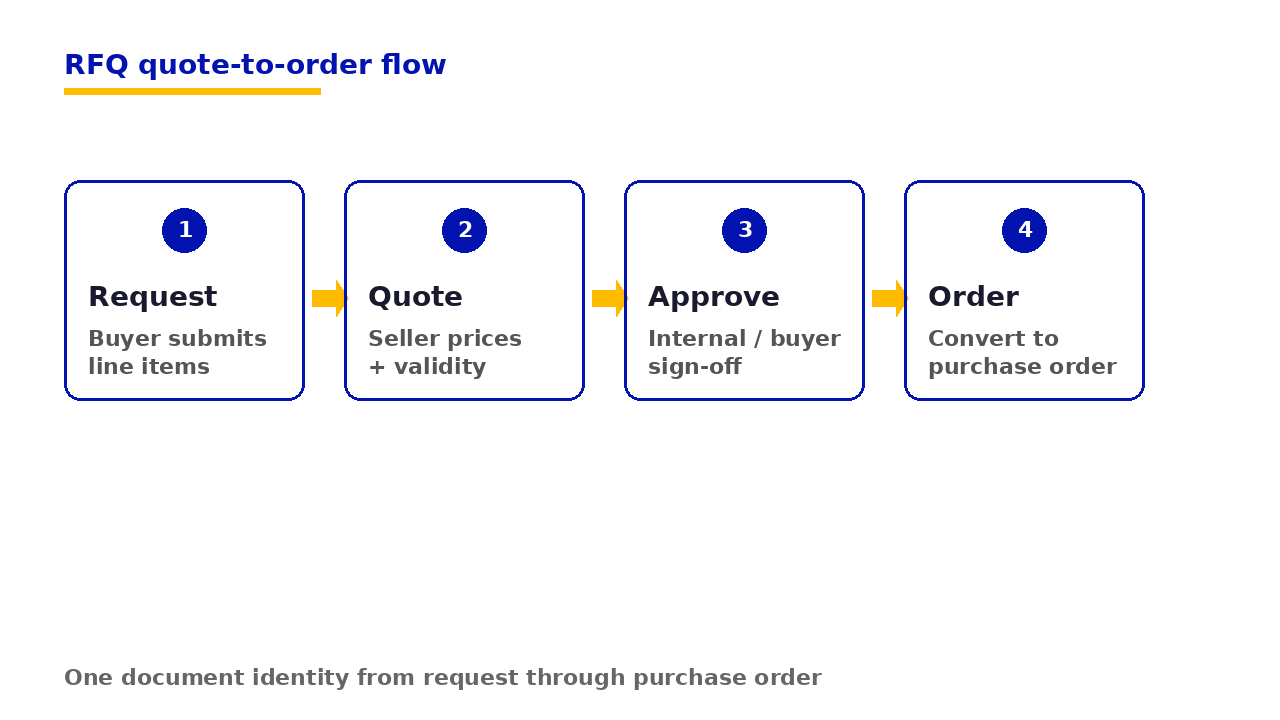
Once RFQ ecommerce is treated as a document rather than a message, its lifecycle becomes the thing worth designing carefully: requested, priced, sent, negotiated, approved or rejected, converted, or expired. Each state needs its own record, a timestamp, and an owner, because a quote that sits unpriced for three days is a different problem than one that’s been sent and gone quiet.
Walk one quote through that lifecycle and the reason for each state becomes obvious. A buyer requests pricing on a configured order; that’s requested. A sales rep prices it against cost and margin rules; that’s priced. It goes out to the buyer; that’s sent. The buyer counters on volume or delivery timing; that’s negotiated, and it might loop through priced and sent more than once before it settles. Someone on the buyer’s side signs off; that’s approved. The buyer converts it into a live order without re-entering a single line item; that’s converted. Or nobody acts within the validity window, and it quietly expires. Skip any one of those states in the data model and that stage of the process has to live somewhere else, usually in a person’s memory or an inbox thread nobody else can see.
Two details matter more than they first appear to. The first is versioning: when a buyer pushes back on price and the seller revises the quote, that should create a new version with the old one preserved, not an overwrite. Without versioning, nobody can answer “what did we actually agree to” once a deal is under way. The second is expiry: a quote priced against last quarter’s costs is a liability if a buyer converts it into an order six months later. RFQ ecommerce systems that skip expiry logic quietly accumulate stale pricing that eventually turns into a support ticket, or worse, an order fulfilled at a loss.
Approval workflows: the other half
Approvals show up on both sides of an RFQ ecommerce transaction. On the buyer’s side, a purchase might need sign-off from a department head, then finance, before it’s placed. On the seller’s side, a sales rep offering a discount past a certain threshold might need a manager’s approval before the quote can be sent. Both are the same underlying problem: a decision that has to pass through a person before the process can continue.
The most common failure mode is implementing approvals as email notifications instead of document states. “Please approve this quote” lands in an inbox, gets buried, and the quote sits in limbo with no record of who was supposed to act or by when. A real approval workflow is a state machine: the quote or order cannot move to the next stage until the required approver has acted, and the system tracks exactly who approved what, and when. That distinction, blocking state versus polite reminder, is what separates an RFQ ecommerce flow that scales from one that quietly falls apart once more than a handful of accounts are using it.
Punchout, briefly

Punchout deserves a mention at the concept level, even in an article that isn’t a deep technical standards guide. It lets a buyer’s procurement system open a seller’s catalog, let the buyer build a cart, and send that cart back into the buyer’s own purchase order and approval process, all without the buyer leaving their internal system. The mechanics run on established standards like cXML and OCI PunchOut, and most SMEs don’t need to implement it on day one.
What matters earlier is designing the RFQ ecommerce data model so punchout isn’t a rewrite later. If quotes, pricing, and approvals already exist as first-class records with clear states, adding a punchout integration on top is a connector. If they don’t, punchout forces the same restructuring that should have happened from the start, just under a deadline instead of on a roadmap.
Where RFQ ecommerce implementations go wrong

Most broken RFQ ecommerce implementations share a handful of the same root causes:
- Treating quotes as a lead-gen form field instead of a stateful document with its own lifecycle.
- No expiry logic, so buyers place orders against month-old, and sometimes quarter-old, pricing.
- Approvals implemented as email chains instead of states that actually block progress until someone acts.
- No versioning, so a negotiated quote silently overwrites the original with no audit trail of what changed.
- Punchout bolted on after launch instead of designed into the data model from the start.
- A sales team working from a parallel spreadsheet because the platform doesn’t track what they actually need, so the two disagree within weeks.
None of these are exotic mistakes. They’re what happens when RFQ ecommerce gets scoped as a form-and-email feature instead of a process with real states, and the cost shows up later rather than at launch. Building it correctly the first time (states, versioning, expiry, and blocking approvals) usually takes a few extra weeks of design work up front. Skipping that step doesn’t remove the work, it just moves it downstream, where it shows up as sales operations manually reconciling a spreadsheet against whatever the platform actually recorded, one deal at a time.
Build it as a process, not a feature
RFQ ecommerce is really the third piece of a larger picture. What makes B2B ecommerce structurally different from B2C covers the shape of the problem: multiple stakeholders, negotiated terms, longer cycles. B2B payment terms covers the money side: net terms, credit limits, and how invoicing actually gets paid. RFQ and quote-to-order cover the process that connects the two, turning a negotiated conversation into a document that a buyer, an approver, and a fulfillment team can all trust.
Done well, RFQ ecommerce becomes the backbone that ties catalog, pricing, approvals, and fulfillment into one traceable flow instead of three disconnected systems held together by email. That’s the difference between B2B ecommerce that scales past a handful of accounts and one that needs a person manually reconciling spreadsheets every time a deal closes.
If your quote process still lives in email and spreadsheets, a B2B ecommerce technical audit is a practical next step: a structured look at where your RFQ ecommerce flow breaks down and what it would take to turn it into a real system.
Frequently asked questions
What is RFQ in ecommerce?
RFQ (request for quote) ecommerce is a buying flow where a buyer asks for a custom price instead of checking out at a listed one. The request moves through states: requested, priced, sent, negotiated, approved or rejected, converted into an order, or left to expire.
What is quote-to-order?
Quote-to-order is the process that turns an accepted quote into a live order without the buyer re-entering line items, quantities, or pricing. It preserves the negotiated price and terms from the quote and carries them straight into fulfillment.
How do approval workflows work in B2B ecommerce?
They work as document states, not email threads. A quote or order moves through defined approval stages (for example, department head, then finance) and cannot progress until each stage signs off, with the system tracking who approved what and when.
What is punchout in B2B ecommerce?
Punchout lets a buyer’s procurement system open a seller’s catalog, build a cart, and send it back into the buyer’s own purchase order and approval process, so the buyer never has to leave their internal system to place the order.