


Most B2B ecommerce projects start with a reasonable sounding sentence: we will use the same platform as our consumer store, just for our trade customers. Twelve months later the same project has a spreadsheet for customer pricing, a manual approval process running over email, an accounts team reconciling invoices the platform cannot issue, and a checkout that quietly assumes everyone pays by card today.
Nothing went wrong technically. The platform did exactly what it was built for. It just was not built for a buyer who is an organization rather than a person.
That is the real difference behind every B2B ecommerce vs B2C comparison, and everything below follows from it. A B2C sale is one person deciding, paying, and receiving. A B2B sale is a company buying: several people involved, prices negotiated in advance, payment on terms after delivery, and an ERP that considers itself the source of truth. Build for that from the start and B2B ecommerce is very tractable. Retrofit it later and you get the spreadsheet.
One clarification, because the terms get used interchangeably: this article is about B2B ecommerce vs B2C for a single seller, meaning you selling your own catalog to business customers through your own portal. If you are building a platform where multiple independent sellers transact with business buyers, that is a B2B marketplace instead, and the architecture question is different.
This is not an academic distinction. Founders across Southeast Asia are running headlong into the B2B ecommerce vs B2C question right now, because the region’s manufacturers, distributors, and wholesalers are digitizing sales channels that used to run entirely on phone calls and PDF price lists. The team that treats a B2B ecommerce vs B2C decision as a checkbox on a consumer platform’s settings page is the team that rebuilds eighteen months later.
The five things B2B has that B2C does not
1. The customer is an organization, not a login
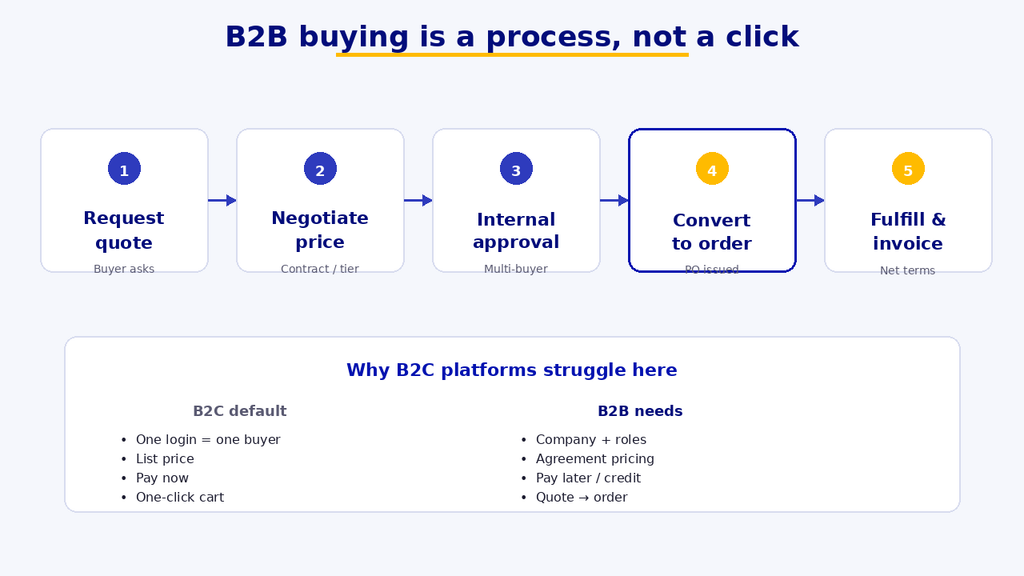
In B2C, account equals person. In B2B, a customer is a company with multiple buyers inside it: a procurement lead, a site manager, a finance approver, each needing different permissions against shared entitlements such as the company’s negotiated prices, its credit line, its order history, and its delivery addresses.
This is where the B2B ecommerce vs B2C gap breaks consumer platforms first, at the data model, which is the most expensive place to break. Common workarounds, like shared logins passed around a purchasing department or one account per person with pricing duplicated across them, fail at exactly the moment you need them most: audit trails (“who approved this?”), staff turnover, and any attempt to enforce spending limits. If you build one thing correctly first, build the company account model.
2. Prices are agreements, not numbers
A consumer store has a price, optionally discounted. A B2B business has price agreements: this customer gets contract pricing on this category, that one has volume tiers negotiated last quarter, a third buys on a price list tied to their annual commitment. Prices can be customer specific, quantity dependent, contract dated, and confidential from each other.
The retrofit, customer groups plus discount rules, works until the exceptions arrive, and in B2B the exceptions are the business. What you actually need is pricing resolved per customer per product at request time, with rules that are effective dated (so last quarter’s agreement stays knowable) and auditable.
3. Payment happens after delivery
B2C checkout assumes payment now, by card. Most B2B trade runs on net terms: goods ship, an invoice issues, payment arrives in 30 or 60 days, within a credit limit your finance team set. That means checkout must be able to not take money, validating available credit instead, and creating an obligation rather than a transaction.
This is not a payment method plugin; it is a different checkout outcome, with credit limits, exposure tracking, and invoicing attached. It is also the single most common reason B2B teams end up running orders through email: the store literally cannot complete the sale the way the business sells.
4. Buying is a process, not a click
B2B purchases frequently start as a request for quote, not an add to cart: the buyer specifies quantities and requirements, sales responds with pricing and lead times, the two sides iterate, and only then does a quote become an order. On the buyer’s side, that order may need internal approval above a threshold, sometimes several levels of it.
A consumer checkout has no concept of a document that negotiates before it becomes an order, or of a purchase pausing for someone else’s sign off. Bolting approvals on with notifications produces a workflow everyone routes around. That quote to order and approval lifecycle is a topic in its own right, and we will cover it in a dedicated guide.
5. The ERP thinks it is in charge (and it usually is)
In B2C, the store is the system of record for orders and often for inventory. In B2B, your ERP typically owns customers, pricing agreements, stock, credit, and invoices, and the storefront is a channel onto it. That inverts the integration relationship: rather than pushing orders out, your commerce layer must read authoritative data (customer specific prices, real availability, credit status) and write orders back in a form the ERP accepts.
The practical consequences decide the project: what is real time versus synced, what happens when the ERP is unavailable, and which system wins when they disagree. Teams that treat ERP integration as a late phase task discover it is actually the architecture, and it is the piece of every B2B ecommerce vs B2C comparison that consumer platform demos never show.
Underneath all five differences sits one practical test worth running on your own operation: pull up your current order process and count how many steps happen outside the platform, in email, in spreadsheets, in a phone call to confirm a price. Every one of those steps is the platform quietly admitting it was not built for this buyer. That gap is the entire B2B ecommerce vs B2C argument, made visible in your own operations rather than in a framework on a page.
Why “just configure the B2C platform” keeps failing
Each of the five above is individually workaroundable, which is exactly the trap. Teams solve them one at a time, a customer group hack for pricing, a form for quotes, an email approval, a nightly ERP sync, and each fix is defensible on the day it is made. Two years later the business runs on five workarounds that interlock, no one can change pricing logic without breaking approvals, and the “cheap” platform is the most expensive thing in the operation.
The failure is not the individual workarounds. It is that B2B’s requirements are structural: they live in the data model (company accounts, price agreements) and in the transaction lifecycle (quote, approval, order, invoice, payment). Structure cannot be configured in later; it can only be rebuilt around, which is the whole reason a B2B ecommerce vs B2C comparison has to happen at the architecture stage, not after launch.
None of this requires exotic engineering. It requires sequencing: solve the company account model and pricing agreements first, because every later feature depends on them, then layer in checkout outcomes, quotes, and ERP integration once the foundation holds. Teams that reverse that order, bolting a company account model onto a checkout that was built for individuals, end up rebuilding the checkout twice.
How to build for B2B ecommerce vs B2C correctly
- Model the company first. Companies, employees, roles, and entitlements before anything else. Every later feature, pricing, approvals, credit, hangs off this.
- Treat pricing as versioned agreements. Effective dated, customer scoped, auditable. Not a discount stack.
- Design checkout to have more than one outcome. Pay now (card) and place on account (credit check, invoice). The second is not an edge case.
- Make the quote a first class document. Something that exists, gets revised, expires, and converts into an order, not a contact form that emails sales.
- Decide ERP ownership on day one. Which system owns which entity, what is live versus synced, and the degraded mode behaviour when integration fails.
On foundations, this is a good fit for modular commerce frameworks, where B2B capability is built as modules and workflows over an owned core rather than configured around a consumer platform’s assumptions. Medusa, for example, documents B2B patterns including company accounts, spending limits, quotes, and approval flows, worth evaluating if you are weighing an owned platform. If you are trying to decide whether that route fits your team, a dedicated decision framework walks through the model fit, capability, and economics questions in order.
Is custom B2B ecommerce right for you?
Not always. If your trade customers all pay the same list price, pay by card at checkout, and your ERP is happy with a nightly export, a well configured consumer platform may genuinely serve you, and you should take that deal.
Custom becomes the rational choice when the five structural requirements above are actually your business: real negotiated pricing, real credit terms, real multi person buying, real ERP authority. At that point you are not paying for flexibility you might use someday; you are paying to stop maintaining five workarounds that fight each other.
If you are not sure which side of that line you are on, that is exactly what an audit answers: your requirements mapped against what your current stack can express, and an honest read on whether the gap justifies a build. Request a B2B ecommerce technical audit, including the answer “your platform is fine, fix the process instead,” when that is the truth.
FAQ
What is the difference between B2B and B2C ecommerce?
B2C serves an individual buying for themselves and paying immediately. B2B serves an organization: multiple buyers under one company account, customer specific negotiated pricing, payment on credit terms after delivery, quotes and internal approvals before ordering, and an ERP that usually owns the authoritative data. That is the core of every B2B ecommerce vs B2C comparison.
Why is B2B ecommerce harder to build than B2C?
Because the differences are structural rather than cosmetic. Company accounts and price agreements live in the data model; quotes, approvals, and invoicing live in the transaction lifecycle. Both are difficult to retrofit into a platform designed around one person paying by card.
Can you use Shopify or a B2C platform for B2B ecommerce?
For simple trade sales, uniform pricing, card payment, light ERP needs, often yes. It breaks down when you need genuine per customer price agreements, net terms with credit limits, multi level approvals, or the ERP as source of truth; those tend to become workarounds rather than features.
What is customer specific pricing in B2B ecommerce?
Prices resolved per customer rather than published per product: contract rates, volume tiers, and negotiated agreements that differ between customers and change over time. Implemented properly it is effective dated and auditable, so historical orders remain explicable.