


Introduction
Inventory management usually feels manageable when ecommerce operations run from one warehouse. The team knows where products are stored, stock updates are easier to check, and fulfillment rules are relatively simple. But once the business expands to multiple warehouses, retail locations, marketplaces, or regional fulfillment points, stock visibility can start to break quickly.
The issue is not only that the business has more inventory. The real issue is that inventory now has context. A product may be available in one warehouse, reserved in another, blocked for wholesale orders, delayed in transfer, damaged, returned, or too far from the customer to fulfill profitably.
For CEOs, this creates a serious operational problem. The ecommerce platform may show stock as available, but the warehouse cannot fulfill the order. A product may be physically available, but the system marks it as unavailable online. A campaign may push traffic to a product that cannot be shipped from the right location. These errors create lost sales, overselling, delayed fulfillment, and weaker customer trust.
Multi warehouse ecommerce inventory requires more than basic stock tracking. It needs clear inventory sync, stock allocation rules, OMS and WMS integration, and often ERP integration to keep operations aligned.
Key takeaways
Multi warehouse inventory is more complex because stock availability depends on location, reservation, fulfillment rules, delivery cost, channel allocation, and customer priority.
Stock visibility often breaks when ecommerce, OMS, WMS, ERP, and marketplace systems do not update inventory consistently.
A simple total stock number is not enough for multi location ecommerce. Businesses need to know which stock can actually be sold and fulfilled.
Overselling often happens when multiple channels compete for the same inventory without clear reservation and allocation logic.
Better inventory integration helps teams reduce manual checks, improve fulfillment accuracy, and protect customer trust as operations expand.
Why single warehouse logic fails in multi warehouse operations
Single warehouse ecommerce often depends on a simple question: how many units are available? Multi warehouse ecommerce requires a better question: which units are available, where are they located, and can they be fulfilled for this customer?
This difference matters because one product can have different availability depending on location and business rules. A warehouse in one region may have stock, but shipping from that location may be too slow or expensive. Another warehouse may be closer to the customer, but its stock may already be reserved for marketplace orders. A third location may hold returned products that are not ready to sell.
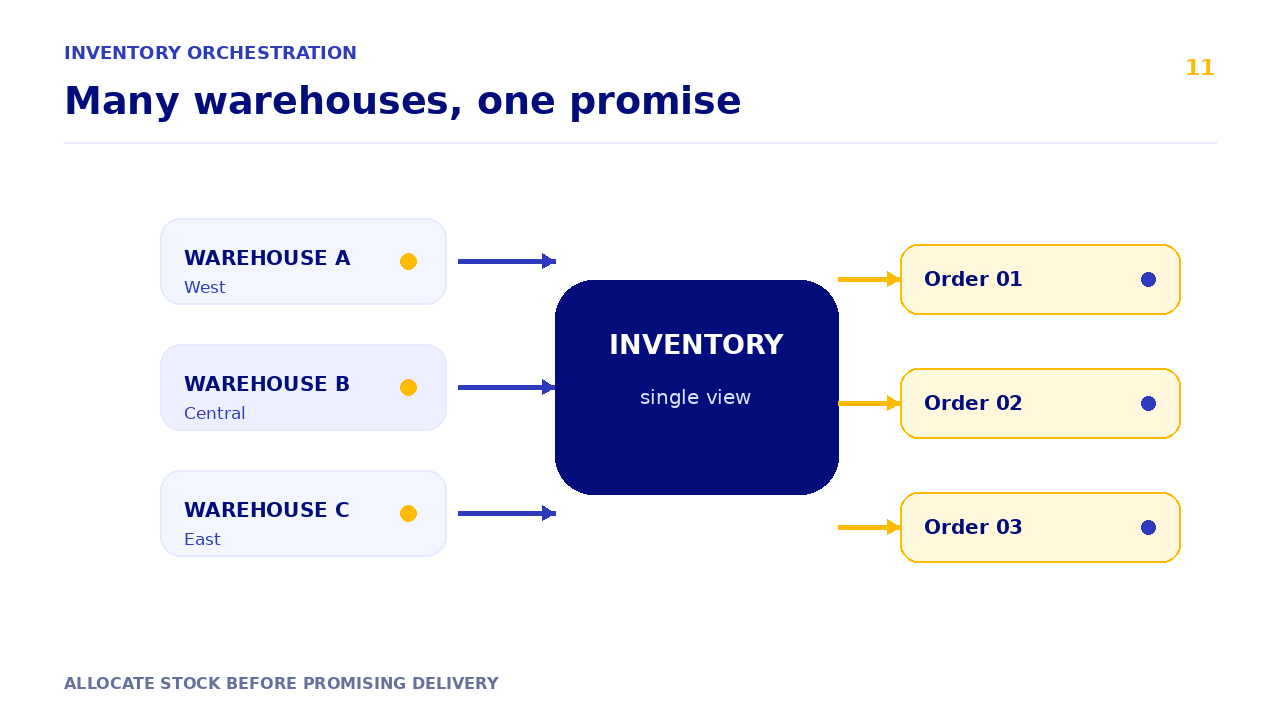
If the ecommerce platform only reads one total stock number, it cannot understand these details. It may show a product as available even when the available units are not suitable for that order. It may also hide products that are sellable from another location.
This is where many growing ecommerce businesses start to see stock mismatch. The system is technically showing inventory, but it is not showing operationally useful inventory.
Where stock visibility usually breaks

Stock visibility usually breaks at the points where systems need to exchange data quickly and accurately. For example, the ecommerce platform may receive orders, the OMS may route them, the WMS may process picking and packing, the ERP may manage inventory records, and marketplaces may sell from the same stock pool.
If these systems do not sync correctly, each team starts working from a different version of inventory truth.
Common breakpoints include delayed stock updates after orders are placed, manual stock adjustments that do not sync across systems, warehouse transfers that are not reflected online, returns that are counted before quality checks, and marketplace sales that reduce inventory too late.
The result is operational confusion. Customer service does not know which stock number is correct. Marketing promotes products with unreliable availability. Warehouse teams receive orders they cannot fulfill. Finance sees revenue that may later become refunds or cancellations.
In a multi warehouse setup, these small delays can become expensive because errors multiply across locations and channels.
The hidden cost of poor stock allocation

Stock allocation is one of the most important parts of multi warehouse ecommerce inventory. It decides which stock is available for which channel, customer, region, or order type.
Without clear stock allocation rules, multiple channels can compete for the same inventory. The website may sell a product at the same time a marketplace order is placed. A B2B sales team may promise stock to a key account while the ecommerce system still shows the same units to retail customers. A warehouse may reserve inventory for one region, but another channel may consume it first.
This creates overselling and broken customer promises. Once a customer places an order, they expect the product to be secured. If the business later cancels the order because stock was already used somewhere else, trust is damaged.
Stock allocation should answer practical questions:
Which stock is available for ecommerce?
Which stock is reserved for wholesale or B2B customers?
Which warehouse should fulfill this order?
Should low-stock products be blocked from certain channels?
How should inventory be shared across marketplaces and the main website?
When these rules are not defined, teams rely on manual checks. That may work for a short time, but it becomes unreliable as volume grows.
Why OMS, WMS, and ERP integration matters
Multi warehouse operations need stronger system coordination because no single platform usually owns the full process alone.
An OMS helps manage order routing and decide where orders should be fulfilled from. A WMS helps warehouse teams handle picking, packing, stock movement, and warehouse-level accuracy. An ERP often manages business records, finance, procurement, purchasing, and broader inventory control.
The ecommerce platform is only one part of the system. It shows product availability to customers and captures orders, but it needs reliable data from the systems behind it.
This is why OMS WMS integration and ERP integration matter. When these systems are connected properly, the business can reduce stock mismatch and improve fulfillment decisions. Orders can be routed based on location, available stock, delivery cost, customer priority, and warehouse capacity.
The goal is not just to move data between systems. The goal is to create a shared view of what can be sold, where it should be fulfilled, and how the order should move through operations.
How to improve multi warehouse stock visibility

The first step is to define the source of truth for inventory. Some businesses use ERP as the source of truth. Others rely on WMS for warehouse-level stock and OMS for order routing. What matters most is that every team knows which system owns which data.
The second step is to separate total stock from available to sell stock. Total stock may include items that are reserved, damaged, returned, in transfer, or blocked for specific customers. Available to sell stock should reflect what can actually be offered to customers.
The third step is to define stock allocation rules. This includes how inventory is shared across ecommerce, marketplaces, B2B accounts, retail locations, and regional warehouses.
The fourth step is to review sync frequency. Not every business needs instant updates for every inventory event, but high-demand products, low-stock items, and marketplace-connected SKUs usually need faster updates.
The fifth step is to create exception reporting. Leaders should know when stock mismatch happens, which products are affected, which warehouse creates the most errors, and how often orders are delayed or cancelled due to inventory problems.
For growing ecommerce teams, the practical goal is not perfect inventory in every second. The goal is reliable enough visibility to sell confidently, fulfill accurately, and reduce manual correction.
When to reassess your inventory architecture

A business should reassess its inventory setup when stock mismatch becomes a regular operational issue. Warning signs include frequent overselling, rising cancellations, warehouse teams manually checking stock, customer service asking for order status updates, campaigns promoting unavailable products, or marketplaces showing different availability from the main website.
These are signs that the current ecommerce architecture may not support the new operational reality.
Before adding another warehouse or sales channel, CEOs should review whether the current system can handle multi location inventory, stock allocation, fulfillment routing, and integration between ecommerce, OMS, WMS, and ERP.
KVY can help ecommerce businesses assess and build inventory workflows that connect platforms, warehouses, and business systems. The focus should stay practical: better visibility, fewer stock errors, and a more reliable fulfillment foundation.
Conclusion
Multi warehouse ecommerce inventory becomes complex because stock is no longer just a number. It depends on location, availability, reservations, customer rules, channel allocation, fulfillment cost, and system timing.
When inventory visibility breaks, businesses face lost sales, overselling, delayed fulfillment, wasted marketing spend, and declining customer trust. These problems are not always caused by warehouse mistakes. They often come from disconnected systems and unclear stock rules.
As operations expand, CEOs should treat inventory visibility as a core revenue capability. A stronger inventory architecture helps the business sell with more confidence, route orders more accurately, and scale without creating constant operational firefighting.
Frequently asked questions
1. What is multi warehouse ecommerce inventory?
Multi warehouse ecommerce inventory refers to managing stock across multiple warehouses, fulfillment locations, retail sites, or regional storage points while selling through ecommerce channels.
2. Why does stock visibility break in multi warehouse ecommerce?
Stock visibility breaks when ecommerce, OMS, WMS, ERP, and marketplace systems do not sync inventory consistently. It can also break when stock allocation, reservation, and fulfillment rules are unclear.
3. What is stock allocation in ecommerce?
Stock allocation defines how inventory is reserved or shared across channels, customers, warehouses, and order types. It helps prevent overselling and ensures the right stock is available for the right demand.
4. Why is a total stock number not enough?
A total stock number does not show whether units are reserved, damaged, returned, in transfer, or available in the right warehouse. Multi warehouse ecommerce needs available to sell inventory, not just total inventory.
5. When should a business improve inventory integration?
A business should improve inventory integration when stock mismatch, overselling, manual checks, order delays, or channel-level inventory conflicts become frequent.
Resources
- Shopify, multi-location inventory management
Link: https://www.shopify.com/blog/multi-location-inventory-management - Shopify, inventory management guide
Link: https://www.shopify.com/blog/inventory-management - Oracle NetSuite, warehouse management system guide
Link: https://www.netsuite.com/portal/resource/articles/inventory-management/warehouse-management-system-wms.shtml - Oracle NetSuite, inventory management resources
Link: https://www.netsuite.com/portal/resource/articles/inventory-management.shtml - IBM, what is an order management system
Link: https://www.ibm.com/topics/order-management - McKinsey, operations and distribution technology insights
Link: https://www.mckinsey.com/industries/industrials/our-insights/distribution-blog/harnessing-the-power-of-ai-in-distribution-operations