


Minimum order quantity (MOQ) is the smallest amount of a product a supplier is willing to sell in one order, typically set by product type and by the seller’s business model. A distributor might sell a cleaning chemical only in lots of 10 cases, or a manufacturer might refuse orders under 500 units of a printed carton.
Minimum order value (MOV) is the same idea measured in money. The order must reach a minimum amount, whatever the mix of items. So MOQs can be based on units or on value, and many wholesalers use both: a minimum order quantity per item and an MOV per order.
Unlike B2C, where single-unit orders are the norm, B2B transactions revolve around bulk purchases, which makes the minimum order quantity an everyday business rule. The minimum order quantity affects which orders are worth packing, which production runs are worth starting, what inventory levels the warehouse carries and how much cash is tied up in it.
This article is for owners and operations heads at wholesalers, distributors and manufacturers who sell online while orders also arrive through sales reps and marketplaces, and an ERP runs the back office. It covers how minimum order quantity is set, how to enforce it on a webstore without losing orders, and how to keep it agreeing with the ERP and the warehouse. For a platform-by-platform comparison, see our guide to choosing a wholesale ecommerce platform.
Understanding minimum order quantity (MOQ) and minimum order value
Both rules stop orders that cost more to fulfil than they earn.
| Rule | What it measures | Where it is usually checked | Typical use |
|---|---|---|---|
| Minimum order quantity (MOQ) | Units, cases or another unit of measure, per item | On each order line | Production runs, full cases, made-to-order items |
| MOV (order value) | Money, across the whole order | On the order total | Delivery and handling cost per drop, mixed baskets |
Understanding minimum order quantity starts with its wording. A minimum order quantity (MOQ) says: you can buy this item, but not less than this amount. It is attached to an item, sometimes to an item and a customer, and it is counted in a unit: each, box, case or pallet.
The supplier’s minimum order quantity often comes from its own costs. A production run has setup costs and production costs, a print plate has a fixed cost, and a pallet costs the same to move whether it is full or half empty.
An MOV sets a minimum amount per order. For example, a hypothetical distributor delivers free across town but only for orders of SGD 300 or more, because each delivery drop has a fixed cost. The buyer can mix any items to get there.
Fixed vs calculated minimum order quantity
A fixed minimum order quantity is a set number that buyers must meet to complete a purchase, regardless of their needs. A calculated MOQ is based on demand forecasts, cost structures and operational efficiency, and it is reviewed as those change.
Fixed MOQs are easy to explain and enforce. Calculated MOQs follow the business more closely but need data and a review routine. Many sellers start fixed and move the high-volume items to a calculated minimum order quantity later.
Why sellers enforce minimum order quantity (MOQ) rules
Sellers enforce minimum order quantities to cover costs, manage customer demand and protect profitability. A high MOQ is common where smaller orders fail to cover production costs and logistics costs.
Covering setup, production and administrative costs
Every order carries fixed costs that do not shrink with the order: picking, packing, invoicing, credit checks and delivery. In manufacturing, every run also carries setup costs such as machine changeovers and cleaning, and production costs per batch.
A minimum order quantity spreads those fixed costs over enough units to leave a profit margin on every order. It also cuts administrative costs and administrative expenses, because fewer, larger orders mean fewer documents to raise and reconcile, and it brings lower unit costs through economies of scale.
Holding costs, storage costs and cash flow
Inventory costs money while it waits. Holding costs (also called carrying costs, or inventory carrying costs) include storage costs, warehouse space, insurance, handling, shrinkage and the cash tied up in goods that have not been sold.
For a manufacturer, a minimum order quantity that matches the production batch keeps inventory levels close to what was made, so finished goods do not pile up. For a distributor, matching the supplier’s MOQ to its own selling MOQ protects cash flow, warehouse space and storage capacity. A badly set minimum means increased storage costs on one side or lost orders on the other.
MOQs make demand forecasts more useful. When orders arrive in predictable lots, the supply chain can be planned against forecast demand, and the business can meet customer demand without falling into excess inventory. It also separates immediate demand from stock bought only to reach a minimum.
By predicting sales volume, suppliers can adjust minimum order quantity levels to avoid surplus stock or stockouts. MOQ policies also give a firm footing for supplier agreements that protect both their interests and those of their customers.
What shapes a supplier’s minimum order quantity (MOQ)
The supplier’s MOQ is not arbitrary. It reflects how the product is made, stored and shipped, and the raw materials behind it.
Raw materials and production processes
Raw material availability affects the MOQ suppliers can offer. If raw materials such as a resin, fabric or pigment are bought in drums or rolls, the supplier wants each drum used in one run, and scarce raw materials push the minimum up. Production processes with long changeovers push the minimum up; production processes that switch quickly allow a low minimum order quantity.
Production schedules across the supply chain matter too. A supplier that runs a product once a month will set its minimum around those production schedules, and a high MOQ can mean longer lead times for order fulfilment while the buyer waits for the next slot.
Shelf life and perishable goods
Shelf life changes the maths. For food, chemicals, paints and coatings, a large lot that expires before it sells is a loss, not a saving. Perishable goods often carry low MOQs or MOQs set per batch date, so the buyer can sell through before expiry.
A high minimum order quantity brings increased storage costs and obsolescence risk. Packaging changes, a new model or a regulation change can leave the buyer holding units that no longer sell.
In inventory management, regularly reviewing sales data helps identify slow-moving inventory before it becomes dead stock, and it shows which minimums need to come down.
Components and factory location
Using off-the-shelf components can reduce MOQs, because the supplier is not ordering custom parts through its supply chain for one buyer. Domestic manufacturers often offer lower MOQs than overseas factories, since their runs and shipments are smaller. Both trade off against unit costs and supply chain efficiency.
How to calculate minimum order quantity (MOQ)
To calculate minimum order quantity well, do not start from a round number. It involves analysing operations, forecasting demand and calculating costs.
Set it too high and smaller customers walk away. Set it too low and orders erode profitability. The ideal MOQ balances the supplier’s costs and the buyer’s needs.
The common EOQ-style calculation (minimum order quantity formula)
A common method uses the economic order quantity (EOQ) formula, which finds the order size that minimises total inventory costs: ordering costs plus inventory holding costs. The economic order quantity is also called the minimum cost order quantity. Many guides present the same maths as a minimum order quantity formula:
EOQ = √(2 × D × S ÷ H), where D is annual demand in units, S is the ordering cost per order (placing it or setting up the run), and H is the annual holding cost per unit (unit cost × annual holding cost percentage).
For example, with hypothetical numbers: a distributor sells 12,000 units a year, each order or production setup costs USD 150, and each unit costs USD 4 with an annual holding cost of 25%, so H is USD 1.
EOQ = √(2 × 12,000 × 150 ÷ 1) = √3,600,000, which is about 1,897 units. That is the optimal order quantity under those assumptions, and a worked minimum order quantity example: below or above it, total inventory costs rise. The seller might round it to the nearest full pallet and use it as the starting point for a calculated MOQ.
The formula assumes steady demand and fixed costs, so treat the result as a starting point, not an answer. Break-even analysis is the other common check: below the break even point, the order does not cover its fixed costs. Comparing the economic order quantity with the break even point shows how much room there is to lower the minimum.
After the calculation, three practical checks usually move the number. It should match a case pack or pallet, so the warehouse never splits a carton. It should fit storage capacity and shelf life. And it should be compared with what key customers actually order, using historical sales data and market demand.
When sellers calculate MOQ this way, they reduce both surplus stock and stockouts, keep inventory turnover rates healthy and see reduced inventory costs over the year.
Setting minimum order quantity (MOQ) by product, customer group or order
Once the number is known, decide what it attaches to. The choice changes how the rule is stored and enforced.
Minimum order quantity per product
The simplest rule is a minimum per item: 10 cases of this SKU, 50 metres of that cable. It suits items with production or packaging constraints. Fast-moving products can carry low MOQs, while custom or speciality items may need a high MOQ because of production complexity or supply chain constraints.
Minimum order quantity per customer group
Some sellers set different minimums for different buyers: a lower minimum quantity for retailers, a higher one for distributors who get deeper prices. Segmenting customers by purchasing volume or product type lets the MOQ follow the business relationship.
The cost is complexity: every item may now have several minimums, and the system must know which customer group is ordering before it can check anything.
Minimum per order (MOV)
An order-level rule checks the basket as a whole, by value or by total units. It suits catalogues with many small items where no single line justifies a delivery, and it is where an MOV is most useful.
Case packs and order multiples

Buyers often order by the case, while stock and prices are kept per unit. A case pack is the fixed number of units in a shipping carton: 6, 12 or 24. An order multiple says the quantity must be a whole number of cases.
A minimum order quantity and a multiple work together. For example, a hypothetical rule of a minimum quantity of 48 units in multiples of 12 accepts 48, 60 and 72, and rejects 50.
If the webstore enforces the minimum but not the multiple, the warehouse opens cartons, repacks loose units and loses the profit margin the rule was meant to protect. If the minimum is not itself a multiple of the case pack, no valid order equals the minimum, which confuses buyers.
Keeping minimum order quantity (MOQ) in line with the ERP and warehouse units

Most supply chain problems with MOQs are unit problems. The ERP keeps stock in a base unit, often each. The webstore may sell in cases. The warehouse picks in cartons or pallets.
A minimum order quantity of 10 has to say 10 of what. If the webstore checks 10 each while the ERP item master says 10 cases, an order that passed online can be rejected or under-picked downstream.
The safer pattern is to keep the MOQ, the multiple and the unit conversion on the item in the ERP and sync them to the store. The store then displays and enforces them, and orders reach the ERP already in valid units.
Inventory levels should be reserved in the base unit, with conversion factors held in one place. When the ERP is the single source for those fields, effective inventory management follows, and alerts can fire when inventory falls below the level needed to fill a minimum order: stock counts, reservations and invoices agree with what the buyer ordered.
When a sales rep’s MOQ differs from the webstore
Online, the MOQ (minimum order quantity) is a hard rule. In the field, a sales rep can agree to “just this once” on the phone. Buyers notice quickly and start routing small orders through the rep, which moves cost back to the most expensive channel.
The reverse also happens. The rep quotes 5 cases from an old price list while the webstore asks for 10, and the buyer calls to complain.
The fix is one minimum order quantity per item and customer group, held in one system and shown in the same way to reps and buyers. Reps can still make exceptions, but through the same exception process as everyone else, so the decision is visible and counted.
MOQ exceptions: who approves them and how they are recorded
Exceptions to an MOQ (minimum order quantity) are normal. A key account needs a top-up, a new customer wants a trial order, or a product is being cleared to free cash flow. The problem is exceptions nobody can see.
- Who approves: the sales manager for commercial reasons, and operations when the exception affects production, picking or stock.
- What is recorded: the order line, the normal minimum order quantity, the quantity accepted, the reason, the approver and the date.
- How long it lasts: one order, or a dated period for a customer, with an end date the system enforces.
- What is reviewed: a monthly list of exceptions by customer and item, which shows where the MOQ itself is wrong.
If one item needs an exception on most orders, its minimum order quantity is set too high for how that item really sells.
When MOQ blocking helps, and when a warning is enough
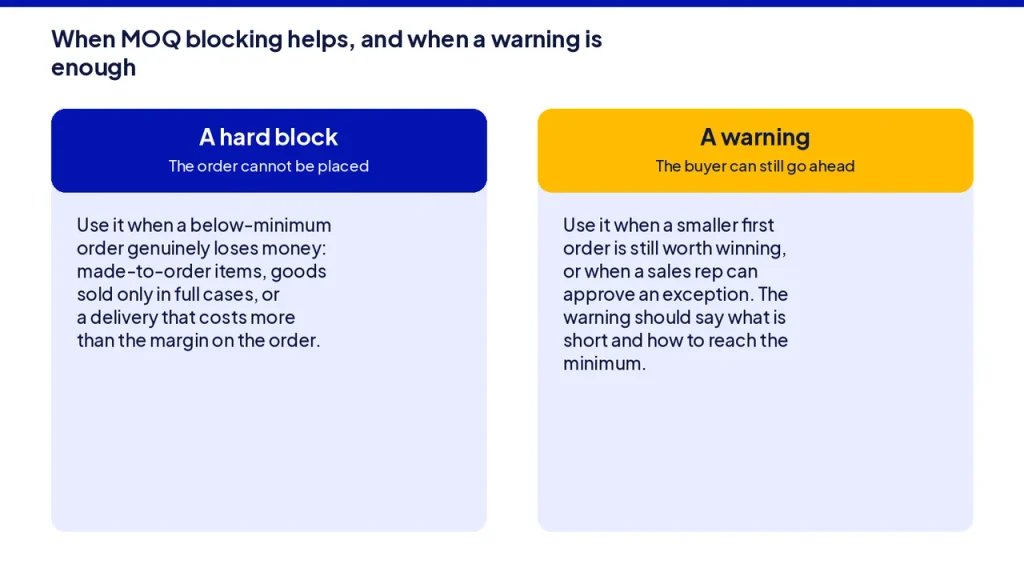
A hard block stops the order until the minimum order quantity is met. It helps when a below-minimum order genuinely loses money: made-to-order items that need a production run, items sold only in full cases, or deliveries that cost more than the margin on the order.
A soft rule warns the buyer and lets the order through, sometimes with a handling fee. It suits first orders, samples and top-ups for regular customers, where the relationship is worth more than one order’s profit margin.
Many wholesalers use both: hard blocks on a few items, warnings on the rest. Whichever you choose, write the rule down so the webstore, reps and customer service apply the same one.
Showing the MOQ error so the buyer does not drop the order
An MOQ message at checkout, after the buyer has filled a cart, is where orders get abandoned. The rule should be visible earlier and the message should say how to fix it.
- Show the minimum order quantity and the multiple on the product page and in search results, next to the price.
- Set the quantity field to start at the minimum quantity and step in valid order quantities.
- Put the message on the order line, not in a general error: “Minimum 10 cases. Add 4 more cases to order this item.”
- For an MOV, show progress, for example “SGD 120 to go” in a hypothetical case, and suggest items the buyer usually orders.
- Never empty the cart. Let the buyer save it, adjust it or request an exception.
- Use the same wording in the rep’s ordering app and in order confirmations.
Flexible MOQ options that keep orders coming
Once your minimum order quantity policy is set, make it clear, transparent and fair to buyers. Strategic inventory management means the minimum supports sales, not only the warehouse. Several options keep the rule while giving buyers room.
Offer tiered pricing and volume discounts above the minimum order quantity to reward larger quantities, whether buyers meet low MOQs or need flexibility with smaller ones. Product bundles help buyers meet MOQ thresholds without buying large quantities of a single product, which is useful where the catalogue has many product types.
Offering lower MOQ options for first-time buyers, or smaller MOQs for specific business models, eases the burden of a high initial investment. A low minimum order quantity on a trial order helps a new buyer save money while testing the product. Pre-order campaigns can validate demand before manufacturing, so the seller commits to a run only when enough orders are in.
For complex MOQs, segment customers by purchasing volume or product type and set the minimum order quantity requirements to match.
The buyer’s side of MOQ
Buyers in B2B eCommerce face MOQ structures that vary by supplier, and the minimum shapes their purchasing decisions. A high minimum order quantity can be daunting for small or start-up businesses, yet buyers who negotiate can gain discounts on bulk purchases or better payment terms.
Buyers often negotiate to lower the supplier’s MOQ or to find a balance that works for both parties, which can bring preferential pricing, lower risk and early access to new stock.
Small businesses can also pool orders with others. Dropshipping suppliers may offer low MOQs, but usually with higher per-unit prices, while larger quantities bring economies of scale and more flexibility in fulfilling orders.
Sellers benefit from understanding this side. A minimum that suits the warehouse but not the buyer’s shelf, cash flow or ability to store inventory sends the order to a competitor. Sellers who offer low MOQs on slower items often win more frequent orders.
Using inventory management software to manage MOQs
Effective inventory management of minimum order quantity policies at scale needs dependable systems. Inventory management systems and ERP platforms use real-time data so both sides can track MOQ compliance, manage inventory levels and anticipate demand shifts.
Inventory management software lets businesses track needs, improve demand forecasts and calculate MOQ again as demand changes. Advanced inventory management tools can analyse real-time data to suggest MOQ changes, so the business neither inflates inventory levels nor loses sales to insufficient quantities.
To optimise inventory management, review sales volume, inventory turnover and exceptions together, alongside current market conditions. A minimum that never triggers is too low; one that triggers on every order is too high. Inventory management software that shows both helps optimise inventory management without guesswork.
Where MOQ policies are heading
MOQ in B2B eCommerce is changing with personalised products and just-in-time manufacturing. Dynamic MOQ adjustments based on customer demand and historical buying behaviour are becoming possible as systems collect better data.
Flexible and customisable products bring more complex MOQs, and businesses need policies that support smaller, more frequent orders. For ecommerce brands, staying ahead means treating MOQ as an adaptable strategy that can:
- Improve profit margins by reducing waste and excess inventory
- Improve inventory control through accurate demand forecasting
- Strengthen buyer and seller relationships through clear MOQ structures and fair negotiations
Frequently asked questions about minimum order quantity
What is minimum order quantity (MOQ) in B2B eCommerce?
Minimum order quantity (MOQ) is the smallest number of units a supplier is willing to sell to a buyer in one order. It is a common practice in B2B eCommerce, where suppliers require bulk purchases to cover production, shipping and handling costs.
Why do suppliers set a high minimum order quantity?
Suppliers set high MOQs to cover production costs, packaging and logistics. Larger quantities spread fixed costs and lower per-unit costs, and they make inventory management easier.
How can small businesses handle a high minimum order quantity?
Small businesses can negotiate with suppliers to reduce the minimum, or pool their orders with other small businesses. Some suppliers, especially dropshipping suppliers, offer flexible MOQ policies that allow smaller quantities.
How do MOQs affect buyer and supplier relationships?
MOQ policies can strengthen or strain the relationship. Buyers who regularly meet or exceed the MOQ can earn negotiated discounts, preferential pricing and better payment terms. If a high MOQ goes too far, buyers look elsewhere, so open communication and some flexibility matter.
How do I calculate minimum order quantity for my business?
To calculate MOQ, use demand forecasts and sales data, work out ordering costs and inventory holding costs, and start from an EOQ-style optimal order quantity or a break-even check. Then round to case packs and check it against how key customers actually order. ERP and inventory management systems make this easier with current data.
What happens if the minimum order quantity is too high or too low?
Too high, and it alienates buyers, especially small businesses, and leaves unsold inventory that strains cash flow. Too low, and orders may not cover operational costs or protect the profit margin. A balanced minimum avoids both excess inventory and stockouts.
Can minimum order quantities differ by product type?
MOQs can and should differ by product type and market conditions. Fast-moving products may carry low MOQs, while custom or speciality items may need a high MOQ because of production complexity or supply chain constraints.
How can businesses avoid stockouts while enforcing MOQs?
Monitor demand and inventory levels closely with predictive analytics and inventory management systems. Flexible MOQ policies, such as tiered pricing or adjustable minimums based on buyer behaviour, reduce the risk of running out of stock.
What are common mistakes when setting MOQs?
The common mistakes are minimums too high for smaller customers, ignoring seasonal changes in demand, and one MOQ for every product type or business need. Skipping forecasting or real-time inventory tracking leads to slow inventory turnover or missed sales.
Can MOQs be negotiated with suppliers?
A supplier’s MOQ can often be negotiated, especially for long-term or high-volume customers. Better MOQ terms can bring cost savings, more flexible ordering and better service, which benefits both buyer and seller.
Minimum order quantity, stock and prices on one system
A minimum order quantity is only as reliable as the stock and unit data behind it. A Malaysian paint manufacturer has run its orders and stock on a system KVY built and has operated since January 2025. Sales orders and stock availability sit on one system, customer price groups are resolved per item and per unit of measure, and stock reservations are kept as their own records so stock is never promised twice.
That is the kind of system KVY TECH works on in B2B ecommerce development: minimums, units and stock held where the ERP and the webstore agree, so an order accepted online is an order the warehouse can ship.
If you are weighing this for your own business, start with a plan. In two to three weeks we map how the system would connect to your ERP, warehouse, payments and sales channels, set out the build in phases with the cost to run it over three years, and give a fixed quote for the first phase. You keep the plan whatever you decide.