


Most marketplaces don’t fail because the platform broke. They stall because the platform quietly stopped fitting how the business actually runs and nobody could point to the exact moment it happened.
If you run a marketplace, you’ve probably felt it. A vendor request that should take an afternoon turns into a week. A report your team needs lives in three exported spreadsheets instead of one dashboard. A feature that’s obvious for your model isn’t possible without “a workaround.” None of it is a crisis on its own. Together, they’re a signal worth reading carefully.
The hard question isn’t “is my platform limited?” every platform is limited by design. The question is whether the limit you’re hitting is a temporary annoyance you can work around, or a structural ceiling that will keep costing you more the longer you stay. This piece is about telling those two apart before the decision makes itself for you.

What counts as a marketplace platform limitation?
A marketplace platform limitation is any point where the platform you built your marketplace on a no-code builder or SaaS like Sharetribe, Arcadier, CS-Cart, a Shopify multi-vendor app, or a managed platform like Mirakl can no longer support how your business needs to operate, forcing manual workarounds, bolt-on tools, or compromises to your own model.
One clarification, because the phrase gets used two ways. This isn’t about being capped as a seller on someone else’s marketplace (Amazon listing limits, a restricted Facebook Marketplace account). It’s about the platform you operate your own marketplace on and the operational limits that start dictating what your business can and can’t do.
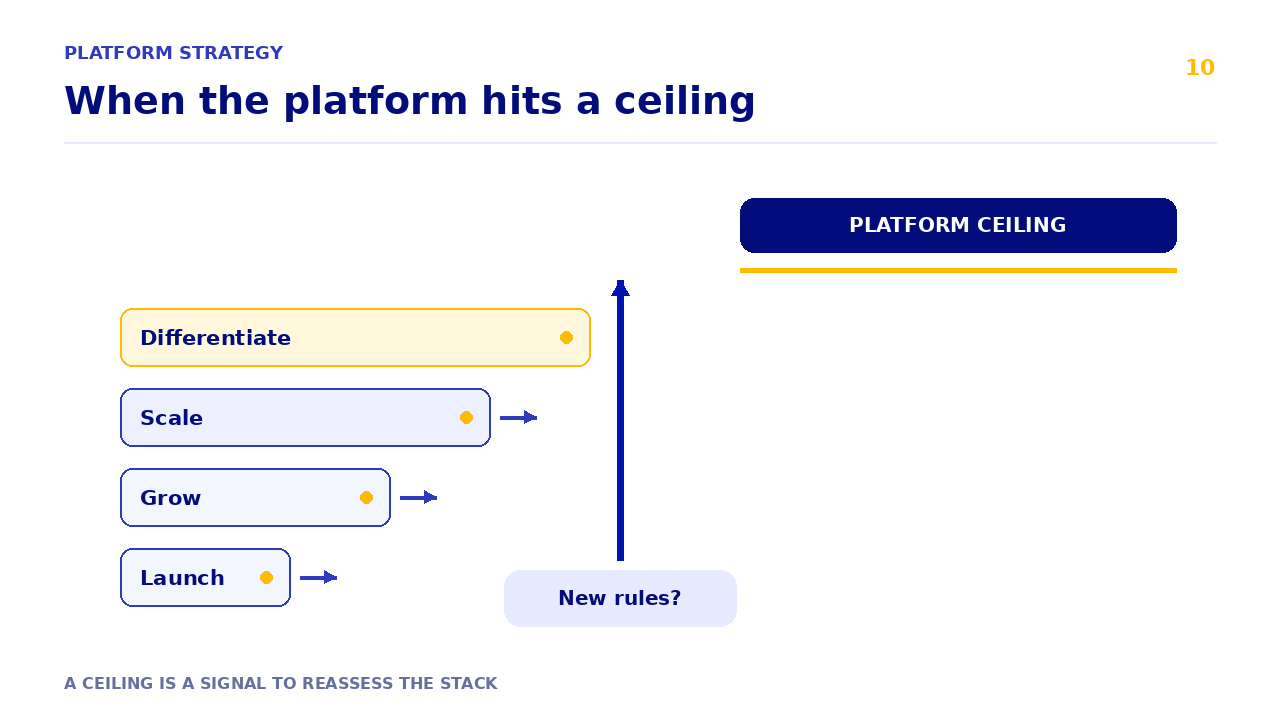
Where marketplace operational limits actually show up
The platform rarely announces it. The limits show up in your operations first.
You’re running the business out of spreadsheets the platform should handle
The clearest tell is a quiet one: The work that should happen inside your platform happens in spreadsheets next to it. Vendor payouts reconciled by hand. Commission tiers tracked in a sheet because the platform only supports one flat rate. Order exceptions managed over email. When your team’s real source of truth lives outside the system you pay for every month, the platform has stopped being the operating system of your business and become one more data source to babysit.
Every new requirement turns into a workaround or another app
Healthy platforms absorb new needs. A platform you’ve outgrown turns each new requirement into either a workaround or a new subscription. Need a custom vendor approval flow? Bolt on a tool. Need a different payout schedule per region? Manual process. Need an integration the platform doesn’t natively support? Pay for a connector then maintain the connector. Individually these look manageable. Stacked up, they signal that your operations have moved past what the platform was built to do, and you’re paying in money and maintenance to paper over the gap.

The roadmap is someone else’s
On a managed or no-code platform, you don’t own the roadmap the vendor does. That’s a fair trade early on; it’s why you launched fast without an engineering team. But the cost grows: the feature your business actually needs sits behind the vendor’s priorities, their release schedule, and their definition of “the standard case.” If the thing that makes your marketplace different is exactly the thing the platform makes hardest, you end up flattening your advantage to fit the tool.
Your operations team feels it first; your customers feel it next
Limits start as internal friction – slower onboarding, manual fixes, reports rebuilt by hand. The danger point is when that friction reaches the people on either side of your marketplace: a checkout that can’t handle the payment method your buyers expect, a payout delay your vendors notice, a search experience that sends users away because filtering can’t be customized. Once a platform limit touches customer or vendor experience, it has crossed from inconvenience into business risk.
A real-world pattern
Here’s a pattern we see often (a composite, not a single client). A regional services marketplace launches on a no-code builder and grows quickly exactly what the platform is good for. Then the edges start to show. The platform supports one commission rate; the business needs three tiers, so finance tracks the difference in a spreadsheet. Vendor approvals run over email because the built-in flow doesn’t match how they vet sellers. Each fix is small and reasonable on the day it’s made.
Eighteen months in, two people spend a meaningful slice of every week keeping the spreadsheets and the platform in sync, and a launch in a second market is on hold because multi-currency payouts aren’t supported. The “cheap” platform is now the most expensive thing in the operation just in a column nobody’s adding up. Nothing broke. The business simply outgrew the shape of the tool.

The hidden cost of working around your platform
The subscription line on your invoice is the cost everyone sees. It’s almost never the real one.
The real cost is the workaround tax – the hours your team spends every week moving data between tools, reconciling payouts by hand, rebuilding the same report, and chasing exceptions the platform can’t process. That time doesn’t appear as a line item, but it scales with your team and your volume. A few hours a week across a small operations team is a meaningful salary cost quietly converted into pure inefficiency.
Then there’s the lock-in cost. The longer you operate, the more your workflows, data, integrations, and team habits wrap around the platform’s particular way of doing things. That dependency is exactly what gives a vendor pricing power and what makes the eventual move feel daunting enough that many teams keep paying the workaround tax instead.
And the cost that’s hardest to see: Opportunity cost. Every hour spent making the platform behave is an hour not spent on what grows the marketplace better liquidity, a stronger vendor pipeline, a differentiated experience. When the platform sets the ceiling on what you can build, it’s also setting a ceiling on how far you can pull ahead of competitors running on the same off-the-shelf limits.
Temporary annoyance or structural ceiling?
Not every limit justifies a big move. Plenty are fixable inside your current setup. The fastest way to tell them apart is to look at four things:
| Probably temporary / fixable | Probably structural | |
|---|---|---|
| Feature gap | One or two features the vendor has on its roadmap, or a plugin reliably covers | Touches your core model how commissions, payouts, or vendor flows work |
| Cost trend | A one-time cleanup or single integration removes most of the friction | The workaround cost rises with volume, not stays flat |
| Recurrence | A one-off annoyance | The same kind of workaround reappears every time you grow or change |
| Roadmap impact | Minor; it can wait | You’re shelving roadmap decisions because “the platform can’t do that” |
If you’re landing mostly in the right-hand column, the problem isn’t a missing feature, it’s a mismatch between your operations and the platform’s design. That doesn’t fix itself, and it gets more expensive to ignore.

What your options actually are
A structural ceiling doesn’t automatically mean “rebuild everything.” Be honest about which of these fits, in roughly increasing order of effort:
1. Stay and optimize. If the friction is real but contained, the cheapest win is often a cleanup: tighten your processes, remove redundant tools, and add the one or two integrations that kill the worst workarounds. This solves a surprising amount of pain without touching the platform and it’s the right first move far more often than anyone selling a rebuild will admit.
2. Extend the platform. Some platforms let you add custom code or modules on top of the managed core. If the gaps are specific and the rest still fits, extending can buy real runway. The caveat: every extension you own is something you now maintain.
3. Replatform to something you control. When the limit is structural and the workaround cost keeps climbing, the math eventually favors moving to a platform you can shape around your operations rather than the other way around a more flexible commerce framework or a custom build. This is the biggest move, and it’s worth doing deliberately, not in a panic.
If your honest read is that you’ve hit a structural ceiling, the next step is to pressure-test that against the specific signals that justify a move we walk through those here: [link: S1Outgrowing Your No-Code Marketplace: 5 Signs It’s Time to Migrate].
If you’re leaning toward building something you control, here’s how founders in the region approach it without over-spending: [link: M7 How to Build a Marketplace in Singapore: A Founder’s Guide].
Before you decide, get the picture clear
The most expensive version of this decision is the one made on a gut feeling – either staying too long out of inertia, or jumping to a rebuild you didn’t need. Both are avoidable with a clear-eyed look at where your platform actually constrains your operations and what each path would realistically cost you.
That’s what a marketplace technical audit is for: mapping your current friction, separating the fixable from the structural, and laying out your options with the trade-offs made explicit so the decision is a calculation, not a guess.
→ [Request a marketplace technical audit] and get an honest read on whether your platform is holding you back, and what to do about it.
FAQ
How do I know if I’ve outgrown my marketplace platform? Look at where your real work happens. If core operations payouts, commissions, vendor approvals, reporting increasingly run in spreadsheets and bolt-on tools instead of inside the platform, and the same workarounds reappear every time you grow, you’ve likely outgrown it.
Is a marketplace platform limitation temporary or structural? It’s usually temporary if one feature or integration fixes it and the cost stays flat. It’s structural if it touches your core model how commissions, payouts, or vendor flows work and the workaround cost rises as your volume grows.
What does working around a platform actually cost? More than the subscription. The real cost is the weekly hours your team spends on manual reconciliation, duplicate data entry, and rebuilt reports a workaround tax that scales with volume plus vendor lock-in and the opportunity cost of not building what grows the marketplace.
Should I rebuild my marketplace or stay on SaaS? Not automatically rebuild. If the friction is contained, optimize or extend your current setup first that resolves most cases cheaply. Rebuild only when the limit is structural and workaround costs keep climbing.