


Introduction
Enterprises lose an average of $370 million every year to technical debt and outdated technology. When we talk about legacy system modernization, we are not talking about a side project. We are talking about whether a company can grow, raise capital, and stay secure over the next few years.
Modernization used to be something teams pushed aside in favor of “just one more feature.” By 2026 it has become a requirement for survival. While 62 percent of U.S. firms still run on obsolete software, the legacy modernization market is projected to reach $56.87 billion by 2030. Boards, investors, and regulators now treat brittle systems as direct business risk, not just an IT headache.
As founders, CTOs, and product leaders, we face the same tension: we know legacy platforms hold us back, yet we worry about cost, disruption, and failure. At KVY TECH, we see that every day. This guide distills how we handle those trade‑offs in real projects, without buzzwords or wishful thinking.
Modernization is no longer “an IT project” it is a core business decision about risk, growth, and value.
In the sections that follow, we look at the true cost of inaction, the technical and financial pain legacy systems create, and the 2026 trends that make modernization far more manageable. We then outline a decision framework, a three‑phase roadmap, and delivery patterns that reduce risk. By the end, you will have a clear first version of a modernization plan that fits a real business, not a textbook.
Why 2026 Is Your Legacy System’s Breaking Point
By 2026, the compounding cost of legacy systems reaches a tipping point. Enterprises can lose around $370 million a year to technical debt and outdated technology, with as much as 80 percent of IT spend disappearing into maintenance. That leaves little room for new products, data platforms, or serious AI work. No surprise that many companies underperform because they cling to aging platforms.
The impact goes beyond operating expenses. Investors now study the technology stack almost as closely as the financials. A brittle monolith with long‑ignored technical debt signals:
- Higher risk and slower response to market shifts
- Steep future spending requirements
- Lower margins and stalled innovation
That picture can reduce acquisition interest, damage merger talks, and depress valuations even when revenue looks healthy.
Security risk is just as serious. Legacy systems often run on outdated infrastructure and old security models that are hard to patch. Many IT leaders believe these systems put critical services at risk. With more zero‑day exploits and tighter regulation, running core processes on old software looks less like “being careful” and more like gambling.
The riskiest decision with a fragile legacy platform is often the decision to do nothing.
At the same time, the rewards for action are clear. Modernized platforms can cut infrastructure costs by up to 74 percent and speed up time to market by around 65 percent. The projected $56.87 billion modernization market shows this is a broad shift in how companies run technology.
The psychological barrier remains real: a price tag in the millions feels heavy after years of making the old system “good enough.” Yet the math has changed. Ongoing losses from delay now exceed a staged modernization investment. At KVY TECH, our senior‑led teams focus on this balance, using a battle‑tested process that gives founders and technology leaders more predictability at the point where their legacy stack is close to breaking.
The Dual Burden: Technical Failures and Financial Drains

When we step into a company with aging systems, we usually find the same pattern: technical fragility at exactly the wrong moments and a constant drain on money and attention.
Technical Problems Strangling Your Operations
Typical technical issues include:
- Security gaps. Older systems rely on weak encryption, outdated access control, and libraries that no longer receive patches. Vendors may have ended support years ago, so new vulnerabilities stay open. A single breach can cost more than a full modernization program and damage long‑term trust.
- Integration pain. Around 41 percent of businesses struggle with siloed applications that talk via SOAP, file drops, or brittle custom scripts. Each new SaaS tool or partner integration becomes a mini‑project. That slows automation, makes reporting hard, and blocks the omni‑channel experiences customers expect.
- Limited scalability and poor performance. Monolithic architectures were never built for current data volumes or spiky traffic. A promotion or seasonal peak can trigger slow responses or outages, directly hitting revenue and customer loyalty.
- Slow development speed. In tightly coupled codebases, a small change can ripple across multiple modules. Teams respond with long regression test cycles and full‑app deployments even for minor updates. That overhead makes product leaders cautious and lets faster competitors pull ahead.
- End of vendor support. Many organizations still run systems that vendors no longer maintain. When something breaks, there is no official fix on the way. Internal teams carry the full burden, and each incident turns into an expensive firefight.
- Weak observability. Logging is inconsistent, tracing is missing, and dashboards give only a rough picture of what is happening. During incidents, engineers spend hours hunting through logs instead of resolving issues quickly.
Together, these issues make operations fragile at exactly the times when the business needs reliability.
Financial Problems Draining Your Innovation Budget
Those technical problems show up directly in the numbers:
- Maintenance eats the budget. Around 39 percent of organizations report that infrastructure, licenses, and scarce specialist skills consume a large share of IT spend. Money that could fund AI pilots or new products instead goes to “keeping the lights on.”
- Big upfront cost fears. Many leaders hear numbers like $2.9 million per system and postpone action. That fear is understandable but often ignores how a phased roadmap spreads cost and begins paying back through lower incidents and operating costs.
- Fear of disruption. About 38 percent of organizations worry that migration will take down critical services, so they delay and keep patching. In reality, structured approaches with parallel runs, canary releases, and slice‑by‑slice change make modernization compatible with ongoing operations.
- Organizational resistance. Around 30 percent of companies face internal pushback because leaders do not see clear ROI or are tired of large change programs. Without a story that connects modernization to revenue, margin, and valuation, projects stall.
Think of technical debt as interest payments: every month you delay modernization, the “interest rate” on your old stack goes up.
At KVY TECH, we focus on making that story concrete, using numbers and real incidents to show the cost of delay and the payoff from targeted change.
Technologies and Trends Defining Modernization in 2026
AI-Native Modernization: Your New Competitive Advantage

Artificial intelligence has moved from theory into day‑to‑day modernization work, representing The Next Wave of adaptive learning and strategic planning that will define modernization success through 2026. In 2026, roughly a third of enterprise modernization investment involves AI‑driven tools. Instead of reading thousands of lines of code by hand, teams can use large language models to:
- Scan entire codebases
- Map dependencies and data flows
- Highlight technical debt and risky areas
Studies show these tools can improve code design by about 20 percent compared with manual review alone.
Testing is where AI often delivers the fastest wins. AI‑driven test generation and smart regression suites can shrink test cycles by up to 4×, which allows:
- Smaller, safer releases
- Faster feedback on changes
- Quicker scope adjustments without losing schedule control
Even mainframe workloads are now within reach. Advanced assistants can analyze COBOL and similar languages, suggest target architectures, and support staged migration of important business logic.
At KVY TECH, we treat production AI as part of the standard toolkit. We combine AI‑powered analysis and testing with senior engineers who know how to interpret the output and make sound architectural decisions. That mix gives clients faster progress with clearer risk management.
Cloud, Data, and Composable Architectures: The New Foundation
Modernization in 2026 almost always involves hybrid or multi‑cloud infrastructure. By 2027, around 90 percent of organizations are expected to run across more than one cloud provider. Rather than a simple lift‑and‑shift, teams now design cloud‑native systems that use:
- Managed databases and queues
- Auto‑scaling and regional redundancy
- Observability and cost controls baked into the platform
Data is the second pillar. Traditional warehouses struggle with the mix of structured and unstructured data modern businesses collect. Data lakehouse platforms let analytics and AI tools work on a single governed store. Since about 29 percent of enterprises cite poor data quality as a barrier to AI, improving this layer is often a prerequisite for serious machine learning.
On top of this sits an API‑first, composable architecture. Around 82 percent of businesses now follow some version of this model. Services are decoupled behind clear APIs, so teams can update or replace them without breaking the whole system.
This is where KVY TECH does much of its work, especially in headless commerce and custom business platforms. Instead of forcing clients into rigid off‑the‑shelf products, we design modular systems that can adapt as the market changes.
Security-by-Design and Zero Trust Architecture
Security now has to be designed in from the start. A security‑by‑design approach means thinking about threats, access, and compliance in each phase of the software life cycle instead of bolting controls on at the end.
Zero Trust architecture pushes this further:
- No user, device, or service is trusted just because it sits inside a network
- Every request is verified
- Device health is checked continuously
Modern encryption protects data at rest and in transit, while policy as code keeps rules consistent across environments. Given that many organizations already worry about legacy security gaps, these practices directly shape which modernization strategies make sense.
Choosing Your Modernization Strategy: The Decision Framework
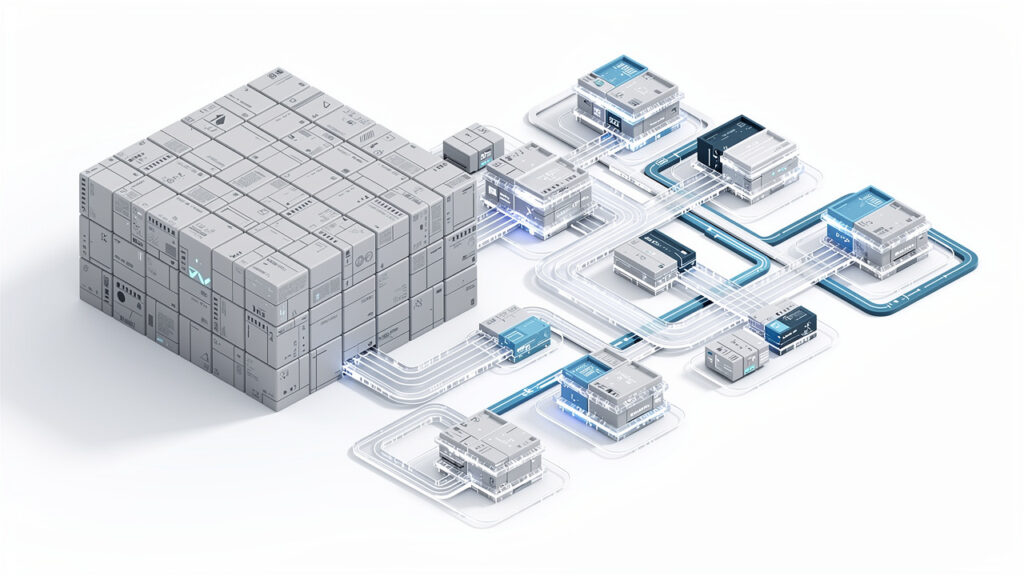
The Six Modernization Strategies
When we help teams choose a path, we start from a simple idea: there is no single best strategy. The right choice depends on how important the capability is and how unhealthy the system has become.
The six main approaches are:
- Rehosting (lift and shift). Move the application as‑is to cloud infrastructure. Good for fast data center exits and quick infrastructure savings. KVY TECH often uses this as a first step, paired with a later improvement plan.
- Re‑platforming. Keep the core app but adopt managed services such as cloud databases or message queues. This brings cloud benefits like auto‑scaling and lower operational effort without a full rewrite.
- Refactoring. Clean and restructure code while keeping behavior the same. Ideal for systems with reasonable design but messy internals. We usually pair refactoring with automated tests and better observability.
- Re‑architecting. Change both code structure and system shape, for example by splitting a monolith into microservices or domain modules. Best for high‑value systems where demand has outgrown the original design.
- Encapsulation. Keep the legacy system but wrap it behind modern APIs. Useful when data and business rules still matter, yet interfaces and integrations must move ahead. KVY TECH often uses encapsulation as a bridge while replacing modules underneath.
- Rewriting or full replacement. Build a new system from scratch or adopt a SaaS product. Best when the old platform no longer fits the business or would cost more to fix than to replace. We usually run old and new in parallel before cutover.
A simple grid with business value on one axis and technical health on the other helps. High‑value yet unhealthy systems tend to deserve refactoring or re‑architecting; low‑value and unhealthy ones often belong in the replacement bucket.
Your Three-Phase Strategic Roadmap to Successful Modernization

Phase 1: Assessment, Prioritization, and Strategic Alignment
Phase 1 is about seeing the current state clearly and tying every technical choice to business outcomes, following (PDF) Navigating the Modernization of effective strategies and best practices for legacy application transformation. Typical activities include:
- Deep system audit. Map applications, dependencies, integrations, and business processes. AI‑assisted code analysis reveals hidden couplings and fragile areas, while interviews with product and operations teams surface pain points that logs miss.
- Technical debt and risk mapping. Build a heat map of risk and cost, using metrics such as incident history, change failure rate, and support effort. This makes it easier for executives to see why one module should come first.
- Business alignment. Define measurable targets such as lower total cost of ownership, better uptime, faster release cadence, or stronger security. These metrics become the north star for the roadmap.
From there, we prioritize domains and pick the first slices that blend high value with manageable risk often a customer‑facing area or a core data service. A clear business case lays out expected savings, risk reduction, and revenue upside so a staged investment feels justified instead of scary.
At KVY TECH, senior architects lead this phase with attention to both technology and business, so later decisions rest on shared facts rather than guesswork.
Phase 2: Phased Roadmap for Incremental Delivery
Phase 2 turns strategy into execution. We begin by forming a cross‑functional alliance that includes IT, operations, finance, and executive sponsors. When all of these voices help shape scope and priorities, surprises and late‑stage objections are less likely.
We then design a pilot project that tackles a small but meaningful slice of the system for example a single domain or service. The pilot has three goals:
- Prove the chosen modernization strategies
- Refine working practices (DevOps, CI/CD, testing, AI‑assisted analysis)
- Deliver visible value within weeks, not years
Based on the pilot, we lay out a phased delivery plan. Work is organized into stages that draw on patterns such as the Strangler Fig pattern and canary releases. Old and new systems often run in parallel with data synchronization, so operations continue while risk stays controlled.
We also invest in people: training around new frameworks, cloud services, and modern engineering practices, plus internal champions who know both legacy quirks and the target architecture. KVY TECH’s battle‑tested development process gives clients predictable iteration cycles and transparent reporting.
Phase 3: Building Sustainable and Future-Ready Systems
Phase 3 shifts focus from one‑time change to ongoing adaptability. We design systems as modular components with clear contracts so they can evolve without another massive program a few years from now. Plans leave space for future AI integration and multi‑cloud options, so new tools and providers can be adopted without major rewiring.
Data strategy becomes a long‑term concern instead of a one‑off migration. That includes:
- Strong data governance and clear ownership
- Data quality rules and monitoring
- A shared source of truth across platforms
Continuous improvement is the final pillar. DevOps and SRE practices automated testing, observability, and blameless reviews feed into regular refinements. Platform engineering teams provide self‑service tools so product squads can move fast without trading away stability.
Throughout this phase, KVY TECH focuses on knowledge transfer so internal teams can keep evolving the platform after external help steps back.
Executing with Excellence: Patterns for Low-Risk Delivery
DevOps, CI/CD, and SRE Practices
Modernization programs succeed or fail on the strength of their delivery pipeline. Continuous Integration and Continuous Deployment (CI/CD) automate build, test, and release so every change follows the same reliable path. That reduces human error and makes deployments routine instead of stressful “big bang” events.
Platform engineering extends this by giving teams shared tools and environments: reusable templates, common observability stacks, and self‑service provisioning. Site Reliability Engineering (SRE) adds:
- Clear Service Level Objectives (SLOs)
- Detailed logging, tracing, and metrics
- Blameless reviews after incidents to drive learning
Infrastructure as code keeps environments consistent and allows fast, safe rollbacks when needed.
A common rule in high‑performing teams: “If a release hurts, make releases smaller and more frequent.”
At KVY TECH, we bring these practices into every modernization engagement so new systems stay reliable and easy to change.
Incremental Delivery Patterns That Minimize Disruption
We pair strong pipelines with delivery patterns designed to keep operations running while systems change:
- Strangler Fig pattern. Place a routing layer in front of the legacy system, then build new services that handle one slice of behavior at a time. Traffic for that slice goes to the new code; the rest still hits the old platform until it is safe to retire.
- Canary releases. Send a new version to a small percentage of users first. Monitor performance, error rates, and feedback before rolling out wider. This catches issues early without affecting everyone.
- Feature toggles. Deploy new code but gate behavior behind switches. Enable a feature for internal users or a small region, and turn it off instantly if needed, often without redeploying.
- Parallel runs. Let old and new systems process the same inputs for a period, then compare outputs and performance. This is especially useful for financial, healthcare, or reporting flows where accuracy is non‑negotiable.
- API gateways. Present a single entry point to clients while routing some calls to legacy components and others to modern services. This hides backend churn from front‑end applications and customers.
Used together, these patterns create a safety net for modernization work. KVY TECH designs them into the roadmap from the start so change feels controlled rather than chaotic.
Industry-Specific Modernization Imperatives

The core modernization playbook stays similar, but each sector has its own constraints and drivers.
Government: National Security and Public Service Delivery
U.S. government agencies spend around $337 million a year just to keep ten critical legacy systems running, some more than sixty years old. These platforms support motor vehicle records, eligibility checks, and public safety, so failure has real‑world consequences. Strict procurement rules, audit requirements, and intense security standards mean modernization must rely on careful phasing and parallel runs, not risky cutovers.
Finance: Technical Debt and Fintech Competition
Financial institutions often depend on COBOL‑based core systems with heavy technical debt and security exposure. They are stable but hard to adapt, especially when connecting to modern payment providers, open banking APIs, and mobile experiences. At the same time, fintechs launch new products quickly on modern stacks. Modernization in this sector is about defending market share, integrating with new partners, and meeting PCI DSS and SOX requirements without slowing innovation.
Healthcare: Patient Safety and Data Security
Healthcare organizations hold extremely sensitive data yet often run on siloed, insecure systems. Weak integration between electronic health records, diagnostic tools, and billing platforms can put patient safety at risk because clinicians lack a full view. Modernization helps meet HIPAA requirements, reduce breach risk, and support advanced analytics. Standards such as HL7 and FHIR are central: once systems speak these languages well, data can move safely wherever it is needed.
Insurance: Product Innovation and Customer Experience
Insurers frequently struggle with aging core policy and claims platforms that are hard to change. Many face inflexibility, integration issues, and high maintenance costs. This makes it slow to launch new products, adjust pricing, or improve claims handling. Modernization lets insurers apply data analytics for sharper risk assessment and more personalized pricing while improving digital customer experiences and regulatory reporting.
Manufacturing: Industry 4.0 and Smart Factories
Manufacturers are under pressure to adopt Industry 4.0 practices such as IoT sensors, predictive maintenance, and smart factory automation. Yet many still rely on plant‑floor systems isolated from modern cloud tools and supply chain platforms. These limitations block real‑time visibility into production and logistics. Modernization can reduce infrastructure costs by as much as 74 percent and give leaders the data they need to fine‑tune operations and respond faster to demand shifts.
Across these industries, the playbook is consistent: assess and align, deliver change in phases while old and new run together, then build for continuous improvement.
Conclusion
By 2026, the cost of staying on legacy systems is higher than the cost of modernizing them in a planned way. Aging platforms drain hundreds of millions of dollars, consume most of the IT budget, and limit innovation at the exact moment when markets, regulators, and investors expect more. Companies that modernize well see the opposite: lower infrastructure costs, faster time to market, stronger security, and higher enterprise value.
Modernization is not simple. It touches mission‑critical processes, deep technical design, and company culture. Success needs clear strategy, disciplined sequencing, and a delivery engine that can run for months or years without losing focus.
The good news is that we no longer have to choose between reckless big‑bang rewrites and endless patching. With AI‑native tools, cloud and composable architectures, and proven patterns such as the Strangler Fig pattern, we can move in controlled steps that deliver value along the way.
The best time to modernize a legacy platform was years ago. The second‑best time is now before it fails at the worst possible moment.
The most practical next step is straightforward: start with a structured assessment and a pilot that proves value and builds confidence. At KVY TECH, our senior team combines production AI, headless commerce, and composable architecture expertise with a battle‑tested process that emphasizes predictability and control at the cost level of a Vietnamese boutique firm. The open question is no longer whether to modernize it is how soon you can begin so competitors who are already moving do not widen the gap.
FAQs
Question 1: How Should an Organization Approach Legacy System Modernization?
Start with a thorough assessment. Map current systems, dependencies, business processes, data flows, and risk hot spots so nothing important is missed. Based on that view, evaluate the main modernization options rehosting, re‑platforming, refactoring, re‑architecting, encapsulation, or full replacement and choose the mix that best supports business goals.
From there, design a phased roadmap that delivers change in small slices instead of one huge cutover. Define clear KPIs tied to cost, uptime, speed, and security, and run a pilot project to prove the approach on a contained scope. Many organizations work with an experienced partner such as KVY TECH, so internal teams focus on domain knowledge while external specialists bring modernization patterns and delivery experience.
Question 2: What Is a Realistic Timeline for a Modernization Initiative?
Timelines depend on scope, system complexity, and the chosen strategy, but certain ranges are common:
- A single critical business domain: 3–6 months, including assessment, design, build, testing, and rollout
- A full platform modernization across many domains: 12–18 months, usually delivered in stages
We typically plan:
- 4–8 weeks for the initial assessment and roadmap
- 8–12 weeks for a focused pilot that reaches production
- The first visible benefits (fewer incidents, faster releases, better performance) within 3–4 months
With AI‑assisted code analysis and a seasoned partner such as KVY TECH, parts of this schedule can often be compressed without raising risk, as long as scope remains disciplined.
Question 3: How Much Internal Engineering Capacity Is Needed to Start?
You do not need a huge internal team to start modernization seriously. In many cases, a core group of three to six people is enough for early stages:
- A Product Owner who understands priorities and stakeholders
- One or two senior engineers with deep knowledge of the existing system
- One or two technical leads or architects who can make design decisions
This core team collaborates with external modernization experts who bring additional engineering power and specialized skills in cloud, data, and modern architectures. Internal staff focus on business rules, edge cases, and organizational alignment, while the partner drives technical discovery and delivery. At KVY TECH, we structure engagements so knowledge flows back into the internal team through pairing, reviews, and shared documentation.
Question 4: How Can We Modernize Without Disrupting Business Operations?
Avoiding disruption is one of the main goals of a good modernization roadmap. Instead of switching from old to new in a single weekend, favor approaches that let both systems run side by side.
Common tactics include:
- Using the Strangler Fig pattern to move one slice of functionality at a time
- Applying canary releases so new versions reach a small portion of users first
- Controlling exposure with feature toggles instead of hard cutovers
- Running parallel processing for critical flows and comparing outputs before final switch‑over
- Hiding backend changes behind an API gateway so front‑end applications stay stable
Combined with realistic test environments and strong monitoring, these patterns make near zero‑downtime modernization a practical goal.
Question 5: What Are the Biggest Risks in Legacy System Modernization and How Can We Mitigate Them?
Common risks include:
- Operational disruption. Mitigate with incremental patterns such as the Strangler Fig pattern, canary releases, feature toggles, and parallel runs so changes hit small areas first and can be rolled back quickly.
- Cost overruns and schedule slips. Reduce this risk with clear scoping, phased delivery with defined milestones, and close tracking of progress against agreed metrics.
- Loss of business logic. Counter with detailed discovery, strong collaboration with domain experts, and side‑by‑side output comparison between old and new systems.
- Inadequate testing. Invest in automated tests, AI‑supported test generation, and broad coverage before any cutover.
- Organizational resistance. Address this through early stakeholder involvement, a clear business case, visible wins from pilot projects, and training that builds confidence.
With these practices in place and support from an experienced partner like KVY TECH modernization risks remain real but stay well within manageable bounds.