


1. Introduction
In today’s fast-paced business environment, Data-Driven Decision Making (DDDM) is not just advantageous; it’s essential. DDDM enables businesses to optimize operations, enhance customer experiences, and maintain competitiveness. By leveraging data instead of intuition, companies can uncover trends, predict behaviors, and make informed strategic choices.
1.1. Why DDDM Matters
Traditional decision-making often relies on gut feelings or incomplete data. In contrast, DDDM empowers businesses to:
- Identify Trends: Analyze historical and real-time data to spot emerging patterns.
- Improve Efficiency: Gain insights into workflow bottlenecks and streamline operations.
- Enhance Customer Experience: Tailor products and services based on customer behavior.
- Mitigate Risks: Anticipate challenges and proactively manage risks.
1.2. Introducing Medusa.js
Medusa.js is an open-source headless commerce framework that revolutionizes analytics integration with its API-first architecture. It provides developers and strategists with a flexible solution for modern commerce, enabling seamless data integration.
1.3. Target Audience
This article targets:
- Developers: Seeking guidance on integrating analytics tools with Medusa.js.
- Business Strategists: Interested in leveraging data for strategic decision-making.
- Tech Enthusiasts: Exploring the intersection of frameworks like Medusa.js and data analytics.
2. Understanding Medusa.js
2.1. What is Medusa.js?
Medusa.js is an API-first headless commerce framework designed for scalable and customizable e-commerce solutions. Unlike traditional platforms that tightly couple front-end and back-end systems, Medusa.js allows independent development of each layer, enhancing integration with third-party services, including analytics tools.
2.2. Key Features
- API-First Architecture: Simplifies the integration of external tools for seamless data collection.
- Extensibility: Developers can customize functionalities without overhauling the system.
- Headless Commerce Capabilities: Separates back-end business logic from front-end user interactions for better performance and flexibility.
- Support for Modern Technologies: Integrates well with popular frameworks, providing compatibility for evolving digital markets.
2.3. Benefits for DDDM
Medusa.js offers distinct advantages for implementing DDDM:
- Seamless Data Integration: The API-first design ensures smooth connections to analytics tools.
- Flexibility and Scalability: Its modular structure accommodates growing data needs while maintaining performance.
- Enhanced Customization: Tailor the system to focus on key operational metrics relevant to your business.
3. The Role of Data in Decision Making
In today’s competitive business landscape, data is more than just numbers—it’s the backbone of effective decision-making. When companies harness accurate, real-time data, they transform raw information into actionable insights that can shape everything from daily operations to long-term strategy.
3.1. Importance of Data in Business Decisions
Data empowers businesses to move beyond intuition and anecdotal evidence. Here’s how a data-centric approach makes a tangible difference:
- Informed Decision-Making: By relying on data, businesses can evaluate real performance metrics rather than making decisions based on gut feeling. This leads to more accurate forecasting and better strategic planning.
- Performance Measurement: Key Performance Indicators (KPIs) and performance metrics derived from data help organizations monitor progress, identify areas of improvement, and ensure that strategic goals are being met.
- Risk Mitigation: Data analytics can reveal potential challenges before they become significant issues. For example, predictive analytics can forecast market trends or supply chain disruptions, enabling proactive risk management.
- Operational Efficiency: Analyzing operational data helps uncover inefficiencies, allowing companies to streamline processes, reduce costs, and improve overall productivity.
3.2. How Data Influences Strategic Planning and Operational Efficiency
Data-driven insights have a transformative impact on both strategic planning and day-to-day operations:
- Strategic Planning: Data allows leaders to identify emerging trends, market opportunities, and consumer behavior patterns. This information is crucial for developing strategies that are responsive to market demands. For instance, a company may use data analysis to determine the optimal time to launch a new product or to pivot its marketing approach based on customer feedback.
- Operational Efficiency: On the operational front, data helps pinpoint bottlenecks and inefficiencies. For example, analyzing customer journey data might reveal a common point of friction during the checkout process. Addressing such issues can significantly enhance the customer experience and boost conversion rates.
- Enhanced Customer Insights: With data analytics, businesses gain a deeper understanding of customer preferences and behaviors. This insight allows for personalized marketing strategies and better product recommendations, directly contributing to increased customer satisfaction and loyalty.
3.3. Real-World Examples and Case Studies
To illustrate the power of data-driven decision-making, consider these examples:
- Retail Sector: A retail company integrated data analytics to track customer buying patterns and seasonal trends. By leveraging this data, they optimized their inventory management, reducing stockouts and overstock situations. The result was a noticeable boost in sales and customer satisfaction.
- E-commerce Platform: An online retailer used predictive analytics to personalize its marketing campaigns. By analyzing past purchase behaviors and browsing history, the company was able to deliver targeted promotions that resonated with individual customers, ultimately driving up conversion rates and revenue.
- Manufacturing: In a manufacturing setting, data analytics was employed to monitor machine performance and maintenance schedules. This proactive approach minimized downtime, improved production efficiency, and significantly reduced maintenance costs.
These examples underscore that when businesses harness the power of data, they not only enhance operational efficiency but also position themselves for sustainable growth.
4. Integrating Analytics with Medusa.js
Integrating analytics into Medusa.js involves several key stages:
Stage 1: Selecting Your Analytics Platform
Choose platforms that align with your business needs:
- Google Analytics: Comprehensive web traffic analysis.
- Mixpanel: In-depth user behavior tracking.
- Amplitude: Product analytics focusing on user patterns.
- Hotjar: Qualitative insights through heatmaps and session recordings.
Platform Comparison: Google Analytics, Mixpanel, Amplitude, and Hotjar
Below is an overview of some popular analytics platforms and how they compare in terms of their features and focus areas:
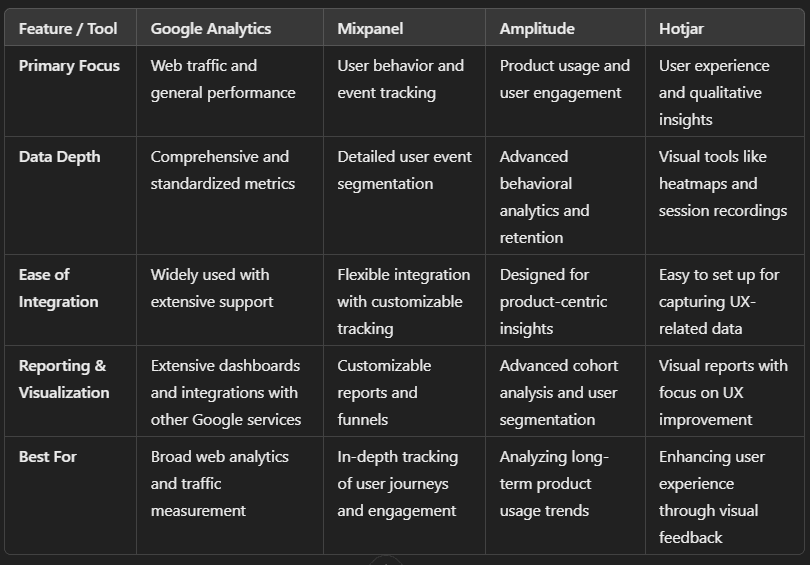
This comparison table can help you decide which platform, or combination of platforms, best meets your analytics needs within a Medusa.js environment.
Stage 2: Configuring Medusa.js for Analytics
- Establish Integration Points: Identify key areas for data collection (e.g., storefront, checkout).
- Set Up Data Collection Mechanisms: Use Medusa.js’s architecture to track essential metrics without altering core logic.
- Ensure Data Quality: Verify accurate data capture across touchpoints.
Stage 3: Testing the Integration
Conduct thorough testing to ensure:
- Data transmission accuracy from Medusa.js to your analytics platform.
- Regular monitoring confirms that all key events are tracked as expected.
Stage 4: Security & Privacy Considerations
When integrating analytics tools:
- Ensure compliance with regulations like GDPR or CCPA regarding data privacy.
- Safeguard sensitive information such as API keys and tracking tokens.
- Conduct regular audits of your analytics integration to maintain compliance with security standards.
5. Analyzing Data for Actionable Insights
Collecting data is only the first step toward building a data-driven organization. The real value lies in analyzing that data to extract insights that can inform decision-making, optimize operations, and drive growth. In this section, we explore various analytical techniques, best practices, and tools that can help you turn your Medusa.js-driven analytics data into strategic assets.
5.1. Transforming Raw Data into Meaningful Insights
The journey from data collection to actionable insights involves several key steps:
- Data Cleaning and Preparation: Before analysis, ensure that your data is accurate, consistent, and free of anomalies. This involves removing duplicates, handling missing values, and standardizing data formats. Clean data forms the basis of reliable insights and effective decision-making.
- Identifying Key Metrics: Determine which metrics are most relevant to your business goals. Whether it’s conversion rates, customer lifetime value, or user engagement levels, focusing on the right KPIs ensures that your analysis is aligned with your strategic priorities.
- Segmenting Your Data: Break down your data into meaningful segments. For instance, you might segment by customer demographics, purchase behaviors, or traffic sources. Segmentation allows you to understand trends within specific groups, enabling targeted improvements.
5.2. Analytical Techniques for Actionable Insights
Several analytical techniques can help you derive deeper understanding from your data:
- Trend Analysis: Evaluate historical data to identify patterns or trends over time. Trend analysis can help you forecast future performance and recognize seasonal fluctuations, guiding proactive strategic adjustments.
- Cohort Analysis: Group users or customers based on shared characteristics or behaviors (such as the month they made their first purchase) to monitor how their behavior changes over time. This method is particularly useful for understanding customer retention and the long-term impact of marketing strategies.
- A/B Testing and Experimentation: Use A/B testing to compare different versions of a webpage, email campaign, or product feature. This controlled experimentation helps you understand which variations lead to better user engagement or higher conversion rates, providing a solid foundation for making informed changes.
- Segmentation and Customer Profiling: Beyond simple demographic segmentation, create detailed customer profiles by integrating behavioral data. This approach allows you to tailor marketing strategies, personalize user experiences, and target high-value segments more effectively.
- Predictive Analytics: Leverage statistical models and machine learning techniques to forecast future trends and customer behaviors. Predictive analytics can help you anticipate market changes, optimize inventory, and plan more effectively for future growth.
5.3. Tools and Best Practices for Enhanced Analysis
To facilitate effective data analysis, consider leveraging the following tools and practices that integrate seamlessly with Medusa.js:
- Data Visualization Tools: Tools like Tableau, Power BI, or other data visualization platforms help transform complex datasets into intuitive, visual dashboards. These dashboards enable you to quickly identify trends and outliers, making it easier to communicate insights across your organization.
- Reporting Solutions: Regular reports summarizing key metrics and trends provide a snapshot of performance at a glance. Establish a routine reporting process to keep all stakeholders informed and aligned with your strategic goals.
- Collaboration and Feedback: Encourage a culture of data sharing and collaboration. Utilize collaborative platforms where teams can discuss insights, propose experiments, and refine strategies based on shared data.
- Continuous Improvement: Analytics is not a one-time effort. Continuously refine your metrics, update your models, and incorporate feedback from various departments. This iterative process ensures that your analysis remains relevant as market conditions and business needs evolve.
6. Challenges, Best Practices, and Considerations in DDDM
While leveraging analytics within Medusa.js can empower businesses to make informed decisions, implementing Data-Driven Decision Making (DDDM) presents several challenges. Organizations often face technical, organizational, and cultural obstacles that can undermine their data initiatives. Recognizing these challenges and implementing best practices is crucial for unlocking the full potential of a data-driven strategy.
6.1. Common Challenges in DDDM
6.1.1. Data Quality and Reliability
The effectiveness of any data-driven approach hinges on the quality of the underlying data. Poor-quality data—characterized by inaccuracies, duplicates, missing values, or inconsistencies—can lead to misleading insights and flawed decision-making. For instance, incomplete or outdated customer behavior data may not accurately reflect current market trends.
Key Considerations:
- Consistency: Standardize data collected from various systems (e.g., customer feedback tools, sales platforms).
- Accuracy: Conduct regular audits and cleansing processes to eliminate errors.
- Timeliness: Ensure data feeds are updated frequently to capture real-time changes.
6.1.2. Data Integration Across Disparate Systems
Many organizations struggle to integrate data from multiple sources. When data resides in silos (e.g., separate modules or third-party integrations within Medusa.js), achieving a unified view can be challenging. Incomplete integration may result in a fragmented understanding of business performance.
Key Considerations:
- Unified Data View: Invest in middleware or integration platforms that connect disparate systems.
- APIs and Plug-Ins: Utilize Medusa.js’s API-first architecture and extensible plug-in system for smoother data flow.
- Real-Time Analytics: Prioritize platforms that enable real-time processing to avoid reliance on outdated information.
6.1.3. Data Privacy and Security Concerns
As businesses collect vast amounts of data, ensuring privacy and security becomes paramount. Compliance with regulations (such as GDPR) and safeguarding sensitive customer information are critical to maintaining trust and avoiding legal repercussions.
Key Considerations:
- Compliance: Ensure all data collection activities adhere to relevant laws.
- Secure Storage: Implement encryption and robust access controls for sensitive data.
- Transparency: Clearly communicate to stakeholders how data is collected, used, and protected.
6.1.4. Organizational and Cultural Resistance
Adopting a data-driven mindset often requires a cultural shift within organizations. Resistance to change can occur at various levels—from top management to individual team members accustomed to intuition-based decision-making. Without organization-wide buy-in, even the best analytics initiatives can falter.
Key Considerations:
- Change Management: Develop a structured plan that includes training and continuous communication.
- Leadership Commitment: Leaders must champion data-driven approaches and model desired behaviors.
- Cross-Department Collaboration: Encourage collaboration between technical teams and business units to translate insights into actionable strategies.
6.1.5. Low Data Literacy
Even with high-quality integrated data, low data literacy among team members can hinder the benefits of DDDM. Insufficient skills in interpreting analytics can lead to misinterpretation of insights and poor decision-making.
Key Considerations:
- Training Programs: Invest in ongoing training for employees at all levels.
- User-Friendly Tools: Implement intuitive analytics platforms that offer natural language processing and interactive visualizations.
- Self-Service Analytics: Enable team members to explore data independently with self-service capabilities that require minimal technical skills.
6.2. Best Practices for Overcoming DDDM Challenges
To fully harness the benefits of DDDM using Medusa.js, organizations should consider the following best practices:
6.2.1. Establish a Robust Data Governance Framework
Implementing a strong governance framework ensures data quality, consistency, and security. Define clear policies for data collection, storage, and processing that align with regulatory standards while addressing roles and responsibilities across the organization.
6.2.2. Leverage Medusa.js’s Modular Architecture
Medusa.js’s API-first design is advantageous for overcoming integration challenges. By utilizing community plugins and customizable APIs, businesses can integrate diverse data sources more easily. Partnering with experienced developers familiar with Medusa.js can maximize these benefits.
6.2.3. Promote a Culture of Data Literacy and Continuous Improvement
Empower employees through regular training sessions and accessible analytics tools that enable independent exploration of data. Foster an environment where insights are shared openly, encouraging continuous improvement based on feedback.
6.2.4. Prioritize Real-Time Analytics
Invest in solutions that enable real-time processing so decision-makers have access to current information. This approach minimizes the risk of outdated decision-making and allows for agile responses to emerging trends.
6.2.5. Ensure Cross-Functional Collaboration
Facilitate collaboration between IT, analytics teams, and business units. Breaking down silos fosters alignment between data-driven insights and strategic business goals, ensuring effective implementation across departments. This version maintains clarity while effectively summarizing key points about challenges in DDDM as well as best practices for overcoming those challenges within the context of using Medusa.js.
7. Future Trends in DDDM and Medusa.js
Implementing Data-Driven Decision Making (DDDM) strategies can significantly enhance business performance, particularly when leveraging robust platforms like Medusa.js. The following case studies illustrate how organizations have successfully integrated analytics and data-centric approaches within their Medusa.js-powered e-commerce platforms to drive growth and operational efficiency.
7.1. Tekla: Enhancing Conversion Rates Through Data-Driven Insights
Background: Tekla, a Copenhagen-based textile brand operating in over 50 countries, migrated from WooCommerce to Medusa.js due to limitations in scalability and flexibility.
Data-Driven Approach: With Medusa.js, Tekla accessed advanced analytics capabilities, enabling real-time monitoring of customer behaviors, sales trends, and inventory metrics.
Outcomes:
- Increased Conversion Rate: Post-migration, Tekla achieved a 70% increase in conversion rates through data-informed optimizations in sales and marketing strategies.
- Operational Efficiency: Automation guided by data insights significantly reduced customer service response times and streamlined return processes.
7.2. Makro PRO: Streamlining Order Management with Data Analytics
Background: CP Axtra’s Makro PRO faced challenges managing thousands of complex orders daily, necessitating an efficient solution.
Data-Driven Approach: Implementing Medusa.js allowed Makro PRO to use data analytics for monitoring and optimizing order management processes by analyzing order patterns and customer preferences.
Outcomes:
- Improved Order Accuracy: Data insights identified bottlenecks in the fulfillment process, leading to more accurate and timely deliveries.
- Scalability: Optimizations supported the seamless handling of increasing order volumes without compromising service quality.
7.3. Viessmann: Digitizing Mobile Heating Rentals with Data-Driven Strategies
Background: Viessmann sought to digitize their mobile heating rental services for better operational management and customer experiences.
Data-Driven Approach: Partnering with Agilo, Viessmann implemented Medusa.js to collect and analyze data on equipment usage and customer preferences.
Outcomes:
- Optimized Resource Management: Data insights enabled efficient allocation of heating units based on demand patterns, reducing downtime.
- Enhanced Customer Satisfaction: Tailoring services based on customer needs led to improved satisfaction and loyalty.
This refined section maintains clarity while effectively summarizing the case studies that illustrate the successful integration of DDDM strategies with Medusa.js.
9. Conclusion
Adopting a data-driven approach in e-commerce, facilitated by platforms like Medusa.js, empowers businesses to make informed decisions that drive growth and enhance customer experiences. By embracing DDDM strategies and staying abreast of emerging trends, organizations can navigate the complexities of the digital marketplace and achieve sustained success.
FQAs
Q1. What is Data-Driven Decision Making (DDDM)?
DDDM is a strategy that relies on data analysis to inform business decisions, enabling organizations to optimize operations and enhance customer experiences.
Q2. Why is DDDM important for businesses today?
It helps businesses identify trends, improve operational efficiency, enhance customer experiences, and mitigate risks.
Q3.How does DDDM differ from traditional decision-making methods?
Unlike traditional methods that rely on intuition or incomplete data, DDDM uses accurate, real-time data to inform decisions.
Q4. What is Medusa.js?
Medusa.js is an open-source, API-first headless commerce framework designed for building scalable and customizable e-commerce solutions.
Q5. What are the key features of Medusa.js?
Key features include an API-first architecture, extensibility for customization, headless commerce capabilities, and built-in support for modern technologies.
Q6. How does Medusa.js support data-driven strategies?
Its API-first design allows for seamless integration with analytics tools, ensuring smooth data flow and collection.
Q7. Who should use Medusa.js?
Developers seeking to integrate analytics tools, business strategists looking to leverage data for decision-making, and tech enthusiasts interested in modern e-commerce solutions.
Q8. How can I integrate analytics tools with Medusa.js?
Integration involves selecting an analytics platform, configuring Medusa.js to collect data, ensuring data quality, and testing the integration.
Q9. What analytics platforms are recommended for use with Medusa.js?
Recommended platforms include Google Analytics, Mixpanel, Amplitude, and Hotjar.
Q10. What are the steps to configure Medusa.js for analytics?
Key steps include establishing integration points, setting up data collection mechanisms, and ensuring data quality.
Q11. What security considerations should I keep in mind when integrating analytics?
Ensure compliance with data protection regulations (e.g., GDPR), safeguard sensitive information, and conduct regular compliance reviews.
Q12. How can I transform raw data into meaningful insights?
Steps include cleaning and preparing data, identifying key metrics relevant to business goals, and segmenting data into meaningful groups.
Q13. What analytical techniques can help derive insights from data?
Techniques such as trend analysis and cohort analysis can help uncover patterns and inform strategic decisions.
Q14. Why is data quality important in DDDM?
High-quality data ensures that insights are accurate and reliable, leading to better decision-making.
Q15. Can you provide examples of companies successfully using DDDM with Medusa.js?
Yes! Examples include Tekla enhancing conversion rates through data insights, Makro PRO streamlining order management, QAComet improving e-commerce reliability through testing, and Viessmann optimizing resource management.
Q16. What outcomes did Tekla achieve after migrating to Medusa.js?
Tekla experienced a 70% increase in conversion rates and improved operational efficiency through automated processes guided by data insights.
Q17. How did Makro PRO benefit from using Medusa.js?
They improved order accuracy and scalability by leveraging data analytics to optimize their order management processes.
Q18. What improvements did QAComet see with their E2E testing suite?
Enhanced user experience through bug resolution and increased developer confidence in system performance.
Q19. How did Viessmann enhance customer satisfaction using DDDM?
By analyzing customer preferences through data insights, they tailored services to better meet client expectations.
Q20. What future trends are emerging in DDDM and e-commerce platforms like Medusa.js?
Trends include increased reliance on real-time analytics, enhanced customization capabilities, and a growing emphasis on data privacy and security.