


Most Medusa vs Shopify cost comparisons put a monthly subscription next to a free download and call it an analysis. That comparison is useless, because the two numbers measure different things.
Here is the sentence that actually decides the Medusa vs Shopify cost question: Shopify’s cost scales with your revenue, and Medusa’s cost scales with your engineering. Everything else in this article is arithmetic on that one difference.
You are not choosing between expensive and cheap. You are choosing which variable your platform bill is attached to, and which of those two variables you would rather have grow.
The Medusa vs Shopify cost model on each side

What you pay Shopify. Four layers, and only the first is advertised.
The subscription. In 2026: Basic $39 a month, Grow $105, Advanced $399, and Plus from $2,300 a month on a three-year term, or $2,500 on a one-year term. That gap is worth noticing, because the cheaper number requires committing for three years. Check the current figures on Shopify’s pricing page before you model anything.
Shopify’s cut of each sale. This is the layer that matters most and gets discussed least. With Shopify Payments there is no additional Shopify transaction fee, and you pay only card processing: roughly 2.9% plus 30 cents on Basic, about 2.80% on Advanced, and a negotiated rate near 2.45% on Plus.
If you use any other payment gateway, Shopify adds its own fee on top of whatever your gateway charges: 2% on Basic, 1% on Grow, 0.6% on Advanced, 0.2% on Plus.
That last point deserves emphasis for anyone selling in Southeast Asia or the Middle East. We cover the regional trade-offs in headless commerce vs Shopify in Southeast Asia. Shopify Payments is not available in every market, and where local payment methods matter, which in this region decides conversion, you may be on a third-party gateway by necessity rather than choice. At which point 2% on Basic is not a footnote. On $1M of revenue it is $20,000 a year, paid for the privilege of using the payment method your customers actually use.
Apps. Reported spend for mid-market brands runs roughly $350 to $1,400 a month. Each app is its own subscription, and the number rarely goes down, because apps are how you get past the platform’s defaults.
The variable fee at the top end. Past a certain volume, Plus contracts shift from a flat fee to a share of revenue. Shopify does not publish the threshold, the rate, or the cap. Agencies who model these contracts report the switch happening somewhere around $800,000 a month in GMV, at a rate in the region of 0.2% to 0.4%, with a cap sometimes cited near $40,000 a month. Treat all of those as reported rather than confirmed: the actual terms are settled in a sales conversation.
What you pay for Medusa. Also four layers, but attached to different things.
Licence: zero. MIT-licensed, no seat fees, no GMV charge, no revenue share, at any volume.
Hosting. Either self-hosted or on Medusa Cloud. A minimal production stack, meaning an app instance, a worker instance, managed Postgres, Redis and object storage, typically runs $50 to $150 a month, rising with traffic into the $500 range and beyond. Medusa Cloud publishes Develop at $29 a month, Launch at $99 and Scale at $299, with usage-based overages on top. Autoscaling and automatic backups begin at Launch rather than Develop, and zero-downtime deployment begins at Scale.
The build. This is the real number, it is paid upfront, and it is where the Medusa vs Shopify cost comparison is actually decided. A Medusa build is an engineering project measured in months, not a theme purchase measured in days.
Maintenance. Upgrades, infrastructure, security patches, integrations. Commonly budgeted as a percentage of build cost annually. This is a standing line, not an occasional one.
| Shopify | Medusa | |
|---|---|---|
| Upfront | Low | High |
| Monthly platform | Fixed by plan | Infrastructure only |
| Per sale | 2% to 3% and up, forever | Nothing |
| Scales with | Revenue | Engineering scope |
| Cost of doing nothing | Rises with growth | Roughly flat |
| Cost of changing something | Low if the app exists | Predictable, you own it |
Medusa vs Shopify cost at three revenue levels

These are illustrative Medusa vs Shopify cost models with the assumptions shown, not quotes. The point is the shape, so swap your own numbers in.
Card processing is excluded from both sides, because you pay a processor either way and the rates are broadly comparable. What is included is what differs: platform fees, Shopify’s transaction cut, apps, infrastructure, build and maintenance.
Level 1, at $500,000 a year in revenue.
| Shopify | Medusa | |
|---|---|---|
| Platform, 3 yrs | ~$3,800 (Grow) | ~$3,600 (infra or Cloud) |
| Shopify’s cut | $0 with Shopify Payments; ~$15,000 at 1% on a third-party gateway | $0 |
| Apps, 3 yrs | ~$7,000 to $18,000 | none |
| Build | ~$5,000 to $25,000 (theme plus customisation) | ~$40,000 to $90,000 |
| Maintenance, 3 yrs | modest | ~$18,000 to $40,000 |
| 3-year total | ~$16,000 to $60,000 | ~$62,000 to $135,000 |
Shopify wins, and it is not close. At this level the platform fee is small relative to the cost of building anything custom, so the Medusa vs Shopify cost gap is mostly build cost. A business here choosing Medusa is buying something other than cost savings, and should be clear about what.
Level 2, at $2,000,000 a year in revenue.
| Shopify | Medusa | |
|---|---|---|
| Platform, 3 yrs | ~$14,400 (Advanced) | ~$7,000 to $18,000 |
| Shopify’s cut | $0 with Shopify Payments; ~$36,000 at 0.6% otherwise | $0 |
| Apps, 3 yrs | ~$18,000 to $40,000 | none |
| Build | ~$20,000 to $60,000 | ~$60,000 to $150,000 |
| Maintenance, 3 yrs | ~$15,000 to $45,000 | ~$30,000 to $70,000 |
| 3-year total | ~$67,000 to $195,000 | ~$97,000 to $238,000 |
The ranges now overlap. Which side of the Medusa vs Shopify cost line you land on depends almost entirely on two things: whether you can use Shopify Payments in your market, and how much custom work you are doing anyway. A business at $2M already paying an agency for continuous Shopify customisation sits closer to the crossover than the subscription line suggests.
Level 3, at $10,000,000 a year in revenue. At roughly $833,000 a month in GMV, this sits right at the point where Plus contracts are reported to shift to revenue share, which is not a coincidence, since that is where the flat fee stops being good value for Shopify.
| Shopify Plus | Medusa | |
|---|---|---|
| Platform, 3 yrs | ~$82,800 flat, or ~$75,000 at 0.25% revenue share | ~$18,000 to $54,000 |
| Shopify’s cut | $0 with Shopify Payments; ~$60,000 at 0.2% otherwise | $0 |
| Apps, 3 yrs | ~$25,000 to $50,000 | none |
| Build | ~$50,000 to $150,000 | ~$100,000 to $250,000 |
| Maintenance, 3 yrs | ~$60,000 to $150,000 | ~$60,000 to $150,000 |
| 3-year total | ~$218,000 to $493,000 | ~$178,000 to $454,000 |
The comparison has inverted, and more importantly the trajectory has. Shopify’s number grows with every additional dollar of revenue. Medusa’s number grows only when you ask engineers to build something. In a three-year Medusa vs Shopify cost view, a business planning to double revenue sees one of those lines rise steeply and the other stay roughly where it is.
Hidden costs on both sides of the Medusa vs Shopify cost

A comparison that only finds hidden costs on one side is marketing. A Medusa vs Shopify cost model that is worth anything finds them on both.
Underestimated on Shopify: app sprawl compounds. Each app is individually cheap and collectively significant, and the count grows because apps are how you get past defaults. Apps also change their pricing, get acquired, and occasionally shut down, and a business process sitting on top of one becomes a migration.
Underestimated on Shopify: the third-party gateway penalty. Covered above, and worth repeating because it is the single largest hidden cost for businesses in this region.
Underestimated on Shopify: checkout is the boundary. Deep checkout customisation is limited outside Plus, and the workarounds have their own cost. Contract structure matters too: the attractive $2,300 requires a three-year commitment, and the revenue-share terms past the threshold are not published.
Underestimated on Medusa: build cost, and build time. Months, not weeks. Revenue does not start while you build, and that delay is a real cost that appears in no infrastructure table.
Underestimated on Medusa: upgrades are not free. Medusa releases frequently, and minor versions have carried breaking changes requiring code updates. Budget upgrade work as recurring maintenance rather than an occasional interruption.
Underestimated on Medusa: infrastructure is a job. Postgres, Redis, a worker process, and backups that someone has actually tested restoring. Cheap in dollars, not free in attention.
Underestimated on Medusa: integrations you would have bought. On Shopify, a loyalty programme or a review widget is an app. On Medusa it is either an integration you build or a service you wire in yourself.
Underestimated on Medusa: continuity risk. The largest one, and the least discussed. An owned platform assumes someone owns it. If the team that built it disperses and nothing replaces them, you have the cost structure of an owned platform with the agility of neither.
Where the Medusa vs Shopify cost break-even actually sits
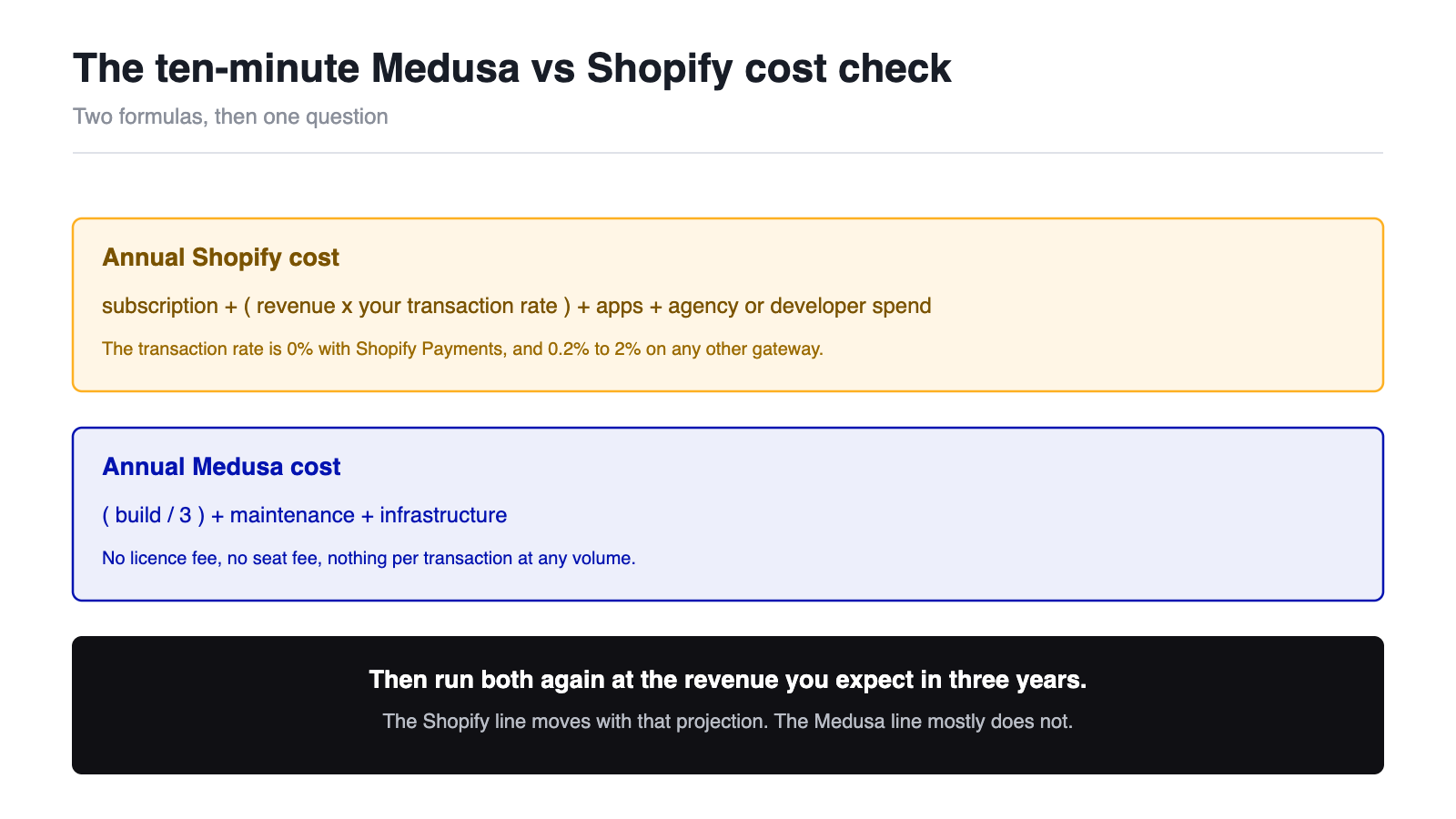
Skip the tables and run this instead. It takes ten minutes.
- Annual Shopify cost = subscription + (revenue × Shopify’s transaction rate for your plan and gateway) + annual app spend + annual agency or developer spend
- Annual Medusa cost = (build ÷ 3) + annual maintenance + annual infrastructure
Then ask one further question, because a single year is misleading: what do both numbers look like at the revenue you expect in three years? The Shopify line moves with that projection. The Medusa line mostly does not.
Two patterns show up consistently when businesses run the Medusa vs Shopify cost honestly.
Break-even arrives earlier than expected when Shopify Payments is unavailable. The extra 0.6% to 2% on every transaction is the largest single variable in the entire model, and it is decided by geography rather than by choice.
Break-even arrives later than expected when the build is ambitious. Teams underestimate build cost more reliably than they underestimate platform fees. A build that comes in at double the estimate pushes crossover out by years.
A closing caution about using the Medusa vs Shopify cost as a reason
If the three-year Medusa vs Shopify cost numbers land close together, cost is not the deciding factor and should not be made into one. Two platforms within 20% of each other over three years are, for practical purposes, the same price, and the decision should be made on what the business needs the platform to do. If you’re building a multi-vendor marketplace rather than a single store, the cost drivers shift; see our breakdown of marketplace development cost.
The businesses that are clearly better off on Medusa are rarely the ones that chose it to save money. They are the ones whose pricing, catalogue, approval rules or fulfilment logic could not be expressed on a hosted platform without a stack of workarounds, and for whom the Medusa vs Shopify cost comparison simply confirmed a decision they had already reached on capability.
Cost is a good way to check a decision. It is a poor way to make one.
Frequently asked questions
Is Medusa cheaper than Shopify?
Not at low revenue. In a Medusa vs Shopify cost model, below roughly $1M a year the build cost dominates and Shopify is clearly cheaper. The lines cross as revenue grows, because Shopify takes a share of every sale while Medusa charges nothing per transaction.
What drives the Medusa vs Shopify cost difference most?
Whether you can use Shopify Payments. On a third-party gateway Shopify adds 0.2% to 2% on top of your processor, depending on plan. On $1M of revenue at 2% that is $20,000 a year, which is the single largest variable in the model.
What does it cost to host Medusa?
A minimal production stack with an app instance, a worker, managed Postgres, Redis and object storage typically runs $50 to $150 a month, rising into the $500 range with traffic. Medusa Cloud publishes plans at $29, $99 and $299 a month with usage-based overages.
Does Shopify Plus really shift to a revenue share?
Agencies who model these contracts report a switch somewhere around $800,000 a month in GMV, at roughly 0.2% to 0.4%, with a cap sometimes cited near $40,000 a month. Shopify does not publish the threshold, the rate or the cap, so treat those as reported rather than confirmed.
How should I model this for my own business?
Annual Shopify cost is subscription plus revenue times your transaction rate plus apps plus agency spend. Annual Medusa cost is build divided by three plus maintenance plus infrastructure. Then run both again at the revenue you expect in three years.
We build commerce systems on Medusa, and we say plainly when a hosted platform is the better structural fit. If you want the three-year numbers run against your actual revenue, gateway situation and requirements rather than illustrative ranges, we are glad to do it with you. See our custom ecommerce development and Medusa.js development services, or request a cost model.