


A founder sits in a planning session debating whether to fund a Customer Data Platform for defining audience segments or to invest engineering time into real-time per-user experiences. The personalization vs segmentation question matters because money goes to different systems. Customer segmentation groups customers into cohorts – by geography, purchase history, or account tier – so you can target them with shared campaigns or rules. Personalisation changes what a single visitor sees based on their individual behaviour and session context. In ecommerce, segmentation drives your email blasts and pricing policies; personalisation drives your “because you bought X” carousels and dynamic banners. From an engineer’s perspective, both are configuration in code, but segmentation queries run against profile attributes while personalisation requires event streams, context data, and tighter latency constraints. This comparison is written for ecommerce founders and managers deciding how far to take personalisation, and for the engineers who will have to build and run it.
Side‑by‑side: personalization vs segmentation at a glance
Most ecommerce teams need both. Segmentation sets up the “who”; personalisation decides “what now.” The table below is the fastest way to see the differences.
| Aspect | Segmentation | Personalisation |
|---|---|---|
| Definition | Grouping users into cohorts for targeting | Adapting content or logic for a specific user or session |
| Unit of targeting | List, cohort, or account | Individual customer, device, or session |
| Data needed | Profile attributes (country, role), aggregate behaviour (orders, average order value) | Detailed behavioural events, context (device, time, current page), possibly real-time stock or pricing |
| Typical ecommerce use | Email campaigns, loyalty tiers, country-specific catalogues, win-back flows | Product recommendations, dynamic home banners, content blocks, in-session offers |
| Effort to run | Upfront design, periodic maintenance, marketing- or ops-owned rules | Heavier engineering and data integration, continuous tuning, QA, and monitoring |
| Where it usually lives in the stack | CRM, marketing automation tool, data warehouse, ecommerce backend | Storefront, recommendation engine, feature flags, experimentation layer |
One trade-off that only surfaces in production: multiplying per-user personalisation rules makes test coverage combinatorial, so a segment-based fallback must always be rigorously defined, otherwise a percentage of users see empty slots or wrong content.
How segmentation and personalization work together in a modern ecommerce stack
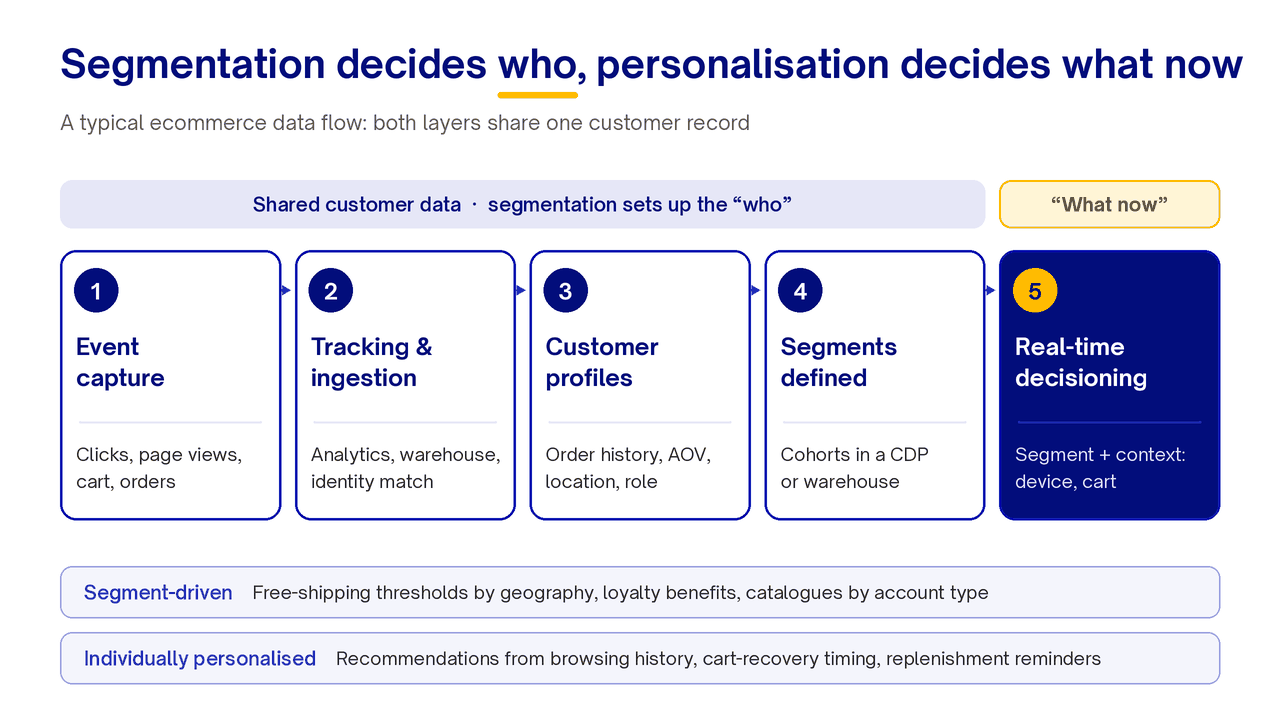
Segmentation is the “who” layer. Personalisation is the “what to show, now” layer. They share the same customer data but operate at different points in the decision chain.
A typical data flow runs through these steps:
- Event capture. The storefront generates click events, page view events, cart events, and order events – logged client-side or server-side.
- Tracking and ingestion. Events feed into analytics tools, streaming systems, or warehouse pipelines. Identity resolution matches sessions to known users or accounts.
- Customer profiles built. Aggregate behaviour (order frequency, average order, categories of past purchases) plus profile attributes (location, role, contract terms) form a unified record.
- Segments defined. Cohorts are created – high-frequency vs seasonal shoppers, D2C vs B2B account tiers – inside a CDP, warehouse, or marketing tool.
- Real-time decisioning. The storefront or recommendation engine uses both segment membership and immediate context (current category, device, cart contents) to serve personalised content and relevant messages.
Key systems involved: the ecommerce platform (custom, composable, or SaaS – for instance Medusa.js or Shopify), a data warehouse or CDP that consolidates user data, a marketing automation tool for email and push notifications, a recommendation service, and an experimentation framework.
Segment-driven decisions include setting free-shipping thresholds by geography, applying loyalty benefits, or showing different catalogues by account type. Individually personalised decisions include recommending items based on browsing history, timing a cart-recovery email per user’s past open behaviour, or adjusting replenishment reminders.
An engineering gotcha worth noting: when segments are only implemented inside the email marketing tool and never surfaced on site, the marketing team cannot reuse them in storefront logic, leading to inconsistent marketing messages and duplicated effort.
Examples for B2C and D2C stores: from simple segments to individual experiences

These are concrete examples an ecommerce manager can copy or adapt. The pattern is always the same: start with segments that divide your customer base into distinct groups based on reliable data, then layer personalisation where the data justifies it.
B2C / D2C segmentation examples that actually ship
- New visitors vs first-time buyers. New visitors, often potential customers comparing several stores, receive a welcome series or content introduction; first-time buyers get product usage tips, review requests, and encouragement to re-order. Data needed: whether the user has an account or cookies, plus order history. Typically owned by the email or CRM tool.
- High-frequency buyers vs seasonal shoppers. High-frequency buyers see subscription offers or early access; seasonal shoppers get reminders before expected buying intervals. Data: order history and purchase dates. Owned by loyalty or operations.
- Category-interest segments. Users who repeatedly browse “home fitness” or “pet care” categories or purchase within them. Used for tailoring catalogue display and promotions. Data: page and product view events plus past purchases. Owned by merchandising.
- Location-based segments. Geographic segmentation by country or region to adapt currency, shipping rules, and local payment options. Data: profile address or IP. Owned by backend configuration.
Customer segmentation is typically built from demographic segmentation, geographic segmentation, psychographic segmentation and behavioural criteria – but the most common failure is when segments exist only in spreadsheets and never sync to the actual stack, so the marketing team thinks they are targeting “VIP customers” while emails go to churned accounts.
B2C / D2C personalization examples on site and in campaigns
- Homepage hero banner changing by last browsed product category. Rule-based logic handles this well for small catalogues; a recommendation model helps when the catalogue is large and dynamic content must be matched to user preferences.
- “Recently viewed” and “Because you bought X” carousels. Collaborative filtering or item-affinity models add relevance here; simple rule-based logic (show last viewed) works for early stages.
- Dynamic cart messages. “Spend S$15 more for free shipping” based on cart value and the customer’s shipping segment. Simple rule-based, minimal engineering.
- Send-time personalisation. Picking email send time per user’s past open behaviour. Requires the email system to record open timestamps and schedule per user – more engineering than most teams expect.
- Personalised replenishment reminders. For consumables, based on known usage or purchasing behaviour intervals from past purchases. A model can predict consumption cycles; simpler cases use fixed intervals.
Rule-based logic covers most of these tactics early on. Machine learning starts to justify itself when repeat traffic is high and the catalogue is deep enough that editorial curation cannot keep up.
One performance trade-off: too much personalised logic per page can slow time to first byte if requests to recommendation engines or feature-flag services are synchronous. Caching or async loading is usually necessary before you see the conversion uplift you expected.
Personalization vs segmentation for B2B ecommerce and account‑based buying

In B2B ecommerce, the unit of targeting often shifts from an individual to an account. Segmentation rules are stricter because they map to contracts, price books, payment terms, and compliance requirements. Personalisation sits on top of those constraints – it must never override them.
Account‑level segmentation for B2B buyers
- Account size tiers. SMB, mid-market, and enterprise accounts are mapped to different order minimums, discount thresholds, and workflows (e.g. sales involvement for enterprise quotes).
- Industry-based segments. Regulatory compliance, product restrictions, and content offerings adjusted per industry. A medical distributor and a hospitality buyer may see entirely different catalogues from the same ecommerce store.
- Lifecycle segments. Prospect, active customer, lapsed, urgent to renew – controlling access, discounting, and outreach cadence.
These segments frequently drive catalogue visibility, payment terms, approval flows, and pricing structures in the ecommerce backend.
An engineering detail that matters: ERP account fields (contract tier, size, industry) must be synchronised into the ecommerce store without duplicating business rules. If the discount logic lives in both the ERP and the storefront, discrepancies between them cause pricing or catalogue mismatches that create customer disputes.
Customer‑specific catalogues, prices and experiences
Personalisation patterns that sit on top of account segments:
- Customer-specific price books and discount structures. Each account sees only the prices agreed in contract. Model-based repricing is unsuitable when contracts are binding.
- Per-account product visibility. Hiding SKUs not in contract so buyers only see what they can order.
- Per buyer role experiences. Procurement managers get quick-reorder lists; executives see dashboards or ROI tools. The experience differs for a named buyer vs the whole account: an approver may see cost-centre allocation fields that a requester does not.
A failure mode seen in production: personalisation rules that accidentally ignore contracted pricing, causing incorrect invoices. One bad cache returning the wrong catalogue version can unravel a customer relationship.
Data requirements: what each approach really needs to work

Deciding how much to invest in segmentation and personalization depends on what data infrastructure exists and how much you trust it. Deploying logic against inaccurate data is worse than doing nothing.
Data stack for reliable segmentation
The minimal data needed: clean customer IDs, order history (recency, frequency, monetary value), geography, and basic profile attributes. Demographic data and firmographic fields help for B2B. Customer segmentation analysis helps identify high-value customer groups, but only when those IDs are deduplicated and identities are resolved across devices.
This data usually lands in a warehouse or CDP and syncs daily or hourly into marketing tools. Daily batches are fine for most email or promotion needs. But for on-site segmentation – showing a “new customer” banner or hiding a loyalty tier offer – you may need near-real-time session detection.
An engineering insight: when different tools use different definitions of “active customer” (email tool: opened email in 30 days; warehouse: placed order in 90 days), segment membership diverges silently. Nobody notices until a campaign hits the wrong list.
Data and systems behind real personalisation
Extra data needed for per-user decisions:
- Event-level data (product views, clicks, cart changes) with timestamps. This is the individualised data that separates personalisation from segmentation.
- Context: device type, referrer, location, stock levels, live prices.
Personalisation relies on individual behaviours and real-time context for targeting. Where this usually lives: session stores (Redis), recommendation services, on-page context, and feature-flag systems. AWS Personalize, for instance, works with user-item interaction data, item metadata, and user metadata to generate model recommendations.
Latency constraints matter. Some decisions can be pre-computed nightly (e.g. “recommended for you” lists). Others must be real-time (banner content based on current cart). Over-fetching data on every page load can erase the conversion gains from better relevance – a performance trade-off that teams discover after launch, not before.
Where personalization and segmentation break in production
The hard part is not the idea. It is edge cases with real customers, real catalogues, and partial data. Both approaches fail in production, and the failure modes are different.
Common segmentation failure modes
- Segments defined once and never updated. “High-value customers” includes people who churned a year ago because nobody refreshed the definition.
- Conflicting segment definitions across tools. Country based on shipping address vs billing address produces different customer segments for the same person.
- Segments too small. The overhead per campaign or variant does not justify the gain; low sample sizes limit statistical validity.
- Logic that ignores operational constraints. Local payment methods advertised in a segment where they are not supported. Shipping options shown to a geographic segment where they do not apply.
Deploying new segment logic without backfilling historical data creates periods when the segment is empty for some tools, making reports show zero audience on day one. Teams that have shipped this learn to run backfills first.
Common personalisation failure modes
- “Creepy” recommendations. Naïve segmentation models that surface sensitive or irrelevant items due to sparse data, which damages brand loyalty faster than having no personalisation at all.
- Personal banners contradicting promotions managed elsewhere. When a CMS and a promo engine both try to control the same banner slot, customers see conflicting marketing messages.
- Broken fallbacks. Users with little history see empty carousels because no default relevant content was defined.
- Personalised experiments never turned off. Old feature flags and stale rules clutter the codebase and create unexpected customer interactions.
- Page load issues. Too many synchronous calls to recommendation or feature-flag services slow first byte time.
A production lesson: teams need offline validation sets before trusting a recommendation model with high-traffic pages. A model might show gains in a small test but fail when scaled because the data distribution changes. Data privacy is less of an issue in segmentation due to its reliance on aggregate data, but personalisation touches individual-level data and must be treated accordingly.
The trade‑offs: cost, complexity and control
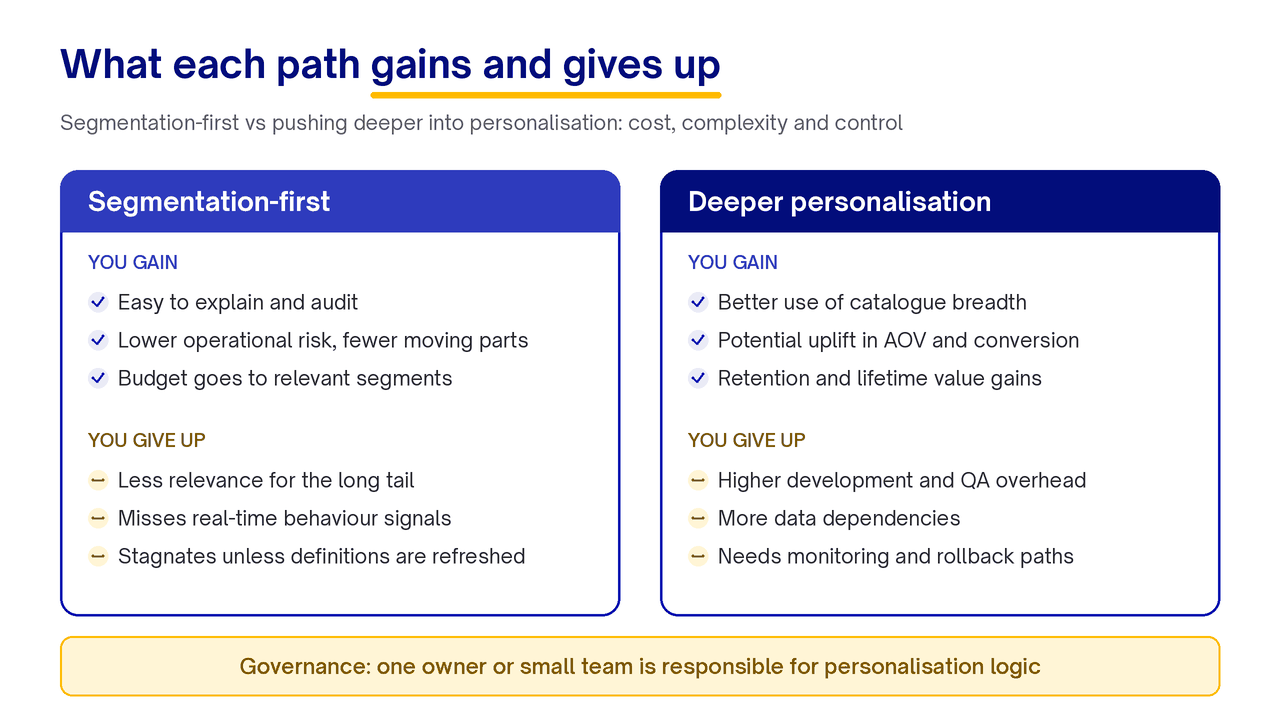
This is what a founder or ecommerce manager must be able to explain to a board or investor: the business outcomes each path can deliver and what it costs to run. Each path has clear gains and costs.
What you gain and give up with segmentation‑first strategies
Benefits: easier to reason about, explain, and audit. “These five rules define high-value customers” is a statement a marketing team and a finance team can both verify. Lower operational risk. Fewer moving parts. Marketing efforts and marketing budgets go to relevant segments rather than blanket campaigns. Segmentation provides a foundation for effective personalization by defining audience buckets – and it makes sense to validate those buckets before doing anything more complex.
Trade-offs: less relevance for edge cases and the long tail of the catalogue. Missing opportunities from real time data insights about immediate behaviour. Segment logic tends to stagnate unless systematically refreshed with new behavioural data. Segmentation only keeps improving engagement while its definitions stay current.
Engineering note: segment rules belong in a central configuration store, not scattered across email templates, storefront code, and warehouse queries.
What you gain and give up when you push deeper into personalisation
Benefits: more efficient use of inventory and catalogue breadth. Potential uplift in average order value, conversion, and customer retention and customer lifetime value for existing customers.
Trade-offs: higher development and QA overhead, more data dependencies. Requires monitoring and rollback paths when a rule or model misbehaves. Personalisation often requires sophisticated technologies and continuous data integration – it is not a set-and-forget investment.
Governance matters: a single owner or small team must be responsible for personalisation logic. Without that, conflicting rules, duplicated effort, and contradictory personalised content are inevitable.
How we approach personalization and segmentation at KVY TECH
KVY TECH projects typically start with clear business rules and segments – shipping policies, pricing tiers, promotion logic, currency handling – before introducing selective personalisation where there is evidence it will help. In product discovery, we map data sources, constraints (payment methods, currencies, tax), and where segment-level decisions are safer than per-user logic.
For JML Singapore, KVY delivered custom promotion and pricing rules with multi-currency support, and the internal team held full operational control at handover. Personalisation rules and promotion configurations sit in one place so managers can reason about what a customer sees without checking three systems. Weekly demos, written updates, and warranty periods serve as guardrails when rolling out new rules to production – because the risk of personalisation going wrong is a business risk, not just an engineering bug.
Frequently asked questions about personalization vs segmentation in ecommerce
Should a new ecommerce brand start with personalisation or segmentation?
Start with clear, simple customer segments and rules. Segmentation is a macro-level strategy for audience division and gives you a reliable foundation before layering complexity. Light personalisation (e.g. “recently viewed” carousels) is worth adding early – but over-engineering personalised interactions before you have enough data and repeat traffic slows development and obscures what is actually driving results.
What tools do I actually need to combine segmentation and personalisation?
A minimal stack: an ecommerce platform, analytics or event tracking (Google Analytics or equivalent for website analytics), an email or marketing tool capable of defining and syncing customer groups, and optionally a recommendation engine or rules engine. Segments belong in the marketing tool or CDP; real-time personalisation rules belong in the storefront or middleware. The most common waste is duplicating the same segment definitions in three places – CRM systems, email tool, and storefront – with slightly different criteria.
How do I know if my personalisation is “working” and not just adding noise?
Run A/B tests with clear key performance indicators: conversion rate, average order value, customer engagement, and customer satisfaction signals like opt-out rates. Check that personalised areas actually render for enough users to be statistically meaningful. Logging and observability must be in place before ramping traffic. Track both model performance (click-through on recommendations) and business KPIs (revenue per session) – a model can increase engagement and still decrease margin if it over-promotes discounted items.
How far can we go without hiring an in-house data science team?
Rules-based logic and vendor-provided recommendation tools – such as Klaviyo’s AI segmentation or platform-native suggestion engines – cover most early personalisation strategies. Custom modelling usually starts to make sense when the catalogue is large, repeat traffic is high, and the right tools alone cannot capture patterns in purchasing behaviour. Clear rules and clean accurate data usually matter more than complex algorithms. The gap is typically evaluation, not algorithms.
Next steps
Successful marketing strategies use both segmentation and personalisation, in the right order. The decision an ecommerce leader needs to defend is not “which one” but “how far, and when.” Segment first where the rules are clear; personalise where the data and customer behaviour justify it. If you are building or extending a D2C or B2B ecommerce stack, we work through that decision during product discovery.
Tell us what you are building. We reply within one working day.