


A distributor with a strong catalogue often reaches the same point. Customers ask for products it does not stock, suppliers ask to sell through its site, and opening the online store to independent sellers looks like the natural next step.
Before long the team is comparing multi vendor marketplace platform options: plugins, hosted marketplace builders and custom development, and most guides on how to build a multi vendor marketplace begin with “install, configure, launch”.
Every marketplace platform already carries answers to business model questions the team may not have settled yet: who the customer pays, when sellers get their money, how commission is worked out, who holds the stock. When you create a multi vendor marketplace, those answers decide which tools fit, so they are worth making on purpose first.
This article walks through those decisions in the order a build usually follows: decide the marketplace model, choose the platform route, set up seller onboarding, set up payments and payouts, launch with a first set of sellers, and operate. For each one it sets out the options, the trade-off and the kind of tool each option points to.
It does not rank tools, because the right answers depend on your sellers, customers and existing operations.
What a multi-vendor marketplace is, and what it asks of the operator
A multi-vendor marketplace is an online store where several independent sellers list and sell to the same customers, and the business running it, the operator, earns from the sales it brings them. To a customer it looks like one shop with one checkout.
Behind it, each order may belong to a different seller, each payment may need splitting, and each refund has to reach the right party.
How it differs from a single-vendor online store
A single-vendor online store sells its own products, while a multi-vendor ecommerce website sells products from many independent sellers through a single platform. Single-vendor stores own their stock, set their prices and keep their revenue.
A marketplace operator takes on work for other businesses: checking who they are, collecting or routing their money, setting standards for how they ship and handle returns, and settling disputes between them and customers.
| Area | Single-vendor store | Multi-vendor marketplace |
|---|---|---|
| Who sells | One business selling its own products | Many independent sellers |
| Stock | Owned by the store | Held by each seller, or by the marketplace on their behalf |
| Payments | Paid into one account | Split between sellers and the marketplace’s commission |
| Customer service | Handled by the store | Shared between sellers and the operator |
| Wider range | Buying more stock | Recruiting more sellers |
Who benefits, and when a marketplace is the wrong model
Customers, sellers and the operator each gain something from a marketplace, and each gain comes with a condition. Customers get a wider range in one place, as long as the marketplace keeps quality even across sellers. Sellers reach customers they could not reach alone, in return for commission and the marketplace’s rules.
The operator widens its range without buying the stock, and takes on the payment, support and quality work described in the steps below. For a distributor, the question is whether that work is worth the range it adds.
When there are few outside sellers to bring in, or customers buy a narrow range, a traditional e-commerce store selling its own products carries less of that work.
Examples of product and service marketplaces
Well-known online marketplaces show the main marketplace types. Amazon, eBay and Alibaba are product marketplaces where many independent sellers list goods. Uber and Airbnb are service marketplaces, where drivers and hosts sell rides and stays through a single platform.
Most new marketplaces serve a focused niche, such as one trade or region, and niche marketplaces often start with sellers the founder already knows.
Step 1: Decide the marketplace model
In a multi-vendor marketplace, the marketplace model is the business model written down: the set of answers about what is sold, where the money goes, who holds the stock and how the marketplace earns. Each answer narrows the tools that fit, so this step comes before any demo or trial.
What kind of marketplace you are opening
Marketplaces usually fall into three kinds. Product marketplaces sell physical goods, and their work centres on stock, shipping and returns. Service marketplaces sell time or work, so they need calendars, bookings and cancellation rules in place of stock. B2B marketplaces sell between businesses, with quotes, invoices, payment terms and prices per buyer.
Some combine more than one, such as products sold with installation booked alongside.
The kind of marketplace also shapes who may sell. A curated marketplace starts with fewer sellers and a more even standard. An open one grows faster and needs stronger checks later. A distributor opening its catalogue can start with suppliers it already trades with, whose terms and reliability it already knows.
What it points to. Product marketplaces need stock and shipping per seller. Service marketplaces need booking and availability tools, which a product-focused tool may not include. B2B marketplaces need company accounts, price lists and invoicing, which narrows the field further.
Who the customer pays
The next decision is where the customer’s money lands. In one marketplace model the marketplace takes the full payment and later passes each seller their share. In another, the customer pays the seller directly and the marketplace collects a fee. Payment providers support both.
Stripe Connect, for example, offers direct charges, destination charges, and separate charges and transfers, and the choice decides whose account the payment lands in first.
Who the seller of record is
The seller of record is the business whose name is on the receipt, which answers for refunds and returns and issues the invoice. When the marketplace is the seller of record, the customer deals with one business, and the marketplace carries the refunds, the tax paperwork and the customer service for every seller.
When each seller is the seller of record, the marketplace carries less of that load and has less control over how customers are treated. The legal and licence side of this differs by country. Our article on building a marketplace in Singapore covers those questions for one market.
What it points to. A marketplace that collects all the money needs a payment set-up that can hold funds and split them later. A marketplace where sellers are paid directly needs every seller to have an account with the payment provider before they can sell.
In both, the provider’s transaction fees apply to every sale, and the marketplace payments set-up decides whose share they come out of.
Who holds stock, and who ships
In one model sellers keep their own stock, handle their own inventory management and ship their own orders. The marketplace never touches the goods, and delivery times and packaging vary by seller. In another, sellers send stock to the marketplace’s warehouse, and the marketplace picks, packs and ships.
Customers get one consistent delivery, and the marketplace takes on warehouse costs and stock records for goods it does not own. Some marketplaces start with the first and add the second later for selected sellers.
A distributor opening its catalogue has a third case: its own stock, held in its own warehouse and recorded in its ERP, sitting next to products from outside sellers. Managing inventory then means two sources, the ERP for its own goods and the sellers for theirs, and the storefront has to show both correctly.
What it points to. Seller-shipped orders need a seller portal for managing inventory and dispatch. Marketplace-held stock needs inventory management per seller in the warehouse. A mix with your own ERP needs an integration that keeps your stock and the sellers’ stock apart.
How the marketplace earns
Commission on each sale is the most familiar way a marketplace earns, and there are other revenue streams. Sellers can pay a monthly subscription to sell, a fee per listing, or for extras such as featured placement or fulfilment by the marketplace. Buyers can pay a service fee at checkout.
Commission ties the marketplace’s income to sellers’ sales, so it earns when they do. Subscriptions give steadier income and can put off small sellers who sell little at first. Fees charged to buyers keep sellers’ terms simple and add to the price the customer sees.
Some marketplaces waive or reduce fees for their first sellers, which helps recruitment and sets an expectation that is hard to change later. Mature marketplaces often add advertising revenue, where sellers pay to promote their products in search results and category pages, once there is enough buyer traffic to make that worth paying for.
Commission itself can be one rate for everyone, a rate per category, a rate per seller, or a mix with fixed fees per order. Simple structures are easier to explain to sellers and to check. Detailed structures let the marketplace price categories and sellers differently, and they add work in finance and support every time a seller questions a statement.
When commission becomes final
Commission becomes final at a point the marketplace has to define, such as delivery or the end of the return period. If a customer returns half an order, the marketplace needs a rule for the commission on the returned half. A second detail is what happens when the rate changes.
Storing the rule that applied on each order keeps past orders as they were when a seller’s terms change later.
What it points to. A single rate fits almost any tool. Rates per seller, per category and per order type need a tool that lets you define your own rules, or code written for them.
Step 2: Choose the platform route
With the model written down, the platform question becomes a matter of fit. There are four broad routes, and each moves work between what you configure, what you build and what you run.
The four routes and their trade-offs
- A marketplace plugin on your existing store. It adds sellers, commission and payouts to the store you already run. It is quick to start and keeps your current catalogue and customers. It is bound by what the plugin and the store underneath support, especially for payouts and order splitting.
- A hosted marketplace builder. A service that runs the multi-vendor marketplace website for you, usually for a monthly fee. There is little to maintain, and it is a fast way to test whether sellers and buyers come. Rules outside its settings are hard or impossible to add.
- An open-source marketplace platform. Code you host and can change, with marketplace features already built. It gives more freedom than a hosted builder, and you or a partner take on the hosting, updates and changes.
- Custom development. A system built around your rules, often on an existing commerce framework. It fits the business closely, takes longer to reach a first version, and needs a team to keep running it.
Plugins and hosted builders are configured through settings, so a marketplace can be created on them without coding, within the rules they support. Open-source and custom routes need developers with the technical expertise to host and change the code.
Examples of multi-vendor marketplace software on each route
Each route has well-known multi-vendor marketplace software, listed here as examples of the route and in no order of preference. Dokan is a multi-vendor marketplace plugin for WordPress sites.
Sharetribe is a hosted marketplace builder, and its site says a marketplace can be up and running in minutes, with customising usually taking no more than a day, as listed on 9 November 2026.
CS-Cart Multi-Vendor is marketplace software that its site describes as supporting niche, regional and B2B marketplaces. Mirakl is a marketplace platform for enterprise retailers, distributors and B2B businesses. On the open-source side, Mercur is a multi-vendor marketplace built on Medusa. Each carries its own answers to the step 1 decisions.
The features to check on each side
Whatever the route, a working multi-vendor marketplace needs features for three groups of users. Checking each candidate against this list, and against the model from step 1, shows where the gaps are.
- Sellers: registration and verification, product listings with images and variants, stock updates, order handling and dispatch, payout statements, and vendor dashboards showing sales and commission.
- Buyers: search and filters across all sellers, product pages that show who sells each item, a multi vendor checkout with multiple payment options, order tracking per seller, returns, reviews and, where people both buy and sell, one account that can switch between the buying and selling roles.
- Operators: seller approval and tools to manage vendors, commission rules, tax settings and invoices, payout runs, refunds and disputes, category and content management, reports for finance, and roles for staff.
How search ranking decides which sellers sell
Search ranking decides which sellers get the sales when many of them list similar products, so the ranking rules are a business decision: price, stock, seller rating, delivery time, or a mix of them.
A mobile app or a mobile-friendly website
A mobile-friendly multi-vendor website serves buyers on phones from the start, and a mobile app is a separate decision: it adds a second product to build, release through app stores and maintain.
When a ready-made platform is enough
For a multi vendor ecommerce website, a plugin or hosted builder fits well when the marketplace functionality you need matches its defaults: one way of collecting money, a payout schedule it already supports, a commission structure it can express, and sellers who ship their own orders.
Some plugins add marketplace features to your own store, and hosted builders run the marketplace website for you. Reading a few multi-vendor marketplace examples for the decisions behind them helps show which defaults are common across online marketplaces.
The fit gets harder when the rules are the business itself. That is common when you look at how to build a B2B marketplace: buyers expect invoices and payment terms, prices differ per customer, orders need approval inside the buying company, and stock and prices live in an ERP.
Each of those is a rule a ready-made platform may handle partly or leave to custom development. Between the two sit open-source platforms that give a starting point you can change. Our comparison of open-source multi-vendor marketplace platforms and our review of Sharetribe alternatives cover several options.
When the rules call for a system built around them, that is the work of custom ecommerce development.
For marketplace owners, the way to build a multi vendor marketplace that keeps working is to choose the tool after the decisions, and to check each multi vendor marketplace platform against your written answers. Some teams find a plugin covers everything. Others find one decision, often payouts or B2B terms, rules out most of the list.
What to agree with a development team
On the open-source and custom routes, project management and communication shape the result as much as the code. Agree who decides on scope changes, how progress is reported, who owns the code and who runs the marketplace after launch.
Technical support needs a named owner too, because sellers and buyers expect responsive support when a payout or an order with custom features goes wrong.
Step 3: Set up seller onboarding

Seller onboarding is where the rules of a multi-vendor marketplace meet real sellers. It covers who may join, what they must provide, and what they agree to before their first product goes live.
How sellers are approved, and what they can change themselves
On a multivendor marketplace, vendor onboarding is the first part of vendor management. Some marketplaces let anyone sign up and sell products. Others review each seller, check documents and approve the first products by hand. Open sign-up grows the catalogue faster and lets poor product listings and unreliable sellers in.
Manual approval protects the customer experience and needs staff time for every new seller.
After approval, the question is what sellers can change in their product listings without asking: prices, product descriptions, images, stock, shipping options. Every right given to sellers saves marketplace owners work and moves some control of the customer experience to the seller.
Once multiple vendors are live, vendor management also means watching vendor performance: late dispatches, cancellations and complaints, and a rule for what happens when a seller falls short.
What it points to. Open sign-up needs automated checks and a way to remove sellers quickly. Manual approval needs a review queue in the admin. Limits on what sellers can edit need a tool with roles and permissions you can set per field.
What sellers provide, and the standards they agree to
Each seller usually provides business details, bank details for payouts, product data in the format the marketplace needs, and agreement to the marketplace’s terms. When a payment provider pays sellers out, it also has to verify who they are.
Stripe’s documentation for Connect describes these as Know Your Customer requirements that vary by country and business type, and notes that charges or payouts can be paused if the information is not provided.
The same page says platforms still have to watch for and prevent fraud after a seller is verified, so the provider’s checks are a starting point for the operator’s own. The platform chooses whether to collect everything at sign-up or gather it in stages as a seller grows. Collecting everything up front slows sign-up and avoids payout problems later.
Collecting in stages lets sellers start faster and leaves a risk of paused payouts when more information is due.
Seller standards set out what the marketplace expects: dispatch times, how returns are handled, the quality of product data and photos, how fast messages are answered, and what happens when a seller falls short. Written standards give the operator a fair basis for warning or removing a seller. Strict standards keep the marketplace consistent and make recruiting harder.
Loose standards fill the catalogue faster and leave customers to find the weak sellers.
Step 4: Set up payments and payouts

In a multi-vendor marketplace, the money flow chosen in step 1 becomes real here: the payment provider, the payout schedule, refunds, disputes and baskets with several sellers. Mistakes in this step reach every seller at once, so it is worth testing with real amounts before launch.
When sellers are paid, and what is held back
Sellers want their money soon. The marketplace wants to keep enough back to cover refunds, returns and disputes that arrive after the sale. The options run from paying on each order, through paying on delivery, to paying after the return period has closed. Some online marketplaces pay in batches, weekly or monthly, with a share held in reserve.
Paying early keeps sellers happy and leaves the marketplace exposed when a refund comes in after the seller has been paid. Paying late protects the marketplace and makes the platform less attractive to sellers who run on tight cash.
Whatever the choice, the rule has to be written down, shown to sellers in their vendor dashboards, and applied the same way every time. Our guide to how marketplace payouts work goes into the mechanics. If sellers offer subscriptions, the timing question gets harder, and our article on the subscription marketplace model covers who owns the recurring charge.
What it points to. Payouts in batches with a reserve need a record of every sale, refund and adjustment per seller, and a payout run that reconciles them. Simple plugins often pay on order. Holding money back is usually where a tool’s defaults stop fitting.
Who carries disputes and chargebacks
Who carries a disputed card payment depends on two things: the charge type chosen in step 1, which decides whose account the money is taken from first, and the marketplace’s terms with sellers, which decide who finally carries the loss.
What happens to an order split across several sellers
A customer who buys from multiple sellers in one basket pays once and expects one order. With three sellers, behind it sit three shipments, three sets of shipping costs, and three sellers who may each accept, cancel or delay their part.
The marketplace has to decide how shipping is charged when several sellers send separately, what the customer sees when one seller cancels, how a partial refund is calculated, and how the single payment is split between sellers and commission.
Split payment processing is what separates each seller’s payout from the platform’s commission. For a basket with one seller, Stripe’s destination charges send the full amount to the seller’s connected account after the charge is captured and transfer the platform’s application fee back to the platform.
Baskets with several sellers usually need separate charges and transfers, so one payment can be divided between them.
Keeping the basket to one seller at a time is simpler to run and less convenient for the customer. Allowing mixed baskets is what customers expect from a multi vendor marketplace, and it makes every later step in the order more involved.
What it points to. Mixed baskets need a multi vendor checkout that splits an order into parts per seller, tracks each part’s status, and splits the payment to match.
Sales tax and marketplace facilitator rules
In many US states, marketplace facilitator laws make the marketplace collect sales tax on the sales it handles for its sellers. Washington’s Department of Revenue, for example, states that marketplace facilitators must collect and report sales tax on all retail sales sourced to Washington made through their marketplace, including sales made on behalf of marketplace sellers.
Rules and thresholds differ by state and country, so the tax set-up is a question for your own tax advisers.
Step 5: Launch with a first set of sellers
Launching a multi-vendor marketplace means bringing in sellers and buyers in an order that gives each side a reason to stay.
Which side to bring in first
Bring in the side that the other side waits for: a new marketplace needs sellers to attract buyers and buyers to attract sellers. One approach is to start with supply: a set of sellers whose products are listed and in stock before buyers are invited.
A distributor has an advantage here, since its own catalogue and existing customers are already on the site. The first outside sellers can be suppliers it already trades with, chosen to fill the gaps customers ask about.
Recruiting sellers by hand gives a small, reliable first catalogue and takes staff time for each seller. Opening sign-up early fills the catalogue faster and makes the first impression depend on sellers you have not checked.
Bringing in the first buyers
Buyers come from the channels the operator already has or builds: existing customers, email lists, sales reps, search engines and paid advertising. A distributor can introduce the marketplace to the customers it already serves, which tests demand with people who know the business.
Reaching new buyers through search depends on product pages with complete, distinct descriptions, and pages that repeat the same supplier text across sellers give search engines little to tell apart. Paid campaigns bring traffic quickly and stop when the spending stops.
Each channel puts a different demand on sellers: a promotion to existing customers needs sellers who can handle a sudden rise in orders on the same day.
What the first version must do, and what can wait
When you build a multi vendor marketplace in stages, the marketplace MVP, the first version that real sellers and customers use, has to get the money right from the first order.
Its essential features are payments landing where you decided, payouts on the agreed schedule, commission calculated correctly, refunds handled, and every order, seller and payment recorded so finance can reconcile them. Seller approval can be manual at first. Other marketplace functionality can wait: seller ratings, advanced search, a mobile app, automated seller onboarding, detailed analytics.
A short first version gets to real sellers sooner, and every feature left out is one the team adds later while the marketplace is running. The test for each feature is whether the marketplace can operate safely without it for its first months.
Test every seller before customers see them
Before a seller goes live, a test order through their part of the marketplace shows whether the whole path works: the order reaches the seller, they accept and dispatch it, tracking reaches the customer, a refund flows back, and the payout statement shows the right commission. Testing each seller takes time at launch. Skipping it means the first real customer finds the problem.
Step 6: Operate the marketplace
After launch, the work on a multi-vendor marketplace moves from building to running, and real sellers and customers test the decisions from the earlier steps.
Seller quality as the number of sellers grows
With a handful of sellers, the team knows each one. With many, vendor management means measuring quality: late dispatches, cancellations, returns, complaints and response times per seller. The operator decides what each measure triggers, from a warning to lower search placement to removal. Measured rules take effort to set up and to apply evenly.
Without measured rules, good sellers can leave when weak ones pull down the customer experience they share.
Disputes, reviews and reconciliation
Disputes between customers and sellers need a process with time limits and a final decision, usually the operator’s. Reviews help buyers choose and start empty, so some marketplaces ask every buyer for one after delivery. Finance reconciles each payout run against orders, refunds and payment provider reports, and each difference has to be traced to a seller.
All of this is a running cost of the marketplace, and the tools chosen in step 2 decide how much of it is automated. When volumes, seller numbers or rules change, the earlier decisions come back up, which is why they are worth writing down at the start.
Growing as the marketplace grows
As the marketplace grows, vendor acquisition moves from personal invitations to a repeatable process: a public sign-up page, clear seller terms and onboarding sellers can finish alone.
Retention matters on both sides. Sellers stay when orders and payouts arrive on time, and buyers return when delivery and returns meet customer expectations across every seller.
Common challenges when you create a multi-vendor marketplace
The common challenges of a multi-vendor marketplace come from having two sides to serve and other people’s money to handle. Each one is decided in one of the steps above:
- Chicken and egg: each side waits for the other (step 5).
- Quality at scale: multiple vendors make uneven service more likely (step 6).
- Payments and compliance: payouts, seller verification and sales tax (steps 3 and 4).
- Empty reviews: early buyers have little to go on (step 6).
- Feature overload: every feature is one more thing to maintain (step 5).
- Low retention: sellers leave without orders, buyers after a poor delivery (step 6).
The decisions side by side
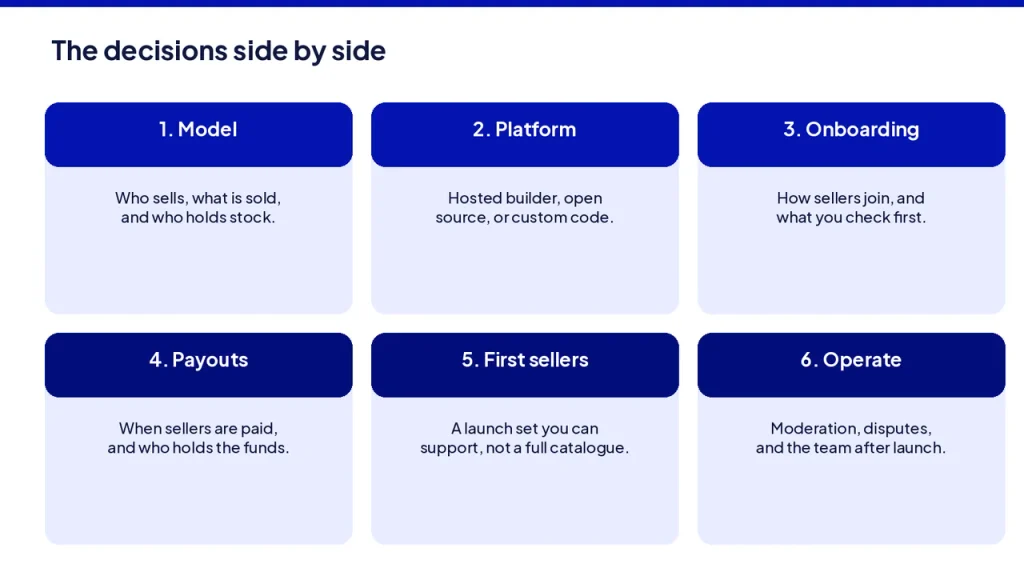
| Decision | The options | The trade-off | What it points to |
|---|---|---|---|
| Kind of marketplace | Products; services; B2B | Stock and shipping; bookings; terms and invoices | Product tools; booking tools; company accounts and price lists |
| Who the customer pays | Marketplace collects; seller collects | Control and load on the marketplace; less control, less load | A payment set-up that holds and splits funds; sellers with their own provider accounts |
| When sellers are paid | On order; on delivery; after returns close | Seller cash flow against refund exposure | Payout batches, reserves and a per-seller ledger |
| Commission | One rate; per category; per seller | Easy to explain; finer pricing with more support work | Default settings; custom rules |
| Stock and shipping | Seller ships; marketplace ships; mixed with your ERP | Less to run; one delivery standard; two stock sources | Seller portal; warehouse records; ERP integration |
| Platform route | Plugin; hosted builder; open source; custom | Speed and less upkeep against freedom to change the rules | Settings; developers and hosting |
| Seller approval | Open sign-up; reviewed sign-up | Faster growth; more control | Automated checks; a review queue and permissions |
| Seller verification | Everything at sign-up; in stages | Slower sign-up; risk of paused payouts | The payment provider’s onboarding settings |
| Mixed baskets | One seller per basket; many sellers per basket | Simpler to run; what customers expect | A multi vendor checkout with order splitting and split payments |
| Launch order | Sellers recruited by hand; open sign-up | Reliable first catalogue; faster growth | Staff time; automated checks |
Questions owners ask before they create a marketplace
What is a multi-vendor marketplace?
A multi-vendor marketplace is an online platform where multiple independent sellers list and sell to the same customers, while one operator runs the site, the checkout and the rules.
How do I create a multi vendor marketplace?
Start by settling who the customer pays, when sellers are paid, how commission works, who holds stock and ships, how sellers are approved, and how mixed baskets are handled. Then compare tools against those answers, and build a first version that gets the money right before adding other key features.
Do I need a payment provider built for marketplaces?
If the marketplace collects money for multiple sellers or pays them out, a provider with marketplace features is usually needed. These providers handle splitting payments, paying sellers and checking seller identities, which a standard checkout does not cover.
Which multi-vendor marketplace platform is best?
The best multi-vendor marketplace platform is the one whose defaults match your decisions on money flow, payouts, commission, stock and seller approval. Checking each candidate against your written answers shows which ones fit and where custom development would be needed.
Can I start with a plugin and move to something else later?
Some marketplaces do. The move is easier when your data on sellers, orders, payouts and commission is clean and exportable, and when you know which decision the plugin could not support. Moving later means migrating live sellers and open payouts, so it needs planning of its own.
How does a multi vendor marketplace make money?
Mostly through commission on each sale, with subscription fees, listing fees, paid placement, fulfilment services and buyer service fees as other revenue streams. The business model that fits depends on how much sellers sell and which fees they will accept.
How much does it cost to create a multi vendor marketplace?
The cost follows the decisions in this article: the platform route, the money flow, the number of seller and order rules, and the integrations with systems such as an ERP. Running costs after launch, including hosting, payment fees and seller support, belong in the same budget as the build.
How long does it take to build a multi vendor marketplace?
It depends on the route and the rules. A plugin or hosted builder can be configured quickly when its defaults fit. Custom rules for payouts, B2B terms or ERP integration add design, build and testing time. Recruiting and testing the first sellers takes time on every route.
Who handles tax on marketplace sales?
That depends on the country and on who the seller of record is, and it is a question for your own tax advisers before launch. The seller of record decision in step 1 is usually where it starts.
Keeping the decisions working after launch
The decisions above keep being tested after the marketplace opens. Sellers ask for different payout terms, a new category needs its own commission, a refund case arrives that the rules did not foresee. KVY built a network marketplace in Dubai on Medusa and still runs it: multi-seller commerce in production, with the same team looking after it and changing it as the business asks. That ongoing work is where the original decisions on money, sellers and orders get checked against real use. Earlier, on an older custom stack, KVY built Pixerf in Singapore, a two-sided creative marketplace with bookings, licensing, payouts and rankings for 50,000+ creators.
If you are weighing this for your own business, start with a plan. In two to three weeks we map how the system would connect to your ERP, warehouse, payments and sales channels, set out the build in phases with the cost to run it over three years, and give a fixed quote for the first phase. You keep the plan whatever you decide.