

Why Singapore SMEs keep adding SaaS
SaaS tools revolutionized how Singapore SMEs operate offering fast deployment, affordable monthly subscriptions, and minimal technical expertise requirements. Early-stage businesses adopt Salesforce for CRM, Xero for accounting, Slack for communications, and dozens of specialized tools addressing specific operational needs. This approach works brilliantly when teams are small, workflows are simple, and growth remains steady.
However, Singapore’s high labor costs median monthly wages of S$4,500-8,000 transform operational inefficiencies into substantial financial losses. As SMEs scale beyond 15-20 employees and manage increasing transaction volumes, the SaaS stack that enabled initial growth becomes an operational constraint. Sales teams toggle between five applications to process single orders. Finance departments manually reconcile data across disconnected systems. Operations managers lack unified visibility into inventory, orders, and fulfillment.
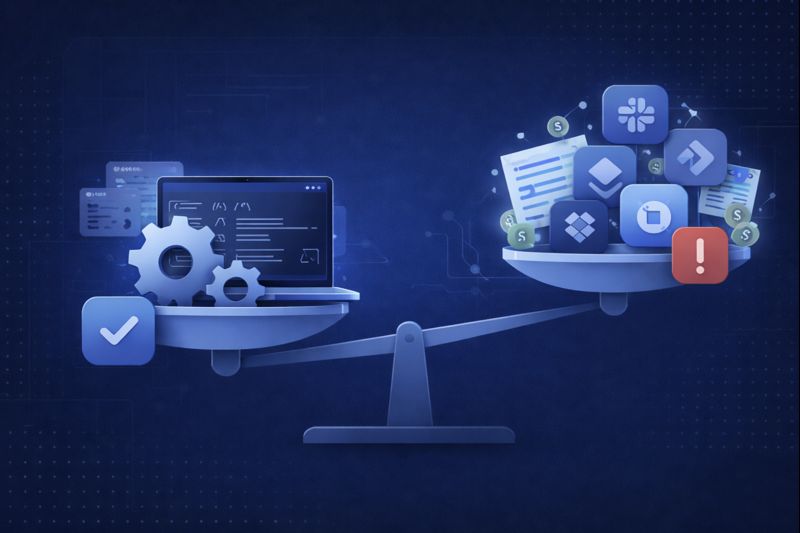
The core challenge: SaaS tools solve isolated problems effectively but rarely support end-to-end workflows at scale. Each tool optimizes its specific function CRM manages leads, inventory software tracks stock, accounting platforms handle finances but business processes span multiple functions requiring seamless data flow and coordinated logic that fragmented SaaS stacks cannot deliver.
When manual workarounds, data synchronization issues, and system complexity costs exceed custom software development investments, SMEs reach the inflection point where building becomes smarter than buying.
1. Your team is manually moving data between systems
The clearest signal that SaaS complexity exceeds its value: employees spending hours daily copying information between platforms. Sales representatives enter customer details into CRM, then re-enter identical information into quotation tools. When orders confirm, data moves manually to accounting software for invoicing and inventory systems for fulfillment tracking. Finance teams export transactions from multiple sources into master spreadsheets for reporting.
This manual data movement creates multiple problems beyond obvious time waste. Data inconsistencies emerge when information updates in one system but not others customer addresses differ between CRM and shipping software, product prices mismatch between quotation and accounting tools. Delayed synchronization means teams make decisions based on outdated information, leading to stockouts despite available inventory or pricing errors from stale contract rates.
Custom systems establish a single source of truth where data enters once and flows automatically to all dependent processes. Customer information captured during initial contact populates quotation generation, order processing, invoicing, and fulfillment without manual intervention. Real-time synchronization ensures every team member accesses current, accurate information regardless of which function they serve.
2. Your business workflows don’t fit standard SaaS logic
Generic SaaS tools assume standardized business processes typical sales cycles, conventional approval hierarchies, common pricing structures. Singapore SMEs operating in specialized markets or competitive niches develop unique workflows that deliver competitive advantages: contract pricing varying by customer relationship depth and purchase history, multi-stage approval processes balancing speed with financial controls, custom order fulfillment logic optimizing across multiple warehouses, and specialized reporting formats required by specific industries or enterprise customers.
When business workflows don’t match SaaS assumptions, teams face impossible choices: compromise operational efficiency by forcing workflows into software constraints, or maintain competitive processes through extensive manual workarounds that negate SaaS efficiency benefits.
Effective custom software inverts this relationship software adapts to proven business processes rather than forcing process changes to accommodate software limitations. Teams codify competitive advantages into automated workflows that scale efficiently while preserving strategic differentiation.
3. You’re paying more for features you rarely use
SaaS pricing scales with team size and feature access through tiered subscription models. As SMEs grow, per-user costs multiply while forcing upgrades to advanced tiers bundling features that don’t address actual operational needs. A 20-person team paying S$50 monthly per user across five SaaS platforms spends S$60,000 annually with 40-60% of available features unused.
Enterprise tiers unlock API access, advanced reporting, and workflow automation but include marketing automation, advanced analytics, and collaboration features that specific businesses don’t require. Teams pay for comprehensive functionality but utilize narrow feature subsets addressing their particular workflows.
Custom software focuses investment exclusively on capabilities driving revenue or operational efficiency. No payments for unused features, no forced upgrades for capabilities providing zero business value. Development budgets concentrate on high-impact workflows contract pricing accuracy, approval acceleration, inventory optimization delivering measurable returns rather than generic functionality benefiting hypothetical use cases.
4. integrations are fragile and increasingly hard to maintain
SaaS ecosystems promise seamless integration through APIs and connector platforms like Zapier or Make. Initial setup delivers impressive automation new CRM leads trigger welcome emails, completed orders update inventory, customer payments reconcile automatically. However, integration maintenance creates ongoing operational risk.
API versions change requiring connector updates. SaaS vendors deprecate features breaking existing integrations without warning. Connector platforms introduce their own reliability issues rate limits pause automation during high-volume periods, authentication expires requiring manual re-authorization, and silent failures stop critical workflows without alerting teams.
Heavy integration reliance transforms operational stability into external dependencies. When critical business processes depend on multiple third-party services remaining compatible and operational, system reliability degrades to the weakest link. Teams dedicate increasing time monitoring integrations, troubleshooting failures, and implementing workarounds when automation breaks.
Custom architecture provides control over data flows and business logic. Systems integrate through purpose-built APIs designed specifically for required workflows rather than generic connectors serving thousands of different use cases. Teams own the integration code, enabling immediate fixes when issues arise rather than waiting for third-party vendors to address problems affecting small user segments.
5. Critical approvals still happen via email or chat
Despite significant SaaS investments, many Singapore SMEs still route critical decisions through email threads or WhatsApp conversations: pricing exception requests forwarded through multi-level email chains, purchase orders requiring approvals scattered across inbox folders, discount authorizations discussed in chat groups without structured tracking, and contract modifications negotiated through document attachments lacking version control.
These informal approval processes create serious operational and compliance problems. No visibility into approval status sales teams don’t know if pricing exceptions are pending or rejected. Zero audit trail for financial controls no systematic record proving who approved discounts eroding margins. Poor accountability when errors occur difficult determining responsibility when approvals happened through informal communications.
Digital approval workflows transform decision processes: requests route automatically to appropriate approvers based on transaction value and type, notifications ensure rapid response rather than emails lost in crowded inboxes, complete audit trails track decision history for compliance and performance analysis, and analytics reveal approval bottlenecks slowing operations.
6. Your business changes faster than SaaS roadmaps
Singapore’s competitive business environment demands rapid strategic adaptation. Market shifts, competitor actions, regulatory changes, and customer preference evolution require swift operational responses. SMEs need systems that evolve with business strategies rather than constraining strategic options to software capabilities.
SaaS vendors prioritize roadmap features benefiting broad user bases rather than specific business needs. Feature requests from individual SMEs rarely influence product development focused on enterprise customers or mass-market segments. When strategic initiatives require system support unavailable in existing SaaS tools, SMEs face extended delays waiting for vendor roadmaps or expensive custom development atop platforms not designed for deep modification.
Custom systems enable rapid iteration aligned with evolving business requirements. New pricing models deploy within weeks rather than waiting months for SaaS vendors to prioritize feature requests. Process improvements implement immediately based on operational feedback rather than conforming to generic roadmap schedules. Strategic initiatives proceed without software constraints limiting competitive responses.
7. You’re hiring more people just to manage complexity
A particularly insidious SaaS complexity signal: headcount growth compensating for system inefficiencies rather than supporting business expansion. SMEs hire operations coordinators manually synchronizing data between systems, system administrators maintaining integrations and troubleshooting failures, data analysts consolidating reports from fragmented sources, and additional salespeople offsetting productivity losses from complex tool workflows.
Labor costs rise without proportional productivity or revenue gains. Teams manage tool complexity rather than serving customers or driving growth. In Singapore’s high-wage environment, personnel expenses easily exceed custom software investments that would eliminate underlying inefficiencies.
Effective automation scales operations without proportional headcount increases. Revenue growth doesn’t automatically demand linear team expansion when systems handle increasing transaction volumes efficiently. Custom software enables 10-20 person teams managing workloads requiring 25-30 employees with manual workflows.
SaaS vs Custom Software: A practical comparison for Singapore SMEs
Understanding the trade-offs helps SMEs make informed platform decisions:
Total cost of ownership: SaaS appears cheaper initially with low monthly subscriptions, but costs compound indefinitely while custom software front-loads investment delivering ongoing value without recurring fees. Over 3-5 years, custom software typically costs 40-60% less at scale.
Flexibility and adaptability: SaaS constrains workflows to vendor-defined capabilities while custom software adapts precisely to business requirements, enabling strategic differentiation impossible with generic tools.
Integration depth: SaaS relies on generic APIs and connector platforms introducing fragility, whereas custom architecture integrates systems purpose-built for specific business logic with full control over data flows.
Data ownership and accuracy: SaaS distributes data across multiple vendor platforms complicating reporting and analysis, while custom systems centralize data enabling sophisticated analytics and unified visibility.
Long-term scalability: SaaS costs scale linearly with growth while custom software scales efficiently, supporting 5-10x transaction volume increases without proportional cost increases.
Custom software doesn’t mean “Build Everything at Once”
Modern custom development approaches eliminate the all-or-nothing risks that made custom software prohibitively expensive historically. Today’s modular, incremental methodology lets SMEs start small and expand systematically.
Begin with highest-impact workflows delivering immediate ROI contract pricing automation eliminating margin errors, approval digitization accelerating decision cycles, or inventory synchronization preventing stockouts. Initial implementations prove value, build organizational confidence, and establish technical foundations for subsequent expansion.
Headless architecture using platforms like Medusa.js reduces upfront investment while providing flexibility. Core commerce functionality comes pre-built while custom modules address unique business requirements. This hybrid approach balances speed-to-market with customization depth deploy quickly using proven components while building strategic differentiators through custom development.
Incremental development spreads costs across time while delivering continuous value. Rather than 12-month projects requiring large upfront investments before seeing returns, 4-6 week implementation cycles deliver tangible improvements each quarter, validating approaches before expanding scope.
When custom software becomes the smarter investment
Clear signals indicate when custom software transitions from optional enhancement to strategic necessity:
Team size exceeding 15-20 employees where coordination costs and manual workflows consume significant productivity. Transaction volumes surpassing 500+ monthly orders where operational efficiency directly impacts scalability. Unique workflows providing competitive differentiation that generic SaaS cannot support. SaaS costs exceeding S$50,000 annually while still requiring manual workarounds. Growth constrained by operational capacity rather than market demand.
The strategic shift moves from “tool management” maintaining fragmented SaaS stack to “system optimization” building integrated platforms aligned with business operations. Custom software becomes cost-control and growth-acceleration strategy rather than technology expense.
Conclusion
SaaS tools effectively launch operations and validate business models. However, sustainable competitive advantage comes from operational systems purpose-built for specific business requirements rather than generic tools serving thousands of different companies.
Singapore SMEs lose money through fragmented workflows, manual data synchronization, and system complexity not through technology investment. The companies scaling efficiently recognize when SaaS stacks become operational constraints and transition strategically to custom systems enabling growth without proportional complexity increases.
KVY Technology specializes in helping Singapore SMEs design and build modular, workflow-driven systems aligned with real operations. Our implementations focus on high-impact workflows delivering measurable returns within 8-12 weeks contract pricing, approval digitization, inventory synchronization, and B2B commerce platforms using modern headless architecture.
Ready to evaluate whether custom software makes strategic sense for your business? Contact KVY Technology for a complimentary system audit identifying optimization opportunities and implementation roadmap.