


A founder planning an online marketplace for selling digital goods such as gift cards, game codes, vouchers or mobile top-ups usually starts with the storefront: the catalogue, the reseller sign-up, the checkout. The harder questions arrive with the first supplier integration.
A customer has paid, the request to the supplier has gone out, and no answer has come back. At that moment nobody knows whether a code was issued, whether trying again would buy a second one, or what the reseller who made the sale should be paid.
All of those questions come from one operations problem. In a digital goods marketplace that buys from suppliers, the money taken and the goods delivered have to agree, sale by sale, across the customer, the supplier, the reseller and your own books.
This article covers the decisions that keep them agreeing: a supplier call that fails halfway, refunds after a code has been shown, the supplier balance, reseller storefronts, commission and payouts.
For each one it sets out the design choice, the trade-off and what breaks if it is skipped. It does not rank platforms.
What a digital goods marketplace sells, and how each type is delivered
A digital marketplace is an online platform where many sellers offer digital products to buyers. Digital goods are products delivered electronically, and most guides cover selling digital products you made yourself.
The type of goods decides how delivery works and what a refund means:
- Downloads such as templates, ebooks and music are digital files, often sold by creative professionals through a download link. A failed delivery is fixed by sending the link again at no cost.
- Video courses and memberships are digital content delivered as access to an account. A refund removes the access.
- Software licences are delivered as a licence key, which the seller can revoke after a refund.
- Gift cards, vouchers and game codes are bought from a supplier, in advance or live through the supplier’s API. A code sent twice is a code paid for twice.
- Mobile top-ups are a credit the supplier applies to a phone account. Whether it can be reversed depends on the supplier’s terms.
Digital products such as files, courses and licences cost nothing extra per delivery. Codes and top-ups are digital products bought from another company, with a cash value from the moment they are issued, so a digital products marketplace of this kind carries some of the risks of a payments business.
Selling your own digital products: an existing marketplace, a hosted store or your own platform
Creators selling digital products they made themselves choose between three routes: an existing marketplace, a hosted store on their own website, or a marketplace they build for many sellers. Most lists of the best platforms for selling digital products compare the first two, and the right platform depends on your target audience and how you plan to reach customers.
An existing marketplace with a built-in audience
An existing marketplace gives new creators a ready-made audience of potential customers, and it charges more for the buyers it brings. Many creators sell on multiple platforms at once, using a marketplace for discovery and their own store for repeat buyers. As listed on 9 November 2026, Gumroad’s pricing page shows 10% + $0.50 per transaction on sales through your own profile or links, and 30% when new customers find you through its Discover marketplace.
For ebooks, Amazon Kindle Direct Publishing offers a 35% and a 70% royalty option, as listed on 9 November 2026, with the 70% option less delivery costs and limited to eligible territories.
Marketplaces for templates, stock photos and design assets
Marketplaces for digital products such as templates, stock photos and other design assets let creators reach new buyers without building a store. As listed on 9 November 2026, Etsy’s fees article sets a flat listing fee of $0.20 USD per listing, charged whether or not the item sells.
Creative Market sells digital products such as graphics, fonts, photos and illustrations, and its sell page says creators set their own prices and are not locked into exclusivity, so they can also sell on their own site.
A hosted store for sellers with their own audience
A hosted store lets creators start selling digital products from their own website with built-in features and nothing to build, and it fits those who already have their own audience and own traffic, for example from email marketing, and who want full control of pricing, brand and the buying experience.
As listed on 9 November 2026, Payhip’s pricing page shows a free plan with a 5% transaction fee, Plus at $29/month with 2%, and Pro at $99/month with no transaction fee, with PayPal and Stripe fees on top.
The same page states that Payhip collects, reports and remits EU VAT and UK VAT on digital sales for sellers, as listed on 9 November 2026.
Building your own digital products marketplace
Building your own digital products marketplace fits a business that runs the platform for many sellers, sets the commission and owns the payouts, or one selling digital codes and top-ups bought from suppliers. That second case brings the supplier, balance and payout problems covered in the rest of this article.
For downloads alone, a WordPress plugin for digital sales is one way to launch a simple digital products marketplace; supplier calls for codes and top-ups would still be custom work.
One sale, step by step
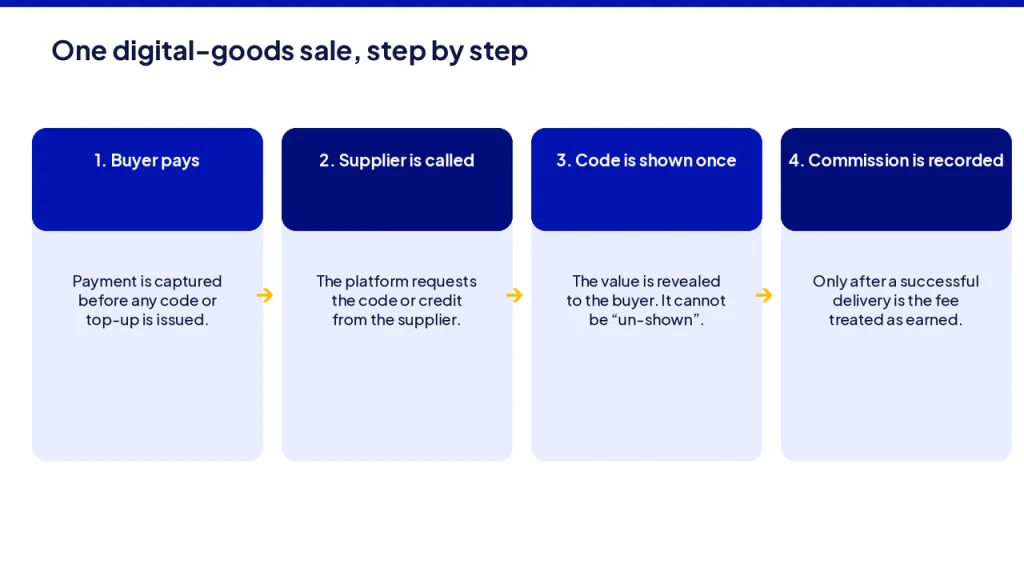
A typical sale of a code or top-up on a reseller network runs in six steps, and each step after the first can fail on its own:
- The customer pays on a reseller’s online store. The payment is authorised or captured, depending on how your payment provider is set up.
- The marketplace records the order under its own reference before anything else happens.
- The marketplace either takes a pre-bought code from its own stock or calls the supplier to buy one live.
- The supplier answers with a code or PIN, or, for a top-up, a confirmation that the phone account was credited.
- The code is shown or sent to the customer.
- The real cost of the code is recorded, the reseller’s commission is worked out, and the sale joins the next payout batch.
The design question at every step is what the system does with a sale that stopped halfway, and how it knows where it stopped.
When the supplier call fails halfway

When a supplier call fails halfway, the marketplace has to find out whether a code was issued before it retries or refunds. A clear error from the supplier is the easy case: no code was issued, so the marketplace can retry or refund. The hard case is a timeout: the request went out, and the reply never arrived. The supplier may have issued the code and charged your account, and the answer was lost on the way back.
Two quick fixes both go wrong. Retrying straight away can buy a second code, charge your supplier balance twice and, if both replies arrive, deliver two codes for one payment. Refunding straight away hands the customer their money back while a paid-for code may already exist.
Give every supplier request your own reference
Give every supplier request a unique reference of your own and send the same reference on every attempt for that sale. Before any retry, ask the supplier for the status of that reference.
If the supplier’s API offers a status lookup, or rejects a repeated reference as a duplicate, a retry becomes safe. If it offers neither, the sale moves to a pending state, and nothing else happens to it until someone has checked with the supplier.
The same idea protects the customer at checkout: a second press of the pay button should find the existing order under its reference and never create a new charge.
The cost of checking before a retry
Checking before retrying adds a call and a few seconds to the slow cases. A pending state means some customers wait for their code, so support staff need a screen that lists pending sales, and the business needs a rule for how long a sale may stay pending before it is refunded or escalated.
What breaks without a reference
Skipping this leads to duplicate codes, a supplier balance that drains faster than sales explain, customers charged twice, and a monthly reconciliation that never quite balances.
Undoing earlier steps when a later one fails
When a later step fails, the earlier steps have to be undone. If the payment was captured and the supplier then refuses the order, the payment has to be released or refunded. If a pre-bought code was reserved and delivery fails, the code goes back into stock.
Some frameworks give this a fixed shape. In Medusa, a workflow step can define a compensation function that rolls back what the step did when a later step fails.
The compensation still has to be designed for each step. A code the supplier has already issued cannot be undone by your system, so compensating there means recording the code as stock you hold, or as a claim against the supplier.
Refunds and voids once a code has been shown

A refund after a code has been shown depends on whether the code can still be voided, because once a code has been shown on screen or sent by email, the customer may have used it, and the marketplace usually has no way to see that. Refund rules for digital goods turn on this moment.
Three refund policies and who carries the risk
There are three broad refund policies. The marketplace can refuse refunds once a code has been revealed and say so clearly before payment. It can refund only when the supplier confirms the code is unused and can be voided, which depends on the supplier offering a void at all.
A third option is to refund at its own cost and absorb the loss when the code turns out to have been used.
Each option shifts the risk to a different party: the customer, the supplier terms or the marketplace’s margin. What you promise customers about refunds can also be a legal question in some markets, and one to settle with your own advisers.
Record “issued” and “revealed” separately
Record “issued” and “revealed” as two separate events on every code. A code that has been bought from the supplier and not yet shown to anyone is in a different position from one the customer has copied.
Some marketplaces put the reveal behind a deliberate click so that issued codes can still be voided, where the supplier allows it, until the customer asks to see them. Top-ups have no reveal step: the credit lands on the phone account at once, and whether it can be reversed depends on each supplier’s terms.
The cost of a reveal step
A reveal click adds a step for the customer, and tracking two states per code adds work for support and finance.
Without it, the marketplace pays refunds on codes that were already redeemed, so the marketplace pays for the same code twice, and reseller commission paid on sales that were later refunded.
Keeping the supplier balance and code stock in step
Keeping the supplier balance and code stock in step means the marketplace tracks its own figure for both, sale by sale. When a supplier works from a prepaid balance or a credit limit, every live purchase draws on it.
Track each supplier balance yourself
If that balance runs out, sales fail at the supplier call, which comes after the customer has paid. The marketplace needs its own running view of each supplier balance: reduced at every purchase, compared with the supplier’s statement every day, and raising an alert well before it runs low.
A second choice follows from that view. You can check the balance before taking payment and hide digital products when it is low, or accept that some sales will fail and be refunded. The first keeps customers out of failed sales and needs a reliable balance figure. The second is simpler and produces refunds and support tickets at the worst moments.
Treat pre-bought codes as stock
Pre-bought codes are stock, and they need the same care as physical products in a warehouse. Each code has a batch, a cost, often an expiry date, and a status: available, reserved for an order, sold, revealed, returned.
Reserving a code at the moment of the order is what stops two customers receiving the same one. Codes are digital assets close to cash, so they should be stored encrypted, and only a few staff roles should be able to view them.
Buying in advance or buying live
Buying in advance means upfront costs, ties up cash and carries the risk of codes expiring unsold. It also gives instant delivery and a cost known at the time of sale.
Buying live keeps cash free and makes every sale depend on the supplier being up and answering. Some marketplaces use both, with pre-bought stock for the digital products that sell most and live purchase for the long tail.
Reseller storefronts and reads scoped to one shop
A digital goods reseller platform usually gives each reseller its own store, branded and often on a custom domain, with its own customers, marketing strategy and sometimes its own prices. Underneath, all resellers share one platform and one database.
That means every read of customer data, orders and codes has to be limited to one shop. A single query that forgets the filter can show one reseller’s customers, or worse, their codes, to another reseller. With codes that work like cash, a leak of that kind is a direct loss as well as a breach of trust.
Where shop scoping is enforced
Scoping can be enforced in one layer that every query passes through, or left to each developer to add to each query.
Enforcing it centrally takes more work at the start and turns cross-shop reports for the marketplace’s own staff into a deliberate exception that has to be built on purpose. Leaving it to each query is quicker to build and fails the first time someone forgets.
Customers, settings and tests across shops
A few related choices need settling early. When the same email address buys from two resellers, the system needs to know whether that is one customer or two. Resellers need to know which settings they control and which the marketplace keeps.
And automated tests should log in as one shop and try to read another shop’s orders and codes, so that a missing filter is caught before release. Open-source starting points exist for multi-seller set-ups.
Mercur, for example, is an open-source multi-vendor marketplace built on Medusa. The scoping rules for codes and customers are still yours to define and test.
How the marketplace earns, and when commission is final
A digital products marketplace can generate revenue through commission on each sale, subscription or listing fees charged to sellers, or the margin between supplier cost and selling price.
Why the margin is not final at checkout
Reseller commission is often tied to the margin on a sale, and the margin depends on what the code actually cost. That figure is not always known at checkout. Supplier price lists change, costs can depend on currency or volume, and the final number may only arrive with the supplier’s reply or monthly statement.
The margin also has to account for payment processing fees on the customer’s payment. A commission worked out at checkout from a list cost can end up being paid on a margin that never existed.
Record commission as provisional, then final
Record commission as provisional when the sale happens and make it final when the actual cost is recorded. Only final commissions enter a payout batch. Store the commission rule that applied at the moment of sale on the sale itself, so a later change to a reseller’s terms does not rewrite past earnings.
The trade-off is that resellers see earnings marked as pending for longer, so their dashboard has to explain why. Finance gains a clear record of what was paid and on what basis.
Without it, the business faces commission disputes that nobody can settle from the records, and payouts that drift away from the real margin month after month.
Paying resellers in batches
Paying a reseller the moment each sale completes is simple to explain and hard to correct. Paying in batches, daily or weekly or on another cycle, gives the marketplace a point at which to check the numbers before money leaves. Payment providers have tools for this.
Stripe Connect, for example, is Stripe’s product for paying out to connected accounts on a platform. For the wider picture of how money is split between a marketplace and its sellers, see how marketplace payouts work.
What to reconcile before a batch is released
Before a batch is released, a few things should reconcile:
- Every sale in the batch has a final cost and a final commission.
- The supplier statement for the period matches the codes and top-ups the marketplace recorded.
- Refunds, voids and disputes since the last batch have been netted against each reseller’s total.
- Pending sales from the supplier timeouts above are either resolved or held out of the batch.
- Each reseller’s payout account or bank account is verified with the payment provider.
- The batch total matches the funds available to pay it, after payment processing fees.
Batches make resellers wait for their money, and the marketplace holds that cash for longer, which some resellers will ask about. Without them, a refund that arrives after a reseller has been paid has nothing to be deducted from, and the marketplace carries the loss.
The decisions side by side
| Decision | The choice to make | The trade-off | If it is skipped |
|---|---|---|---|
| Supplier timeout | Own reference per request, status check before retry, pending state | Slower slow cases; a pending queue to staff | Duplicate codes and double charges |
| Refund after reveal | Separate “issued” and “revealed”; a refund rule per product | An extra click; more states to track | Paying twice for redeemed codes |
| Supplier balance | Own running balance, daily check, low-balance alert | Reconciliation work every day | Sales that fail after payment |
| Code stock | Reservation at order; encrypted storage | Cash tied up; expiry risk | One code sold to two customers |
| Shop scoping | One enforced layer for every read | More work at the start | One reseller sees another’s data |
| Commission | Provisional at sale, final on actual cost | Pending earnings for resellers | Payouts on margins that never existed |
| Payouts | Batches with reconciliation before release | Resellers wait; cash held longer | Refunds with nothing to deduct from |
What to test before real money moves
Test mode can prove a lot if the tests are chosen with the failures above in mind. Before launch, it is worth running each of these on purpose:
- A supplier timeout at each step of the sale, with the supplier side both issuing and not issuing the code.
- A customer pressing pay twice, and two browser tabs paying for the same basket.
- A supplier balance at zero while customers are checking out.
- A refund requested after a code was revealed, and one requested before.
- A login as one reseller trying to read another reseller’s orders, customers and codes.
- A supplier price change between the sale and the supplier statement.
- A full payout batch, reconciled line by line against sales, refunds and the supplier statement.
Each test that fails in test mode is one fewer that fails with a customer’s money.
Questions founders ask about digital goods marketplaces
What is a digital goods marketplace?
It is a digital marketplace where the products are delivered electronically. That covers two different businesses: selling digital products you own, delivered as a download, and selling codes, vouchers or top-ups bought from suppliers at the moment of sale. The second needs supplier integrations, stock or balance tracking, and careful handling of failed deliveries.
What are digital goods?
Digital goods are products delivered electronically: files, course access, software licences, gift cards, game codes and mobile top-ups. Files and course access cost nothing to deliver again, while codes and top-ups are bought from a supplier and carry a cash value once issued. The best digital products to sell depend on whether you create them or buy them from suppliers.
What is the best marketplace to sell digital products?
The best marketplace for selling digital products depends on what you sell and whether you already have an audience. Existing marketplaces bring buyers for a larger share of each sale, hosted stores keep more of the margin when you bring your own traffic, and resold codes or top-ups need a platform built around supplier calls and payouts.
Do I need my own website to sell digital products?
You do not need your own website to start selling digital products. Payhip’s digital downloads page says you can use Payhip as your website, with a store URL to share and a custom domain for free, as listed on 9 November 2026, and sales paid directly to your PayPal or Stripe account.
Can I sell gift cards online through resellers without holding stock?
That depends on your suppliers. If they sell live through an API, each code can be bought at the moment of sale, usually from a prepaid balance or credit limit. If they only sell in batches, you hold stock and carry its cost and expiry risk.
What happens if a customer pays and no code arrives?
The sale should move to a pending state while the marketplace checks with the supplier, using its own reference for that request, whether a code was issued. Then it either delivers the code or refunds the customer. Retrying or refunding without that check is how codes get bought twice.
Can a code be refunded after the customer has seen it?
Only if your refund rules and your supplier’s terms allow it. Once a code is revealed, the marketplace usually cannot tell whether it has been used, so many marketplaces refund only unrevealed codes, or revealed ones the supplier confirms can be voided.
Choosing what to build on
Running your own reseller network for selling digital codes and top-ups means taking on the supplier contracts, balances, scoping and payouts above.
In a digital marketplace of this kind, most of what this article describes sits below the storefront features: workflows, ledgers and access rules.
Questions to ask any platform
When you compare options for a digital products marketplace, it helps to ask each one how it handles a step that fails after an earlier step succeeded, where shop scoping is enforced, how commission and payouts are recorded, and what you would have to build yourself.
Our comparison of open-source multi-vendor marketplace platforms covers several starting points.
If you are looking at Medusa, it helps to understand how Medusa v2 modules work, because supplier integrations, code stock and reseller commission would each sit in modules of their own.
KVY has built a multi-tenant digital-goods marketplace for African markets on Medusa v2 and Mercur. It is pre-launch. Each reseller has a branded storefront, every customer read is scoped by shop, and the workflows can compensate when a step fails. Reseller commissions and Stripe Connect payout batches pass in test mode only, and no real seller has been paid through it. The build shows that shop scoping, compensation and batch payouts can be designed into the first version. How they behave under live supplier traffic and real payouts will only be known after launch, which is why test mode is stated here plainly. This kind of work is what our Medusa.js development team does. KVY is a senior-led boutique software engineering firm in Ho Chi Minh City with 30+ clients and 45+ projects since 2018, and the client owns code, infrastructure configuration and documentation from the first commit.
If you are weighing this for your own business, start with a plan. In two to three weeks we map how the system would connect to your ERP, warehouse, payments and sales channels, set out the build in phases with the cost to run it over three years, and give a fixed quote for the first phase. You keep the plan whatever you decide.